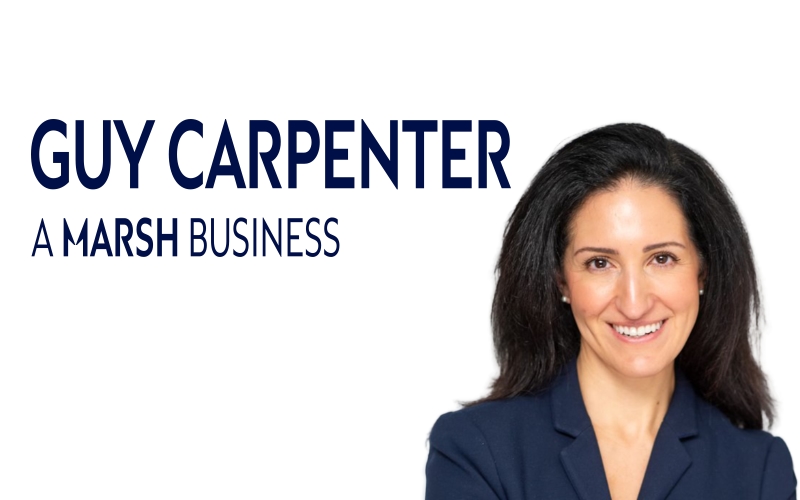
Guy Carpenter’s Jennifer Paretchan recently told Reinsurance News that the growth in alternative capital is providing buyers with greater flexibility to build diversified reinsurance programs, with cedants increasingly seeking partners with access to traditional and alternative sources of capability.
After the company released its July 2026 reinsurance renewal report, Paletchan noted that the expansion of dedicated alternative reinsurance capital has become one of the decisive themes for mid-year renewals.
According to the executive, this development has been incremental over the years, but at 1.7 it “finally manifested itself in a meaningful way.”
Parekan continued: “What this means for buyers is the opportunity to supplement their traditional plans with other sources and create a more diversified capital portfolio when considering reinsurance.
“I think this is a huge development for customers. In practice, it means they can establish traditional occurrence limits (if we’re talking about property) and now supplement frequency or overall protection.”
Sufficient capacity and growing reinsurer interest keep the global property reinsurance market competitive at mid-year renewals, with attractive terms and underwriting options encouraging buyers to explore complementary solutions to complement traditional catastrophe plans, said Guy Carpenter, global risk and reinsurance expert, Marsh Group Business Unit, in his report.
With this in mind, Parekan told Reinsurance News that one of the most important things reinsurers need to consider is taking a customer-centric approach.
She added: “They want to grow and want to use this excess capital to support clients. The situation in reinsurance, particularly from a property and professional perspective, has been weaker than in the casualty market.
“Taking a more client-centric approach, reinsurers review all placements purchased by buyers, enabling them to use their capital more efficiently. This creates a more holistic way for them to deploy capital and grow.
“Additionally, many traditional capital sources have alternative capital capabilities at their fingertips.
“So you have these dual-track options, and clients like being able to work with reinsurers who can access traditional and alternative capital from a single trading relationship. I think that’s very important.”
Parekan further elaborated on the role alternative capital plays in today’s market, observing that catastrophe bonds have become more attractive to buyers given the healthy returns in the sector in recent years.
“Pricing and terms are more favorable, with outstanding limits on catastrophe bonds exceeding $60 billion so far this year, which is a record,” she said.
Parameterization is also emerging as a more robust solution in situations where severe convective storms prevail, which creates challenges for clients due to the frequency of low-intensity events.
This form of protection has been around for a long time, Parequin said, focusing primarily on hurricanes and earthquakes because they are easier to model.
But through better modeling and better analysis, people now have more comfort with what we call secondary hazards, severe convective storms, wildfires and floods.
Paretchan continued: “Over the last year we have been talking about the need for buyers to implement comprehensive solutions, and parametric technology is starting to fill that space in a bespoke way, whether for a specific region or for a specific hazard. It addresses a real need in the market.
“We are in an interesting market and ample capital is meeting the needs of ceded properties in better ways. These solutions give both underwriters and reinsurers the ability to grow and execute their business plans.”
Guy Carpenter President and CEO Dean Klisura echoed this sentiment in the report, saying: “Under current market conditions, cedants are receiving competitive pricing and terms on their reinsurance programs, but many are also exploring alternatives, such as parametric solutions and sidecars, to supplement their traditional protection. We expect this trend to continue throughout the remainder of the year.”
At the end of the interview, we asked Parekan about her overall outlook for the global reinsurance market in the second half of the year.
“I think if we stay on the real estate theme for a moment, the first thing that comes to mind is the outlook for the 2026 Atlantic hurricane season. A strong El Niño is forecast, which generally indicates below-average activity,” she said.
“Having said that, there are two things to watch. One is if El Niño develops later than expected, which could mean more activity than currently expected.
“The other is sea surface temperatures; if they remain warmer than normal, that could also be more favorable for hurricanes. I don’t think we can get too comfortable; we need to keep an eye on conditions that could change the outlook.”
Paretchan said Guy Carpenter’s analysis of the correlation between early outlooks and actual results showed that the correlation between June outlook and actual activity over the past 10 years was 0.44, while the correlation for the peak August outlook rose to around 0.8. She said as the season neared, confidence in the completeness of the forecasts would increase, providing more assurance heading into the season.
Parekan concluded: “If the season does turn out to be below average, we may continue to see oversupply and competitive market conditions. But it remains a market that supports a multi-faceted approach to reinsurance protection.
“Underlying rate dynamics were a key driver of renewals from a casualty perspective, and carriers were subject to disciplinary action.
“We have now seen seven consecutive quarters of general casualty rate increases, and in the financial sector, U.S. public D&O finally entered positive rate change territory in the first quarter, a significant inflection point for reinsurance renewals.
“The key to casualty renewals in late 2026 and 2027 continues to be strong advocacy for our clients – demonstrating limit discipline, risk selection and other claims, actuarial and underwriting measures.
“Overall, the market remains highly disciplined heading into autumn, but reinsurers are taking a comprehensive, client-focused approach. So the outlook is positive and there are opportunities for both sellers and buyers.”
Based in New York, Paretchan is responsible for Guy Carpenter’s strategic trade relationships, broader market trends and reinsurance market distribution strategy. She also serves as a client account manager focusing on casualty and financial lines.
She has over 25 years of industry experience, having worked in Guy Carpenter’s New York, London, Toronto and Philadelphia offices.