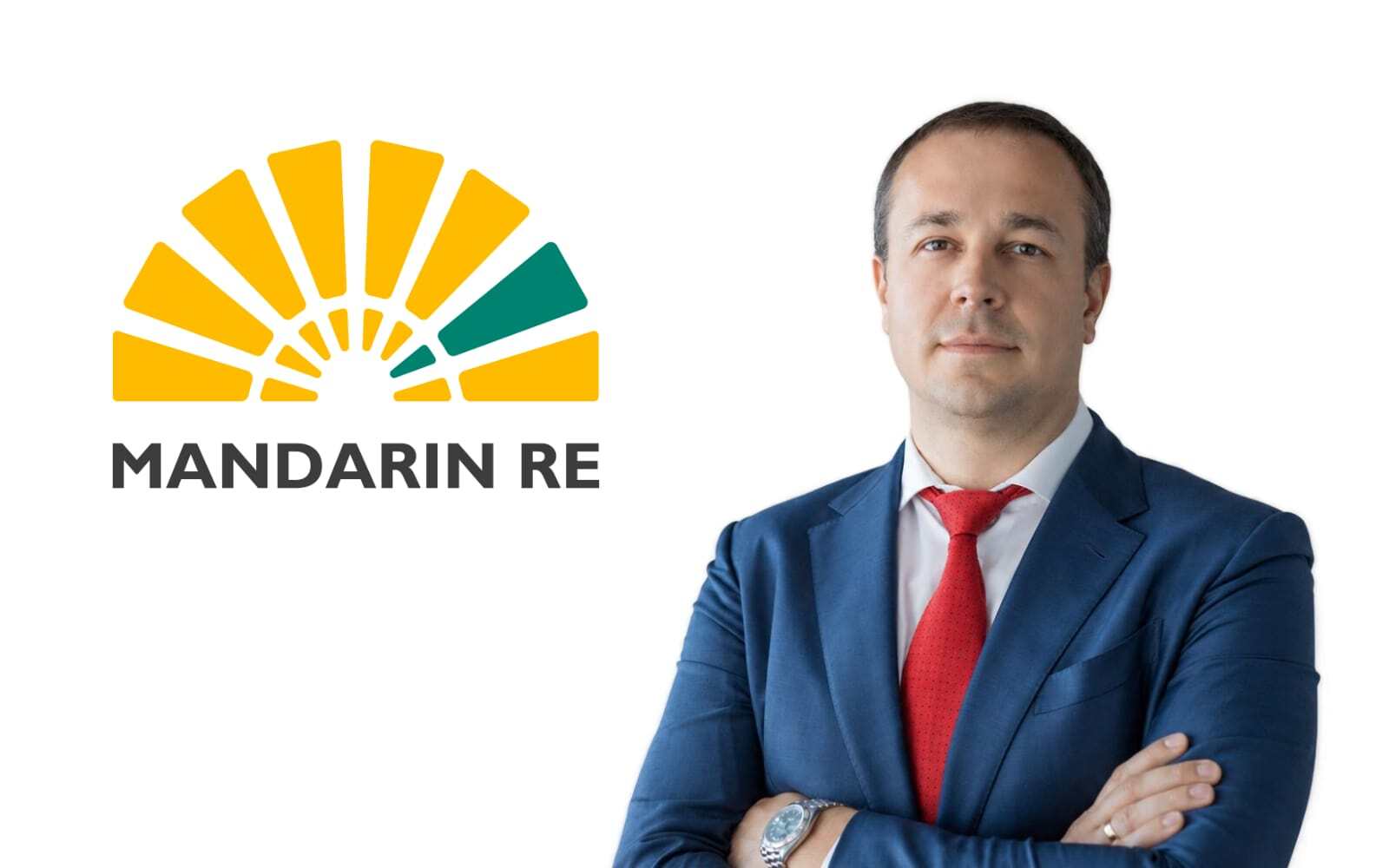
Mikhail Grishin, Chief Operating Officer at Labuan-domiciled reinsurer Mandarin Re, described the current reinsurance market as “exciting and dynamic”, pointing to innovation in reinsurance capital, risk transfer structures and technology as creating whole new sets of opportunities.
In an interview with Reinsurance News around the Singapore International Reinsurance Conference (SIRC) 2026, Grishin said he sees opportunities across the key regions in which Mandarin Re operates, highlighting the innovative factors driving these.
“It’s exciting and dynamic,” he said. “We’re seeing a lot of innovation, for example in the nature of reinsurance capital, the structures that provide its route to market, and the kinds of perils which are being covered. With all that, we’re seeing a kind of opening up, as entrenched approaches are augmented by new ways to gather, distribute, and deliver risk capital. That creates whole new sets of opportunities.”
Grishin continued, “We’re seeing technological innovation, too. Some of that is about processes. That advancement is invaluable, because it makes our product more user-friendly, and it should reduce embedded costs. But some of the technological innovation is to do with risk analysis, and that’s where things get really exciting. That innovation makes our product – and our businesses – better. The more we are able to understand risk, the better we will be able to price, assume, and share it. Ultimately that allows us as a sector to cover more of it, more affordably for businesses and people world-wide.”
However, he stressed that underwriting discipline remains essential amid abundant market capacity and intense competition.
“We cannot let ourselves plummet into the depths of underpricing. I’m optimistic that won’t happen. We see plenty of attractively priced business, and I perceive sufficient resolve among the major reinsurers to ensure it stays that way,” said Grishin.
As the industry gathers at this year’s SIRC, the 22nd edition of the annual meeting, Grishin expects discussions to focus on coverage and market dynamics.
“In terms of coverage, the conversations will be about coverage lower down programs for earnings protection, and about which capacity is acting responsibly, and I suspect about coverage and exclusions for AI-related liabilities and data centers,” he said. “In terms of the market, I expect some discussions about the rising role of ILS capital in areas other than nat cat, and whether it will be sticky as the market softens.”
He continued, “Those topics are interesting, but people should probably be talking more about climate change and its impact on loss events, the possible impacts of a strong El Niño, how the recent run of moderate catastrophe-loss years, particularly in Asia, could come to an end soon, and if reinsurance pricing is truly adequate for that inevitable eventuality.”
During the interview, Grishin also underlined that what clients are looking for from their reinsurance partners today is flexibility.
He explained, “The days have passed when a broker would come to a leading market with a fully formed programme to negotiate based on price alone. Now they often come with a range of ideas, and they’re looking for the best set of solutions based on the cedent’s unique goals, not just the best-priced market. I think that’s because everyone understands the risk dynamics better, which goes back to the technology.”
Expanding on how AI and advanced technology are helping to improve the reinsurer’s operations and underwriting capabilities, Grishin said that technology is one of the secrets of Mandarin Re’s success.
“At an early point during the hard market of the early 2000s, I remember people saying how ‘technical pricing’ would prevent the market from ever entering another terrible softening cycle. But then we had only the idea of risk-based pricing. Now we have the tools to actually do it.
“We’ve developed tools that allow us, for example, to see the impact of any natural peril event, real or imagined, on our portfolio in real time, at least insofar as the information we’ve received from cedents is up to date. As for AI, it has become almost fundamental. But before AI can tell you something you did not know, it will often show you something you missed. That’s AI’s primary advantage for reinsurers: it delivers clarity,” explained Grishin.
Nonetheless, Grishin emphasised that technology, and AI in particular, should support underwriting, exposure management and decision-making, but must not replace underwriting judgement.
“AI doesn’t understand risk appetite, or portfolio balancing, or commercial considerations, for example. That requires people. That said, the best people will get better results with the best technology to support them,” he said.
Looking ahead, Grishin expects the January and April 2027 renewals to be competitive, with greater selectivity around structure, data quality and risk-adjusted pricing amid ample capacity.
“The technological tools I spoke about will allow the markets that have and use them to price based on a much greater understanding of the risks being reinsured, of the perils that threaten them, and of the potential accumulations in any book. That will allow the market to extend its capital supply intelligently and profitably, whilst at the same time giving our clients more of the balance-sheet and even earnings protection that they need,” he said.
Grishin revealed how Mandarin Re balances its growth ambitions with underwriting discipline when market competition intensifies.
“We insist that cedents provide adequate data, then we analyse it well. More uniquely, our business model also supports success in a competitive environment. Alongside our staff underwriters, we work with hugely experienced underwriters around the world on a consulting basis. They know their local markets and cedents better than anyone, and we ensure their interests are aligned with those of Mandarin Re. Because they are independent, they are not compelled to accept risk when there’s no compelling risks to write. What they do bring to us goes through our own rigorous centralized underwriting process. But if a market or a class becomes too competitive, we don’t have to keep writing because we have mouths to feed,” he said.
Grishin explained that Mandarin Re remains positive about growth opportunities in Asia, but stressed that growth must be disciplined and technically sound. In addition, the firm is increasing its activities in Latin America, a region it considers generally underserved.
He noted, “We have multiple underwriters on the ground in both those regions, as well as Africa which is the same. We see opportunities in the growing awareness that natural perils are becoming riskier, and that assets in every part of the world may require new and different types of protection.
“Finally, we see opportunities where our analysis shows that the margins are adequate on a particular risk. That could be anything from a property fac risk to a peak-perils treaty. But most of all we see ample opportunities to deploy our growing capital fund well to our existing customers, as we take larger shares of their well-priced risk.”
Grishin also spoke about alternative capital and how it is influencing the market heading into 2027.
He explained, “Alternative capital may be increasing competition, for now at least, but these investors are driven much more by short-term returns than is the conventional reinsurance market, which prefers long-term relationships. ILS investors would not have tolerated multiple successive years of negative returns, as the global reinsurance market did collectively when for years it failed to cover its cost of capital. ILS money is very much more fungible. Whereas a reinsurer has nothing else to do. Reinsurance is all we do.
“Meanwhile, traditional reinsurance remains essential for complex risks, local expertise, and reliable claims support. Investment capital isn’t particularly interested in that: they see risk and its price, not clients with their risk appetites and need for balance-sheet protection. Conventional reinsurers will always retain that advantage. That’s why I believe we will always remain the clients’ favoured choice.”