We’ve written before at HuffPost UK about the real meaning of the “power” symbol, as well as why USB stands for “Universal Serial Bus”.
We’ve also learned that wi-fi doesn’t actually mean anything, and that “uppercase” and “lowercase” letters used to refer to actual drawers.
But what about another tech-related mystery we face every day in our inboxes?
After years of “cc”-ing and “bcc”-ing people into correspondence, I’ve never really thought about what the abbreviations stand for.
As it turns out, they have a much longer history than I would ever have guessed.
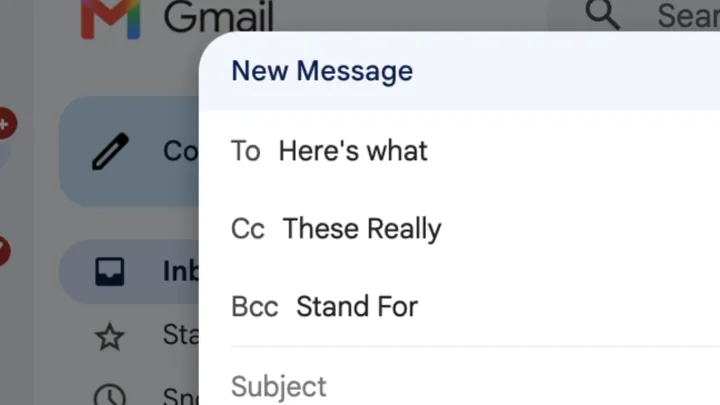
What do “cc” and “bcc” stand for in email, and why?
“Cc” stands for “carbon copy”, while “bcc” is short for “blind carbon copy”.
There’s a pretty good paper-based precedent for using these terms.
At first, “carbon copy” was used to describe an early kind of photo reproduction technology. It involved a sheet of paper covered in light-sensitive gelatin; that gelatin contained a pigment, which was usually high-contrast carbon.
You can still see some “carbon prints” or “carbon copies” made using this method, including those from pioneer Adolphe Braun, in museums.
Sepia Times Sepia Times/Universal Images Gro
But the meaning changed over time to mean a way of copying a typed letter directly.
This new technique involved putting your original sheet of paper over a pigmented sheet, with another regular white sheet of paper behind that.
When the keys of a typewriter or the nib of a pen pressed against the front sheet, depositing ink to create words, it also added pressure to the pigmented paper behind it – transferring the message to create an exact, or “carbon”, copy.
An early version of this technology is the “Manifold writer”, which dates to about the 1830s and used so-called “carbonated paper” which was coated in pigment and oil. But this idea only really took off in the 1870s, when typewriting became more popular.
Writing a letter in 1940, T.S. Eliot said: “You may have noticed that I sent you last week a carbon copy of a poem… I am giving it to Philip Mairet to publish at Easter in the New English Weekly”.
Even years later, the metaphorical potential of this term tempted us to use “carbon copy” to refer to an entity that’s really similar to another. Perhaps the phrase shares that with “stereotype”, which also originated from print.
More practically, though, “cc” became a shorthand for “carbon copy” in the 20th century, where it was used on forms and business letters.
“Bcc”, meanwhile, stands for “blind carbon copy”. It arrived later than “carbon copy”, but before the introduction of email.
Per Britannica, this “is used to indicate people who will receive copies of the message in secret, or without the knowledge of the other recipients”.
Basically, that meant that other recipients weren’t made visible to those “bcc-ed” onto correspondence.
This is still how we use the tool in email.