After a scarily dry summer, it’s safe to say we’ve all let our guards down. Our collective amnesia about the shock of the changing seasons happens every year, but this year, we need to lock in even more than ever.
In case you missed it, Super El Niño is coming, which means you’ll need to hold tight to your brollies because there will be more wind, rain, and storms in the months ahead.
That’s not only going to be a pain on your daily commute, but it could also spell something much more inconvenient: damp and mould finding their way into your home.
Unfortunately, we don’t control the weather, but one thing we can do is help you control the impact of wet weather on your home.
The secret? Dehumidifiers, according to B&Q’s Energy Saving Expert Paul Carroll.
“Dehumidifiers are a great way to protect your home from moisture and mould, as they remove the excess water in the air that can lead to condensation and damp problems,” Carroll explains.
“Condensation is formed when a drop in temperature causes moisture to condense and form on cold surface areas. If left untreated, this condensation is what leads to damp.”
What are the benefits of dehumidifiers?
Not only can dehumidifiers help with keeping your home damp-free, they can also help protect against germs and keep your electricity bill down, too.
“Dehumidifiers also protect against dust, bacteria and germs, so a great addition to any home – especially during these colder months,” says Carroll.
“Plus, lower humidity levels can make your home easier and cheaper to heat, and can help laundry dry quicker, too.”
The best dehumidifiers to shop now
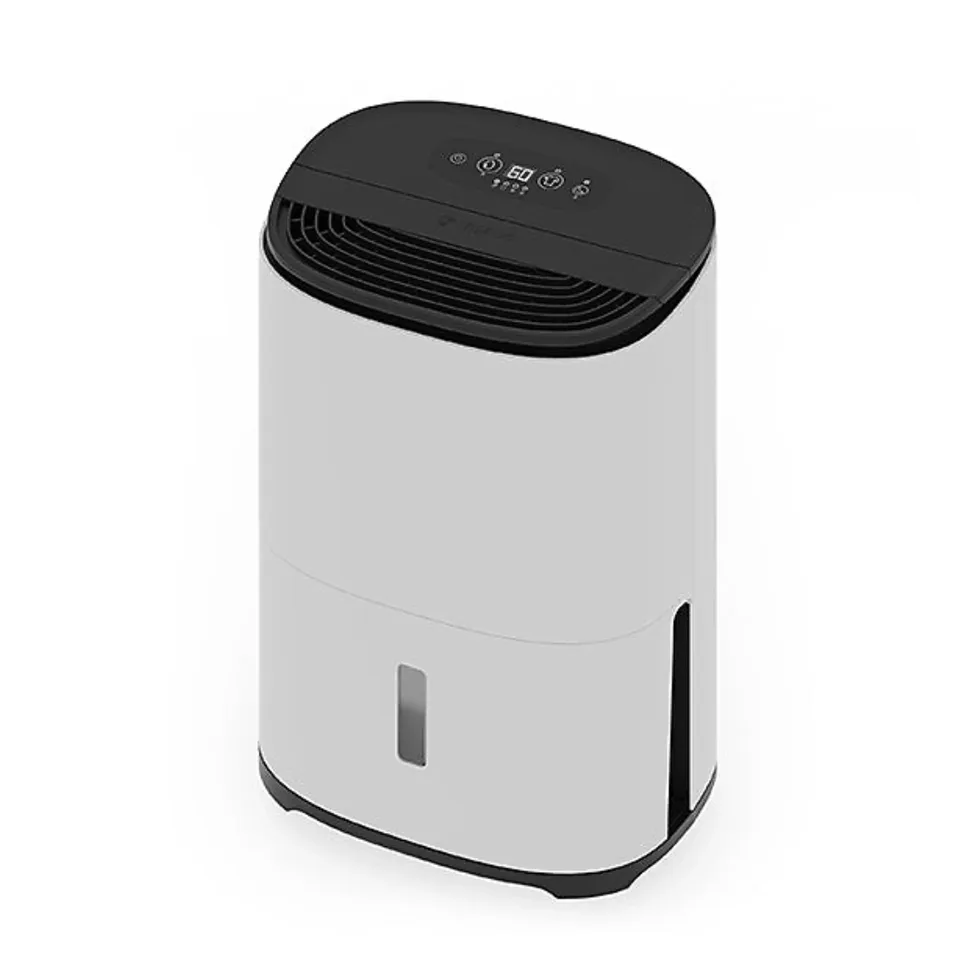
Best dehumidifier and air purifier
There’s truly nothing better than a versatile device, and this dehumidifier doubles as an air purifier, so you can do the most to avoid getting sick this winter.
Ideal for smaller houses, it comes with an extraction rate of 12L per day. It has easy touch controls, so you can easily switch between night mode and laundry mode, but no matter what setting you have it on it’s super quiet, so it won’t disturb you while you’re sleeping or trying to focus.
+ Easy to move between rooms
+ Looks inoffensive in your room
+ Doesn’t cost too much to run
– Tank capacity is low.
Extraction rate: 12l/d
Noise level: 35dB(A)
Tank capacity: 2.5L.
Best dehumidifier for drying laundry
If your main concern is your laundry taking days to feel fully dry, this humidifier from Blyss will get the job done in no time. It has a specific laundry setting.
Plus, it has an auto setting that will turn it on and off according to the humidity levels in your room, so you won’t break the bank by running it.
You’ll also not need to doubt whether it’s working or not, as it’s so efficient you can literally see the airflow sway your clothes as you dry them, and they’ll be done in hours rather than your usual days.
+ Great for drying laundry
+ Quiet to run
– Can get quite hot, which isn’t ideal in the summer.
Extraction rate: 16L per day
Tank capacity: 2.4L.
Best dehumidifier for larger spaces
If you have a larger house, you’ll need a dehumidifier that has a higher extraction rate. This one from Morphy Richards doesn’t disappoint, with up to 30L of water removed per day.
It’s designed for rooms up to 60m squared, and comes with an auto function so that it can turn itself off and on without you having to think about it.
It also comes with a HEPA filter, so it can purify the air at the same time it removes moisture, and it’s good for the planet and your wallet, too.
+ Cost efficient
+ Has a very low Global Warming Potential (GWP) so it’s good for the planet
+ Won’t have to empty the water tank all the time
– It’s quite heavy.
Extraction rate: 30L per day
Tank capacity: 5L
Best mini dehumidifier
When you’re limited on space, the last thing you want is a huge dehumidifier taking up precious space in your flat. You want it to solve a problem, not add another one, so this mini dehumidifier will remove up to 420 ml of water per day without getting in your way.
It’s pretty small, so it can fit on a windowsill, or underneath your bathroom sink, and has a carry handle so you can pick it up and move it between spaces.
Plus, the tank is lit by customisable LED lights, which make it easy for you to spot when the water tank needs emptying.
+ Portable so it’s ideal for smaller spaces
+ Has an auto setting
+ Doesn’t look too obtrusive in your space
Extraction rate: 420ml per day
Tank capacity: 2.3L.
Best app-controlled dehumidifer
If you want to be able to control your dehumidifer from anywhere, this one from Dreo can be synced to an app on your phone so you can switch it on even when you’re on holiday to find your home damp-free.
The app lets you track the humidity levels in your space, so you can set it to automatically turn on when the water level gets too much, and it even comes with a quieter night mode so you can keep it on while you sleep.
+ Large tank so it doesn’t need to be emptied all the time
+ Runs quietly
+ App lets you track your home’s humidity
– Might not be so simple for less tech-savvy folk.
Extraction rate: 16L per day
Tank capacity: 3.4L.
What to consider when buying a dehumidifier
Extraction rate
Bigger homes will require a higher extraction rate. B&Q has a great guide for figuring out what extraction rate you need for the size of your home.
Tank capacity
A water tank of 3.5L is ideal, according to B&Q, as it will be large enough that you don’t have to empty it every day – or even several times a day.
Controls
You’ll also want to think about whether you want your dehumidifier to run all day, be controlled manually, or use a smart control to turn itself on when your home needs it. This can also help keep energy costs down.
FAQs about dehumidifiers
What type of dehumidifier should I buy?
There are two types of dehumidifier: compressor/refrigeration and desiccant. According to Carroll, compressor/refrigeration will work best for everyday use in homes that are between 10 and 22°C.
What is the difference between air purifiers and dehumidifiers?
While air purifiers filter the air to remove small particles like dust, pollen, and smoke, dehumidifiers remove moisture from the air.
How do you know if you need a dehumidifier?
There are a few signs to look out for to tell if you need a dehumidifier. Look for telltales that there is excess moisture in your house, such as if you have lots of condensation on your windows, or if there’s a musty smell in your house.
However, most homes can benefit from a dehumidifier in the winter, especially in damp conditions.