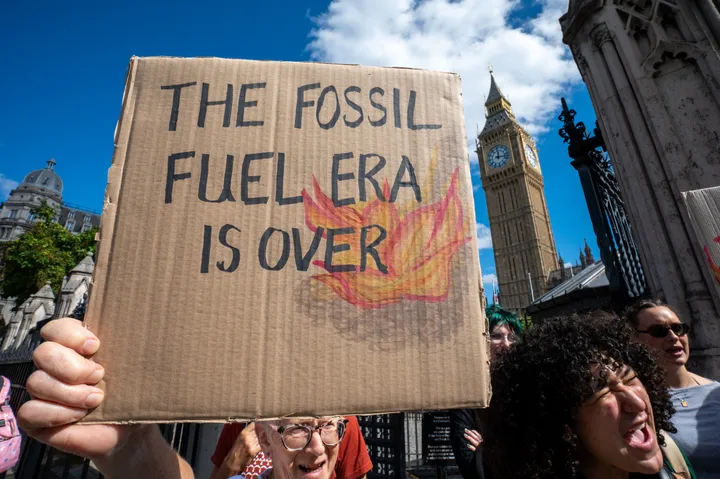
Andy Burnham’s government has officially approved drilling in the Jackdaw gas field in the North Sea in a major blow to climate activists.
It’s a dramatic move and the first confirmed policy set to be included in the upcoming Budget next week.
The government says it will start supplying gas to British homes and businesses from as early as the end of this month, though ministers admit it won’t lower energy bills this winter.
Though the decision is backed by the Tories and Reform, the SNP and Lib Dems, there are significant concerns about what this means for the government’s net zero goals.
However, a government decision on whether drilling takes place at the Rosebank oil field off the coast of Shetland remains a while off yet.
Here’s what you need to know.
What Is ‘Jackdaw’?
This is a gas field based off the east coast of Scotland, 150 miles from Aberdeen and close to the boundary between the British and Norwegian parts of the North Sea.
Discovered in 2005, it was seen as too difficult and pricey to extract gas from at the time.
But development was approved by the Conservatives in 2022 for extraction.
It became a joint venture between Shell and Norway’s state energy company Equinor known as Adura.
However, environmental campaigners – including Greenpeace – began a set of legal challenges against the field.
They argued it would produce up to 35.8 million tonnes of carbon emissions over 11 years at a time when the world is already in a climate crisis.
In 2025, a judge ruled that the development had been unlawfully approved and detailed climate assessments have since been sent for public consultation.
What Do Supporters Say About The Controversial Project?
Developers say the site is untapped potential which could help the country at a time when the economy is struggling to grow and UK energy security is at risk.
Adura say the site would provide 6% of UK gas production, which could power 1.4 million British homes.
But the UK currently imports around 60% of its gas needs, meaning Jackdaw will only accommodate 3% of the country’s total demands.
Still, it will increase the UK’s energy security, which has been particularly vulnerable since Vladimir Putin’s 2022 invasion in Ukraine, which pushed Europe to wean itself off Russia’s cheap energy exports.
The US’s war against Iran has made Britain more vulnerable, too, because Iran has effectively closed the major oil shipping lane the Strait of Hormuz.
That has impacted global fuel supplies and sent prices up around the world.
Ministers also argue it will emit fewer emissions overall because the UK will use less imported energy.
The government’s statement says: “Even on the path to net zero, the UK will still require oil and gas as part of our energy needs for decades to come.”
Unions have welcomed the decision, with Unite’s general secretary Sharon Graham saying the UK cannot have a “jobless transition” to renewable energy.
GMB general secretary Gary Smith said the announcement was “great news”, as vital decisions on gas supply have been put off for “too long”.
Donald Trump will also be delighted. He pushed Keir Starmer to drill for more oil and gas, and was furious when the former PM refused.
As soon as Andy Burnham got into office, the US president began saying Burnham would open up the North Sea with more drilling – long before the government actually said what it planned to do.
So What’s The Downside?
The gas field will also not bring down energy bills this winter because the output will be sold on the international market.
There’s also been some backlash that it will only create 27 jobs as that’s the number of beds on the platform.
However, the chief eƒxecutive of Adura, Neil McCulloch, has argued there will be 300 jobs associated with the processing of the extracted fluids.
Still, Friends of the Earth Scotland said the government was “deliberately” putting hundreds of thousands more people at risk”.
“Giving Jackdaw the green light is guaranteeing more climate impacts like the deadly heatwaves and wildfires in the UK this summer, and the devastating floods in Nepal,” it said.
The World Wildlife Fund also said the move was “disappointing”, adding: “This decision will only support a tiny number of jobs, do nothing to lower prices, barely move the needle on growth, and undermine the UK’s climate leadership.”
SOPA Images SOPA Images/LightRocket via Gett
What About The UK’s Climate Pledges?
The Green Party – the loudest dissenters pushing back on this proposal – have accused the government of “climate vandalism”.
The UK is committed to net zero greenhouse gases by 2050 and has to meet the interim targets.
The Paris Agreement from 2015 is meant to keep the increase in global temperatures to below 2C when compared to temperatures recorded in the pre-industrial era.
The UK has committed to reducing economy-wide greenhouse gas emissions by at least 68% by 2030 when compared to 1990 levels.
Labour is also committed to a “clean” power grid by 2030, meaning at least 95% of it will be funded by renewables.
Scotland has separate net zero goals, pledging to reach net zero by 2045, though it has often missed previous targets.
The SNP – the ruling party in Scotland – is aiming to cut carbon emissions b 57% over the next five years and by 69% by 2035.
However, chancellor John Healey is set to announce in his Budget next week an “energy wealth fund” which will use “tax revenues from North Sea oil and gas to invest in renewable and low carbon energy projects”.
With North Sea profits taxed at 78%, it will mean more tax revenue than if it was imported from Norway or the US.
“I want Britain’s energy wealth to spark a new wave of clean power,” he said. “Our decision to approve Jackdaw alongside the new Energy Wealth Fund means we invest in green transition and benefit from our existing natural resources.”
What About Labour’s Green Promises?
Labour was elected on a 2024 pledge not to issue new licences for oil and gas fields in the North Sea.
The party acknowledged the environmental damage and the minimal impact on energy bills.
It reads: “We will not issue new licences to explore new fields because they will not take a penny off bills, cannot make us energy secure, and will only accelerate the worsening climate crisis.”
However, there is a loophole: the manifesto did it would not revoke existing licences.
Jackdaw has been in the works since 2022 and is ready to go.
Energy secretary Miatta Fahnbulleh told broadcasters after “following careful consideration”, she decided to approve production, praising the “highly skilled workers” in the North Sea.
But it’s hard not to feel like this is a U-turn.
Foreign secretary Ed Miliband, who used to be energy secretary, has often called for Britain to move away from fossil fuels.
Fahnbulleh herself wrote on X in 2022: “To have a shot at saying within 1.5C global warming, we can have any new oil or gas fields”.
She said it’s “irresponsible and short-sighted to be funding new fossil fuels when we need to get to Net Zero fast”.
What about Rosebank?
Rosebank, 80 miles off the coast of Shetland, is a “different proposition” to Jackdaw according to the energy secretary.
It was first approved three years ago by the Tory government, but hindered by the same legal challenges as Jackdaw.
That’s because the oil would be exported rather than used here in the UK.
However, it is still being looked at by the government.
Listen to Commons People, the podcast that makes politics easy. Every week, Kevin Schofield and Kate Nicholson unpack the week’s biggest stories to keep you informed. Join us for straightforward analysis of what’s going on at Westminster.