Whether you’re firing off an all-caps text, editing an email draft or otherwise taking advantage of that “shift” button on your keyboard, you probably use the terms “uppercase” and “lowercase” without a second thought.
But have you ever stopped to wonder where the words came from? Why are these called “cases” and why are they “upper” and “lower,” anyway? HuffPost asked linguistics experts to break it down.
“The terms are more literal than people tend to assume,” Noel Wolf, a cultural and linguistic expert at the language learning platform Babbel, told HuffPost.
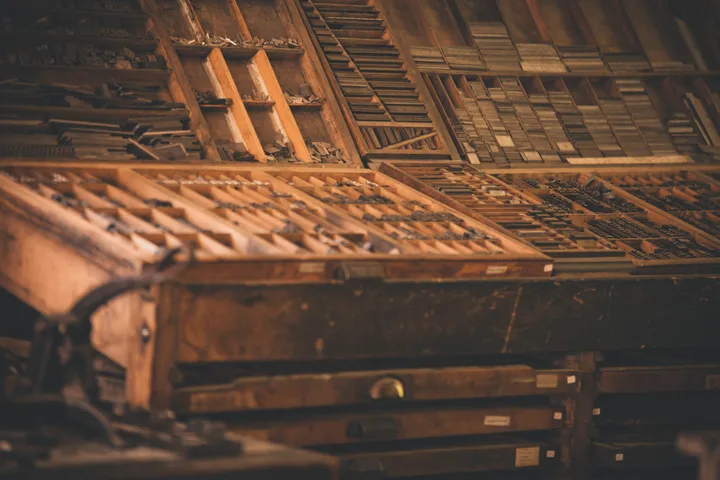
“They come from the printing press, where typesetters stored individual metal letter blocks in wooden trays called cases.
“Uppercase letters were kept in a case positioned higher up, and the small letters, used far more often, sat in a case below, within easier reach. The names therefore describe where a printer physically reached for a letter, not the height of the letter on the page.”
To understand the origin of these terms, you have to travel back several centuries to the age of movable type and skilled printing professionals known as compositors.
The first documented use of uppercase and lowercase appears in Joseph Moxon’s 1683 printing manual, Mechanick Exercises: Or, the Doctrine of Handy-Works Applied to the Art of Printing.
“In his description of a compositor’s equipment, Moxon writes of an ‘Upper-Case and a Lower-Case,’” noted Madeline Enos, a language trends expert at learning platform Preply.
“The terms eventually moved beyond the printing trade and became the everyday words we now use for capital and small letters.”
Thus, the English language maintains a piece of printing-house history in everyday vocabulary.
“It’s a trade term that made it out of the workshop and became the default word, and I’d imagine that most people have no idea what ‘uppercase’ and ‘lowercase’ originally referred to,” Enos said.
Michael Adams, an English professor at Indiana University, traced the origin back further.
“Printing came to England in 1476, and there weren’t many printers at first,” he said. “But by the end of the 16th century, there were quite a few, and over that time, the jargon of printing had amplified – when people work together, they tend to come up with work-specific terms.”
Christopher Kimmel via Getty Images
But how do we know which terms people came up with at the time?
“We depend on manuscripts and print materials for evidence,” Adams said. “Printing was on the rise, but limited, and printers didn’t see much money in printing books about printing – so it took a while for evidence of uppercase and lowercase to enter the record of English.
“The first evidence that printers sorted their type into cases appears in 1553, but there’s no mention of uppercase and lowercase until publication of Joseph Moxon’s ‘Mechanick Exercises.’”
As noted, this important early account of printing from 1683 detailed the traditional layout of cases in printing mechanisms.
“We treat lowercase and uppercase as one word now, but originally, they were lower case and upper case, reflecting the fact that there were physical cases or boxes into which type was sorted,” Adams said. “Conventionally, the so-called capital letters were kept in the upper case, while the smaller letters were stored in the lower case. That’s the mystery, solved!”
This linguistic system is much older than printing
“Capital and small letters existed long before the names ‘uppercase’ and ‘lowercase,’” Enos noted. “Capital letters are the older of the two – they descend from Roman monumental letterforms like the ones we see carved into inscriptions at the Pantheon or Trajan’s Column.”
Small letters, also known as minuscules, developed later as handwriting evolved.
“As scribes wrote more quickly, letterforms became rounder and more efficient to write, developing features such as ascenders and descenders – the parts of letters that stick out like ‘b’ and ‘p’ and extend above or below the main body of the letter,” Enos said.
This dual system of using capital and small letters was formalised under Charlemagne in the late eighth century.
“Pushing to standardise Latin texts across his empire, he commissioned scholars to develop a clear script for copying manuscripts ― what is now called Carolingian minuscule,” Enos said.
“Scribes back then paired the everyday lowercase script with the old Roman capitals for titles and emphasis, essentially creating the two-tier system still in use today. Printers, centuries later, just organised that existing convention into physical cases and drawers which gave the names.”
Ward DeWitt via Getty Images
Not every language even uses capital letters
Interestingly, this kind of system with big and small letters is not as common globally as English speakers might think.
“It’s worth noting that most of the world’s writing systems are one case only,” Enos said. “Arabic, Hebrew, Hangul, Thai, Devanagari, Georgian and Chinese characters all get by with a single form per character. Bicameral scripts, or scripts with two cases, include Latin, Greek, Cyrillic, Armenian and a handful of others.”
In practice, those writing systems handle things like sentence starts and proper names differently.
“They rely instead on spacing, punctuation and context to do the work capitalisation does in English,” Wolf said.
Even among languages that share the two-case system, capitalisation conventions vary.
“Historically, across Europe the uppercase or capital letters were used at the beginnings of sentences and for proper names, though not always – different scribes had different practices,” Adams said.
“By the 18th century, there were many different styles of capitalisation, and different European languages used them differently. In German, all nouns and formal pronouns are capitalised. In French, only proper names and nationalities when they refer to a person and not as adjectives are capitalised.”
That can create a real learning curve for language learners.
“’Case’ is something native English speakers take for granted, but it can be a new concept for language learners who are used to unicameral writing systems,” Enos said.
“Someone who is used to reading Arabic, Korean or Mandarin is learning new vocabulary and learning a new case system, where the same letter can look meaningfully different – A vs. a – and where capitalisation follows its own conventions. Learning a new language can be as much about learning to see differently as it is about learning to speak differently.”
The terms “uppercase” and “lowercase” aren’t universal across bicameral languages either.
“In French they’re called majuscule and minuscule, straight from Latin maiusculus – ‘somewhat larger’ – and minusculus – ‘somewhat smaller.’ German calls them Großbuchstabe and Kleinbuchstabe, literally ‘big letter’ and ‘small letter,’” Enos said.
The Spanish, Italian and Portuguese terms derive from the same Latin “maius” and “minus” roots, with “mayúsculas and minúsculas,” “maiuscolo and minuscolo” and “maiúsculas and minúsculas,” respectively.
“Other languages also adopted a plainer, size-based description,” Wolf said. “Dutch has ‘hoofdletters,’ literally ‘head letters,’ for uppercase against ‘kleine letters’ for lowercase. Turkish uses ‘büyük harf,’ or ‘big letter,’ and ‘küçük harf,’ ‘small letter’. Swedish has ‘versaler’ and ‘gemener.’ Norwegian and Danish both use ‘store’ and ‘små bokstaver’ or ’små bogstaver’ – ‘big’ and ‘small letters.’ Russian distinguishes ‘заглавная буква,’ a ‘title’ or ‘heading’ letter, from ‘строчная буква,’ a ‘line letter.’”
Adams noted that French also has a parallel “bas de casse” for lowercase – literally “bottom of the case” – and “haut de casse,” or “top of the case,” for uppercase. Those terms are less commonly used, however.
Notably, not every language with big and small letters uses them in the same ways.
“German makes the point especially well,” Wolf said. “Unlike English, it capitalises every noun, not just sentence-starts and proper names, a habit that hardened into standard practice by the 18th century. So even among languages that share the same two-case system, they don’t agree on what uppercase is actually for.”
These various quirks and origin stories are part of what makes comparing languages so revealing.
“It’s a reminder that a lot of what looks like grammar is really industrial history that hasn’t been updated,” Wolf said.
“We’re still describing a wooden printer’s tray every time we talk about uppercase letters, centuries after that tray stopped being used. Comparing languages tends to be what surfaces this, you notice these fossils once you see how another language solved the same naming problem differently.”