Andy Burnham is set to apologise for Britain’s roll in the slave trade.
The prime minister has said he is “open” to saying sorry, and is set to have talks with African and Caribbean leaders at this week’s Commonwealth Heads of Government (CHOGM) summit in Antigua.
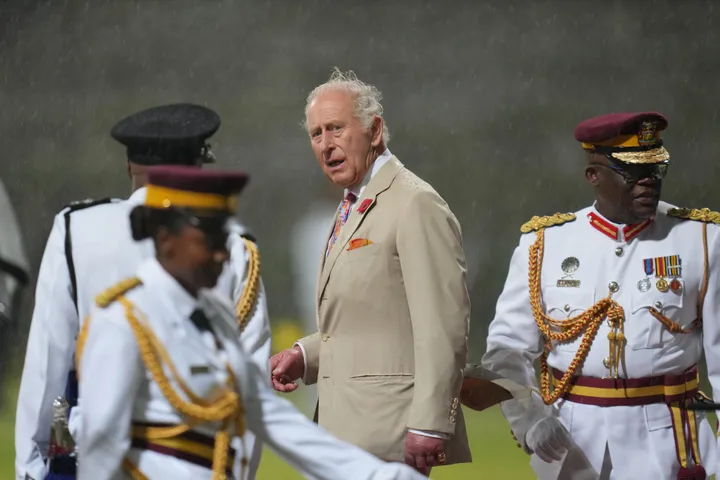
Burnham has been accused of embarrassing King Charles, who will express his “sincere sorrow” for the slave trade in his speech to the gathering – but stop short of making a full apology.
Opposition parties have said a British apology will simply increase calls for billions of pounds in reparations to be paid to those nations affected, although the government has insisted it will not do so.
Around 12 million enslaved Africans were forcibly transported to America between the 16th and 19th century, to work on plantations and as domestic workers.
Britain and Portugal were responsible for exporting approximately 70% of all slaves, with Britain alone sending 3.1 million Africans to British colonies in the Caribbean, according to the National Archives.
Britain was the world’s biggest slave-trading nation at its height, and did not abolish slavery until 1834.
The United Nations passed a resolution in March calling the slave trade “the gravest crime against humanity”.
Here’s what you need to know about the reparations row dominating the CHOGM summit.
Has The UK Apologised In The Past?
No, the UK has never formally apologised,
Britain did offer £20 million financial reparations back in 1833, when it passed the Slavery Abolition Act – but only to the slave proprietors, not to the slaves themselves.
British taxpayers only finished paying off this debt in 2015.
Former Labour PM Tony Blair did make a historic statement condemning slavery back in 2006.
He said: “We condemn its existence utterly and praise those who fought for its abolition, but also to express our deep sorrow that it ever happened, that it ever could have happened and to rejoice at the different and better times we live in today.’”
The UK has consistently rejected calls for slavery reparations to the descendants of the enslaved.
In 2024, Keir Starmer’s government insisted the UK would not pay reparations for the part it played in the transatlantic slave trade, with some estimates putting the potential bill at £18 trillion.
King Charles himself has previously spoken up about the injustice of slavery, claiming he in 2024 that he understands the “most painful aspects of our past continue to resonate”.
However, he added said that “none of us can change the past” and called on the Commonwealth Heads of Government Meeting (CHoGM) to find “creative ways to right inequalities” from our shared history.
Why Do Campaigners Want An Apology And Reparations?
Campaigners have welcomed Burnham’s willingness to at least talk about issuing an apology for slavery.
The prime minister of Antigua and Barbuda, Gaston Browne, said: “No British prime minister has gone this far before… we are ready to engage.
“A dialogue that begins by placing reparations outside the room cannot be a dialogue.”
Last month, Jamaica’s culture, gender, entertainment and sports minister Olivia Grange told HuffPost UK it was time for reparations.
Meanwhile, writer Nels Abbey told ITV’s Good Morning Britain: “Britain, for over 245 years, ran forced labour death camps in what is today called the Caribbean and across the Americas, too.”
He added: “Britain has the opportunity at this particular time to genuinely lead the world in repairing the damage, fundamental damage, that Britain – and others – have waged upon the Africans both at home in Africa and more particularly in the Caribbean.”
Similarly, former Commonwealth secretary Don McKinnon said: “We’ve just got to do something, better than doing nothing.”
“You could look at probably better trading relationships for a start, maybe educational opportunities, training of people, things like that,” he suggested. “It’s in Britain’s interest to have those Commonwealth countries and the Caribbean relatively satisfied with their relationship with the United Kingdom, not continually agitated.”
What Are The Arguments Against It?
Shadow foreign minister Tom Tugendhat told Times Radio the priority should be around tackling modern day slavery rather than focusing on the past.
He said why anyone would be a “fool not to see the argument” in favour of reparations, he said: “The reality is, it’s 200 years ago.
“Should we also be apologising for spreading smallpox?”
On whether King Charles should apologise, he said: “The problem from the King’s perspective, I would have thought, is rather more how often does he apologise?
“Because he apologised through his prime minister [Blair] 25 years ago.
“Does he have to do it every year? Does he have to do it every six months?
“What’s the timescale on this? And by the way, does that mean that we have to ask the Algerian government to apologise for taking slaves from Cornwall in 1640?”
Dr Rakib Ehsan, academic in integration and identity, told Good Morning Britain: “The idea that you would saddle modern British taxpayers with astronimical debt for historical wrongs that they played no part in, I think that would be an injustice.”
Tory leader Kemi Badenoch said the “endless talk about apologies” was a “distraction” from solving current issues.
She told the BBC: “The transatlantic slave trade happened centuries ago.
“It is time for the Commonwealth to start looking forwards, not endlessly backwards.”
What Has The Government Said?
Commenting on the row today, Burnham’s spokesman said: “The prime minister, like his predecessors, has expressed his sorrow and regret for the pain and suffering caused by the transatlantic slave trade and recognised the way it still shapes our world today.
“That is distinct from a formal apology.
“We’re opening a structured dialogue with those affected by the transatlantic slave trade and listening to calls for a formal apology on behalf of the British state. That will form an important part of that process.
“We think it’s right that a formal apology is discussed properly with the countries and communities most affected, rather than simply deciding unilaterally what form it should take.
“An apology of this significance should be informed by the people and countries most affected, as they’re asked for.”
Foreign secretary Ed Miliband said transatlantic slavery was a “horrific chapter” in the country’s history, with an ongoing legacy.
“We can’t change the past but we can face it with honesty, listen to those whose countries and communities continue to be feel its legacy, including in Britain and build stronger relationships for the future.”
He said Burnham is committed to setting up structured dialogue with Caribbean and African partners to discuss the possibility of a formal apology.
“True patriotism is having the confidence to talk about difficult chapters in our past. We are strong enough. We are self-confident enough to have this conversation.”
However, Miliband said: “We don’t believe financial reparations are the right or feasible answer to transatlantic slavery.”
Listen to Commons People, the podcast that makes politics easy. Every week, Kevin Schofield and Kate Nicholson unpack the week’s biggest stories to keep you informed. Join us for straightforward analysis of what’s going on at Westminster.