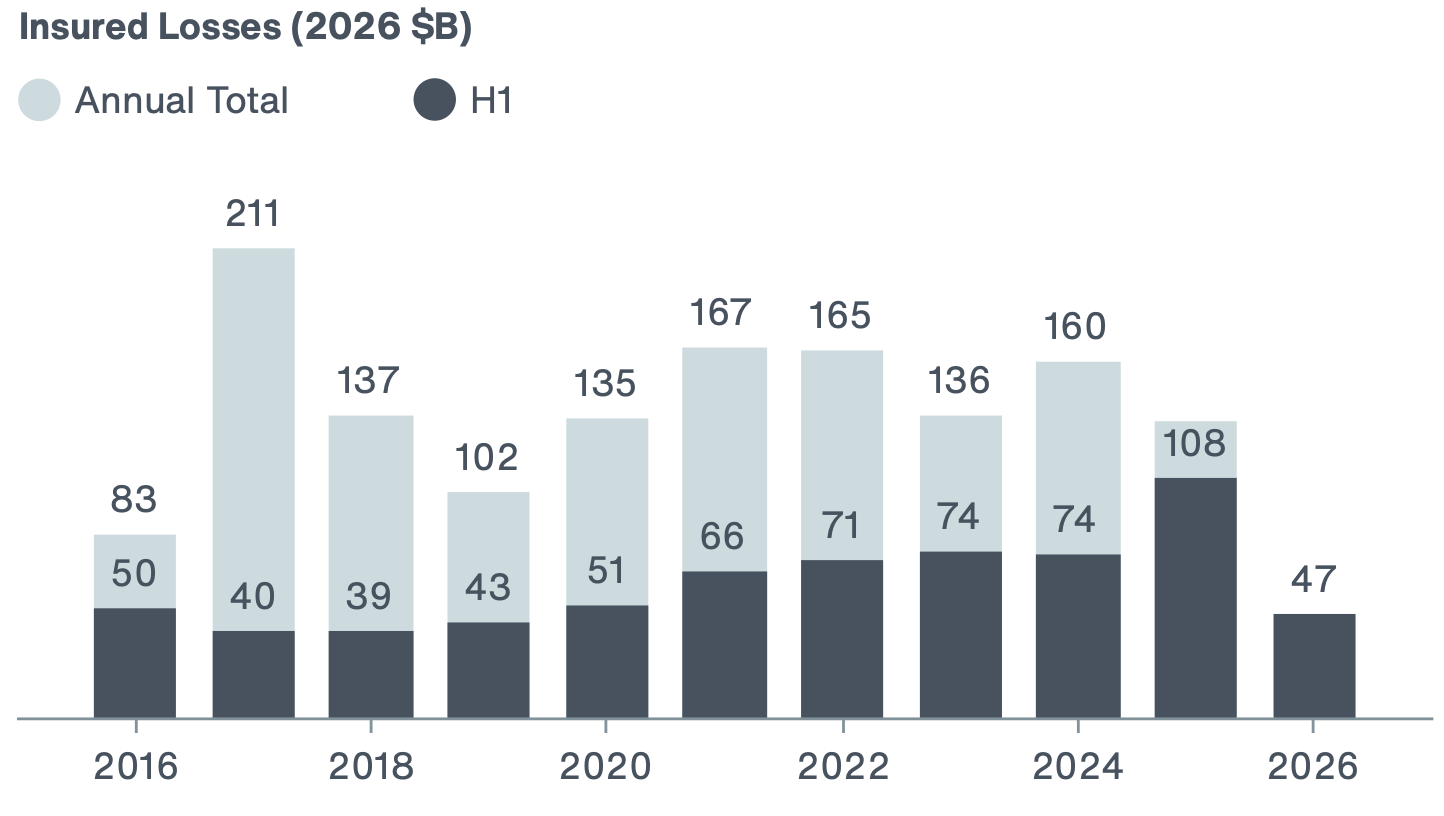
According to Aon Group’s “Global Catastrophes Review: First Half of 2026 Report”, natural disasters in the United States caused approximately US$36 billion in insured losses in the first half of 2026, accounting for 75% of global insured losses.
During this period, the country experienced $11 billion worth of insured events, including nine severe convective storm (SCS) outbreaks and two winter storm events.
South China Sea hazards, including hail, damaging straight-line winds and tornadoes, remain the costliest insured hazards globally. The U.S. SCS epidemic that broke out from April 23 to 29 was the largest single insured catastrophe event in the first half of 2026, causing insured losses of more than $5 billion.
Overall, U.S. SCS activity caused approximately $27 billion in insured losses in the first half of this year, although this figure is still well below the more than $40 billion recorded in the first half of 2023, 2024 and 2025.
The report also highlighted unprecedented tornado activity in the Midwest, with tornadoes in Illinois about four times the long-term average by mid-year, and both Illinois and Indiana setting new annual tornado records.
Despite unusually high activity, insured losses remain below recent peak years, illustrating how disaster impacts vary based on event location, severity and exposure.
Michal Lörinc, Head of Catastrophe Insights at Aon, commented: “Overall global loss figures can obscure where risk actually accumulates. The first half of 2026 shows that even if global loss totals appear modest, regional events can have significant financial, operational and human consequences. Looking beyond total global losses provides a clear picture of the impact communities and organizations are facing.”
In terms of overall material losses, global economic losses reached US$111 billion in the first half of 2026, with economic loss events reaching US$23 billion, which is comparable to the long-term average.
However, total losses in the first half of 2026 were 25% below the 21st century average and were the lowest first half total losses since 2018. Key individual drivers of economic losses include the earthquake in Venezuela (expected to cause $20-30 billion in economic losses), the US$34 billion national South China Sea season, and Portugal’s costliest storm on record ($4.4 billion).
Aon stressed that catastrophe risk depends not only on total losses, but also on where the event occurs and its impact on people, infrastructure, operations and supply chains.
Europe’s record-breaking heatwave highlights how climate-related extreme weather can have significant impacts on people, operations and society, and these impacts are not always fully reflected in insured loss totals.
In late June, 17 European countries broke all-time June temperature records, with temperatures exceeding 40°C (104°F) across much of the continent. The event killed thousands of people, including more than 1,000 in France, the United Kingdom, Spain and Belgium, making it one of the worst heat events ever recorded in Europe.
Liz Henderson, global head of climate risk consulting at Aon, said: “Historical loss experience is becoming a less reliable guide to predicting future risks. Events such as this year’s European heat wave show that emerging vulnerabilities can create new areas of risk that may not always be reflected in insured losses. Understanding these trends is increasingly important for long-term decision-making.”