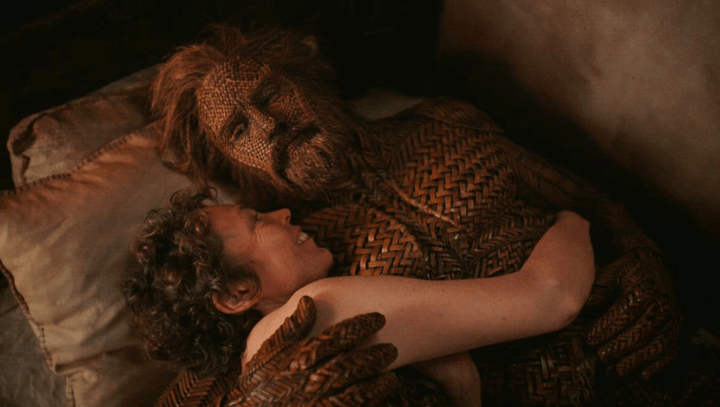
Wicker is probably the most talked-about film around right now – not just because of its racy scenes but also because of leading man Alexander Skarsgård’s jaw-dropping transformation.
In the new twisted romance, the Swedish actor plays the so-called Wicker Husband, donning elaborate prosthetics to bring his character to life using as many practical effects as possible, rather than relying on CGI.
Those who’ve seen the movie this weekend will agree that it looks so convincing that there are parts you really do feel as though you could reach out and touch Alexander’s character’s wicker exterior.
And this naturally begs the question… how exactly did he and co-star Olivia Colman avoid getting splinters on set?
Well, prosthetics master Joe Dunckley had answers during a recent interview with Variety, explaining that Alexander’s character was mostly brought to life through the medium of 3D printing.
In fact, there was no wicker involved in his costuming, with the character’s woven look created through painting effects, which were then stitched onto a spandex suit which the actor wore.
Joe noted: “It’s a semiflexible material, not too dissimilar to the feeling of touching proper wicker weave.”
Opening up about the creation of Alexander’s costume, he added: “It’s a volume of thermoplastic elastomer; you shoot a laser into it and where that focal point of the laser is, it fuses the powder and you can build intricate weave and complex geometry. The powder in the bed holds the strands apart while they set.”
Yeah, alright, we don’t really get that either, but it certainly sounds impressive, doesn’t it?
Last month, Alexander discussed his transformation for Wicker on The Graham Norton Show, revealing: “It was real and made by the same artists that worked on Lord of the Rings. The suit was exquisite and it took them 18 months to make.”
The Emmy winner then shared that he “particularly liked” the “extraordinary craftsmanship” that went into his character’s nipples – before presenting them to Graham as a gift.
Wicker is in cinemas now. Read Variety’s piece full about the making of the film here.