The UK growth forecast has fallen to 1% for next year, according to the country’s public finances watchdog.
In a new report published on Wednesday along with the first Budget of Andy Burnham’s government, the Office for Budget Responsibility (OBR) predicted rising inflation would slow down anticipated economic growth.
While UK gross domestic product (GDP) is expected to improve by 1.2% this year – up from an estimate of 1.1% – it will go down in 2027.
The OBR previously predicted the UK economy would grow by 1.6% next year.
The forecast is also a blow to the government, which has vowed to offer “growth in every postcode”.
However, the predictions were not entirely bad: growth is expected to return to 1.6% in 2028, then reach 1.8% in 2029, 1.7% in 2030 and 1.6% in 2031.
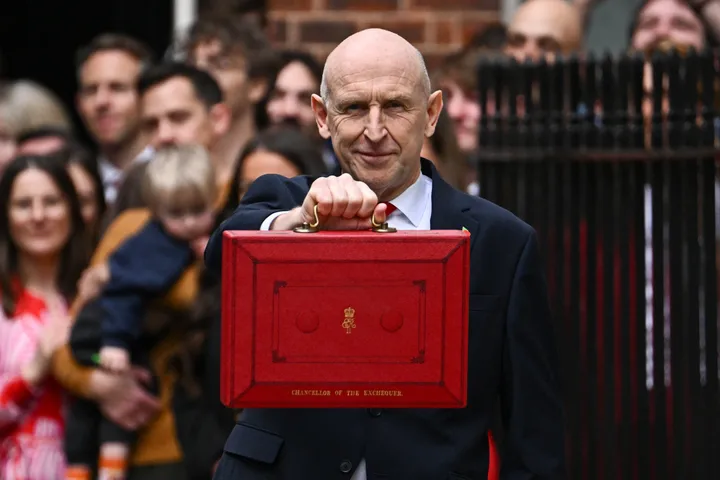
It comes after chancellor John Healey promised to steer the country through “global economic storms” with a series of measures meant to introduce “breathing space” for households and businesses.
That included doubling tax on banks to 6%, announcing a £100 energy payment for millions of Brits and promises for greater “fiscal devolution”.
But, as the OBR warned: “The UK’s economic and fiscal position remains very challenging.
“Since 2008, repeated adverse shocks have contributed to persistently weak GDP growth and elevated levels of government borrowing.
“This has resulted in a sharp increase in government debt as a share of GDP, to a level that is high by both recent historical and international standards.”
The watchdog warned there had been “further adverse developments since our March forecast” as both interest rates and energy prices have risen.
The Iran war has led to the effective closure of the Strait of Hormuz, a major shipping lane which carried around a fifth of the world’s global fuel supplies.
That has made global energy prices shoot up.
The UK also imports more energy than it exports, meaning inflation has increased and real household disposable incomes have fallen.
The OBR expects inflation – how much the prices of goods and services increase over time – to reach 3.1% this year too, despite a previous forecast for 2.3%.
Inflation will then reach 3.4% in 2027 and only return to the Bank of England’s 2% target in 2030.
It’s a contrast to predictions from March, when the Iran war had only just started, when inflation was expected to drop back down to 2% much sooner.
Healey began his speech today by calling his Budget today one “built on fiscal discipline” for the “working people of Britain” and business – even amid “global economic storms” and trade tensions.
He pointed out that the Iran war has caused inflation to rise, as oil and gas prices climbed.
He said the price of oil was now up to around $70 a barrel to well over $100 – and gas prices have nearly tripled since February.
But, Healey added: “Fiscal discipline is my first commitment as chancellor.”
He continued: “I have kept the Labour manifesto promise not to raise tax on working people. And I have rejected broad-based tax rises, or slashing public service, recognising that families and businesses need this breathing space.”
Healey announced 20 million households in council tax bands A to D would receive a £100 payment.
He also said VAT cut on electricity bills would be extended to next July, scrapped fuel duty rises, and shifted energy levies onto general taxation.
Gas standing charges were abolished too, a move meant to cut utility bills for 60% of households.
The chancellor has reduced the UK’s fiscal headroom to £15 billion in 2029/30, down from a previous prediction of £26 billion after seeing borrowing costs increase.
The Tory leader Kemi Badenoch told MPs the Budget is “not bold enough” and the UK is “overspent, overborrowed and overtaxed”.
Listen to Commons People, the podcast that makes politics easy. Every week, Kevin Schofield and Kate Nicholson unpack the week’s biggest stories to keep you informed. Join us for straightforward analysis of what’s going on at Westminster.