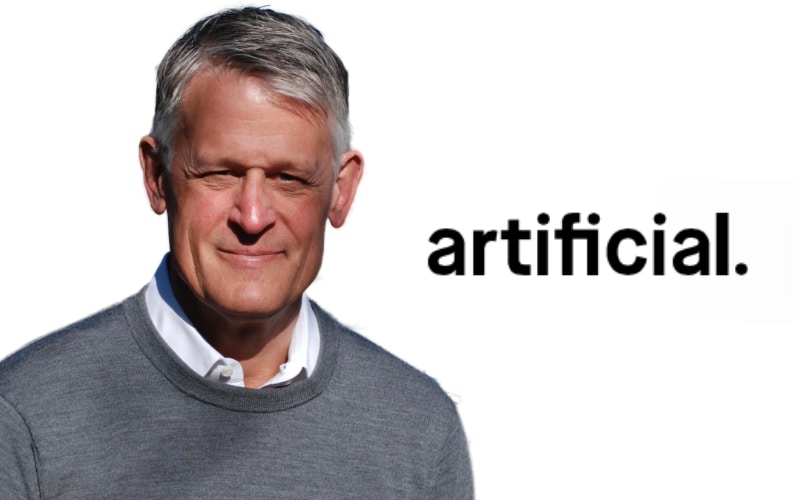
Artificial President Eric Joost said the company sees opportunities in the U.S. reinsurance market, particularly the wholesale market, MGAs and more structured distribution models, as companies seek to manage increasing submission volumes and higher operational complexity.
Founded in 2013 and headquartered in London, Artificial builds technology and software tools for commercial insurers and brokers, and provides clients with a cloud-based algorithmic underwriting platform and applications that can be built on top of existing legacy systems.
Joost, who joined the company earlier this year to lead its U.S. expansion, noted in an interview with Reinsurance News that Artificial’s expansion into the U.S. market is a natural extension of its existing business.
He explained: “A large proportion of the activity we support in London today is already linked to US risks, reflecting how globalized specialty insurance has become. Many of the brokers and carriers we work with already trade in both markets, so the expansion is a natural extension of these existing relationships.”
Joost continued, “This opportunity is particularly important in wholesale markets, MGAs, and more structured distribution models where companies need to manage increasing submission volumes and higher operational complexity. There is no shortage of capital or underwriting expertise in the U.S., but there is pressure to deploy that expertise consistently as businesses scale. This is where we see a clear role for Artificial, supporting more structured, repeatable execution across these workflows.”
At the same time, Joost emphasized that the United States is not a market where London’s approach can simply be copied. Although the basic mechanics of insurance transactions are similar, the way these transactions are handled is different. As a result, Artificial is committed to adapting its approach to how the U.S. market actually works.
He noted that Artificial’s top priority over the next 12 to 24 months is to establish a clearer position in the U.S. market.
“There is already some awareness of AI, but a more important step is to ensure that this translates into a better understanding of what we do and where we deliver outcomes for our clients. This requires a more visible presence in the market – both in terms of people and engagement,” Jost said.
“Building a footprint in the U.S. is part of that, but the broader focus is on relationships and supporting customers as they navigate technology areas that are often widely discussed but inconsistently applied. There is a lot of activity around artificial intelligence and digital transformation, but many companies are still figuring out how to integrate these tools into their businesses in a practical sense,” he added.
Joost also commented that from a president role perspective, the value comes from having experience in both the insurance business and technology.
“In this market, technology cannot be separated from how a company actually operates. Being able to connect those two perspectives helps accelerate the process of translating what Artificial does into results that are relevant to U.S. customers,” he said.
“Success in this period is less about overall expansion and more about establishing credibility with the right counterparties, identifying how the platform works in practice and demonstrating that it can support growth without adding operational complexity.”
Joost also talked about artificial intelligence (AI) and its ability to provide real value to customers.
He explained: “Much of the immediate impact remains around data, specifically ingestion, standardization and the ability to use consistent information across transactions. These issues have been in the market for a long time and remain core to making digital transactions effective. Improvements in these areas have a direct impact on the quality and consistency of decision-making.
“Internally, AI also increases the speed with which development work can be completed, particularly in areas such as prototyping and coding. But a more important point for customers is how technology can be introduced into workflows in a controlled way. The industry has experienced multiple waves of new technology over the past decade, and the difference now is the extent to which it can be embedded into day-to-day execution, rather than existing as a separate initiative.
“In this case, it’s important to gain experience from implementations that are already in use. It allows the focus to go beyond whether a feature exists, and how that feature can be applied consistently across the enterprise.”
Joost said that the most direct impact of artificial intelligence today is on the way information is organized and used.
“Underwriting and placing involve large amounts of data moving between different parties, often in inconsistent formats. Artificial intelligence is already helping to extract, structure and improve this information, which reduces the amount of manual work required and allows more time to be spent on decision-making,” he said.
“In this sense, the benefit is not to replace underwriting judgment but to improve the input to that judgment. If the information is clearer and more consistent, it is easier to apply preferences, guidelines and pricing in a more structured way.
“There is also a broader shift happening in accessibility. More and more advanced tools are increasingly available directly at the desk, changing the way individuals interact with data, research and communications. This brings efficiencies at the individual level, but also creates a second challenge around consistency.”
Joost noted that using AI on its own is relatively simple, but scaling it across a team or enterprise, where multiple people need to operate in the same way and with appropriate spans of control, is more complex.
He concluded that the shift from personal use to institutional adoption could be the next stage in the market’s evolution.