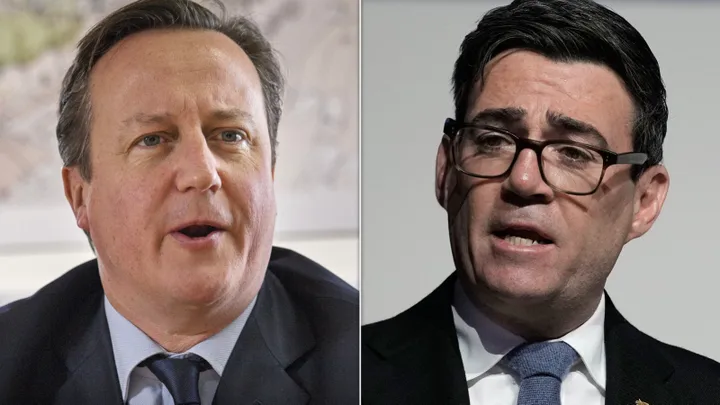
Andy Burnham has slapped down David Cameron after the former Tory prime minister said Britain should not try to rejoin the bloc.
Speaking more than a decade after he called the 2016 EU referendum, the Conservative peer warned this week that starting a conversation about rejoining the EU would be “very long and painful”.
He also claimed the UK’s economic issues are unrelated to Brexit.
But the current prime minister hit back: “I think he is wrong to say that the low growth that we’ve had over the last decade has, quote, ‘nothing to do with Brexit’. I would say the evidence says otherwise and indeed the Treasury analysis says otherwise.”
Burnham has been clear that he would like to rejoin the EU “within my lifetime”, though he has claimed he would let the public decide.
He is currently negotiating a fresh deal with the bloc on food standards and emissions trading, ahead of a UK-EU summit next Friday.
The i newspaper has reported that could include putting the UK in the EU’s protectionist Made in Europe law, even though that could exclude industries from European contracts.
Burnham is set to meet EU leaders in Brussels next week to sign agreements which he claims could increase GDP (gross domestic product) by 0.4%.
Speaking at the European Political Community summit in Dublin, Ireland, Burnham insisted this deal could be a “win-win”.
He said: “I believe there is a good deal to be done that could be a win-win for Britain and Europe. I think it actually could be more like the Brexit that people thought they were voting for it in 2016.
“I don’t think people thought they were going to get a Brexit as hard as the one that finally came through at the end of 2019. It was much harder than Theresa May’s deal when she was trying to come up with an arrangement.
“So let’s see where we get to in the next seven days. But I think in the end, what we get could be good for Britain, but also closer to what people voted for at the referendum.”
He claimed that Cameron’s remarks are about “unity in the Conservative Party” more than “fighting for the British interests”.
When asked if he was any closer to outlining his plans to rejoin the EU, Burnham said: “I think it’s really important to take one step at a time. But I’ve said before, I think we would then consider what are the options beyond that.”
Cameron urged his Labour successor against re-opening another “decade-long debate about whether we should be in or out”.
His intervention sparked intense backlash, especially as he called for the 2016 referendum on the UK’s EU membership in the hope of putting an end to the Conservative Party’s euroscepticism.
He campaigned to Remain in the trade bloc and left Downing Street once the country voted to Leave by a margin of 52% to 48%.
Cameron told Bloomberg this week: “Instead of launching an argument about rejoining, which I think would be a very long and painful argument – and who knows where it would end up – instead of that, focus on how do we be the best friend, best neighbour, best partner.”
He claimed even “flirting” with rejoining could get in the way of negotiating a stronger deal, because EU countries might feel there is no point.
The Tory peer said: “Our economic problems are we are overspending, over-borrowing, over-taxing, over-regulated, and far too much being spent on working age welfare. Those are a set of problems that have nothing to do with Brexit.”
Listen to Commons People, the podcast that makes politics easy. Every week, Kevin Schofield and Kate Nicholson unpack the week’s biggest stories to keep you informed. Join us for straightforward analysis of what’s going on at Westminster.