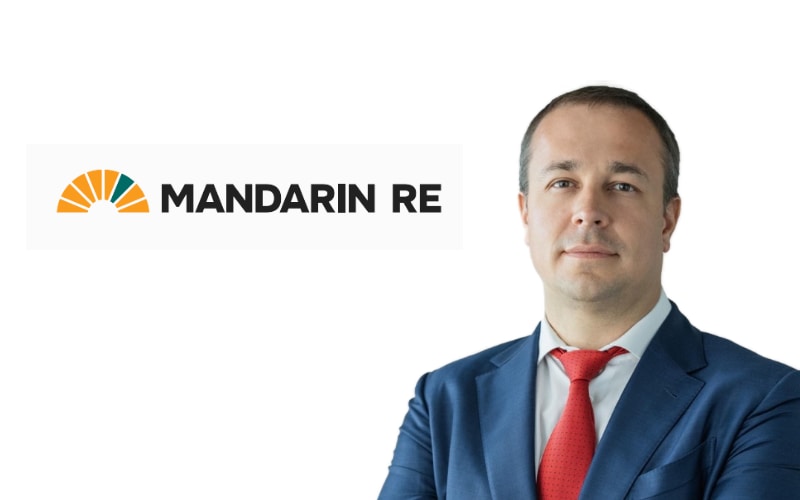
Mikhail Grishin, chief operating officer of Malaysian reinsurer Mandarin Re, said one of the greatest values of artificial intelligence (AI) in the reinsurance sector is its ability to increase clarity in underwriting portfolios, allowing companies to determine where underwriting time is best spent and improve the speed and quality of underwriting decisions.
Grishin stressed in an interview with Reinsurance News that the most immediate impact of artificial intelligence on reinsurers is to help underwriters gain a clearer understanding of their portfolios, starting not with new technology but with the data the company already has.
He explains: “Before AI tells you something you don’t know, it can often show you something you should have seen. This distinction is more important than many companies realize. Over time, this creates structural inefficiencies that are difficult to see from within operations.
“Underwriters are busy. Response times may be reasonable. Cases are being reviewed. But a large portion of that activity still consumes capacity without producing results, and cases that truly deserve deeper engagement are subject to the same limited time constraints as other cases.”
Grishin emphasized that this was not a failure of the effort but a visibility issue.
He continued, “Not every submission represents a real opportunity. Some of the projects in the pipeline are a good fit, priced appropriately, and come from relationships with real track records. But a large portion may not be. The challenge is that these two categories often appear in the same queue and receive the same level of underwriting attention.”
“In a soft market environment, underwriting attention itself becomes a scarce resource. When competition intensifies and pricing pressures increase, the ability to understand where underwriting time should be focused becomes as important as the ability to analyze the risk itself.”
Grishin revealed that at Mandarin Re, the company used data from its underwriting management platform, combined with AI-assisted pattern recognition across the portfolio, to conduct a structured analysis of its submission process. The goal is to understand where the underwriting capacity is actually going and whether this allocation makes sense.
“We found that the quality of incoming traffic was determined not just by geography but more by the broker generating the incoming traffic. Some partners had high submission volumes but limited returns. Other partners, typically those with direct ties to local markets and real cedant engagement, consistently delivered results above our portfolio average. Refocusing on the right sources within the same region produced measurable shifts,” he said.
As a result, Mandarin Re has adjusted the way it allocates underwriting capacity across its broker network, changing focus and priorities.
“The results are clear,” Grishin explains. “By focusing our underwriting time on higher-probability opportunities, we have freed up approximately 23% of our underwriting capacity that was previously absorbed by lower-return activity. In addition to this, our underwriting and hit rates have improved significantly. The business we are underwriting is more aligned with our appetite, and the transition from submission to bound cases is more efficient.”
He added: “One of the most obvious benefits of combining AI with structured data is how it is processed before submission to underwriters. Each case can now be pre-analyzed against our internal underwriting criteria, rather than as a raw data package that needs to be fully interpreted from scratch. Underwriters receive a structured briefing: key risk characteristics, relevant parameters and areas to watch closely. The analytical groundwork is completed before the conversation even begins.
“This changes the quality of underwriting decisions, not just their speed. When underwriters are involved in a case, they are looking at the substance of the risk rather than working through a mechanism of information extraction.”
Beyond that, Grishin noted that the company has been investing in standardizing internal reporting and ways to track underwriting.
“Consistent formats, data points and benchmarks are important. When every case and every period is captured in a consistent way, it is possible to clearly see the portfolio and make informed adjustments. Without this foundation, data analysis can produce noise rather than insight,” he said.
None of this replaces underwriters, Grishin stressed. The final decision on risk assessment, relationship judgment and terms rests with the underwriters; it is the circumstances around them that change.
He continued: “AI and structured analytics can close the interpretation gap between what’s happening in the portfolio and what leadership is seeing.
“They reveal patterns that would otherwise require weeks of manual work to identify. They make it possible to ask specific operational questions and get answers quickly enough to take action.
“In a business where decisions are compounded over years and poor risk choices may not fully become apparent until long after the fact, this clarity is a real competitive advantage. Not because it removes complexity, but because it makes complexity more manageable.”
Grishin stressed that the companies that stand to benefit most from underwriting AI will be those that are building data discipline now, while the tools are still being adopted rather than assumed. This includes consistent data collection, structured analysis of known information, and a willingness to act on what the data reveals.
He concluded: “We are still building, but the direction is clear and the early results confirm the work is worth doing.
“Future advantage in reinsurance may not belong to the companies with the most AI, but to those with the clearest understanding of their portfolios.”