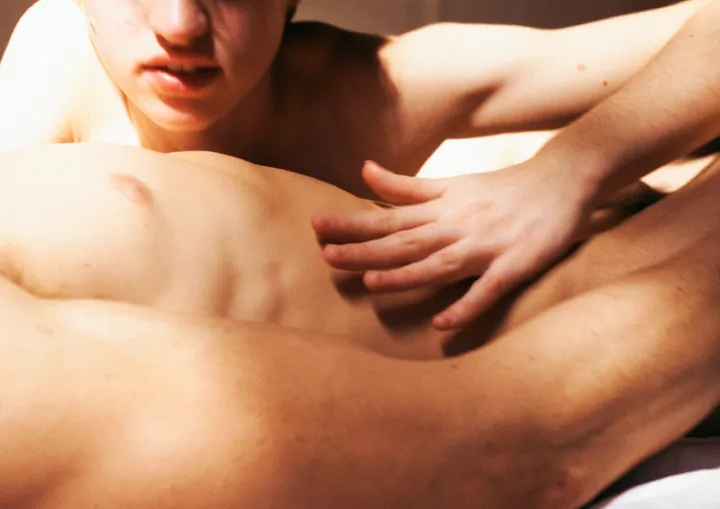
Rather than assuming you already know what your partner likes, or expecting them to somehow know what you like, there’s a better way: pleasure mapping.
Pleasure mapping gives couples a structured way to explore each other’s bodies and communicate what feels good.
By building a shared language around touch and pleasure, the exercise can strengthen intimacy and help couples develop a more satisfying sex life, even after years together. Here’s how to try it.
It’s an intentional guided practice
A guided exercise that helps couples identify and communicate how different areas of their bodies respond to different types of touch. Pleasure mapping can make it easier to communicate your preferences in real time, especially when putting them into words feels challenging.
Performance can make that communication difficult, as we tend to focus on managing our partner’s experience during sex. “We don’t want to hurt their feelings, make them feel like they’re doing something wrong, or interrupt the moment,” said Pamela Madsen, a certified somatic sex educator and founder of Back to the Body sexual wellness retreats, noting that instead of simply noticing and receiving what feels good to us, we may find ourselves wondering whether our partner thinks we’re enjoying it.
But there’s another reason it can be hard to communicate what feels good: many people genuinely don’t know what they like.
“We assume that because someone has lived in their body for 40, 50 or 60 years, they know exactly how they want to be touched. That’s simply not always true,” Madsen said, noting that desire and sensation can change from one day to the next. “‘I don’t know, let’s find out’ can be one of the sexiest and most useful things you can say to a partner.”
Set some ground rules
To get the most out of pleasure mapping, experts stress that the exercise should stay fun, low-pressure and non-performative – and it doesn’t have to lead to sex. “The only goal is curiosity, gathering information about your partner’s body rather than performing for each other,” said Sarah Tomchesson, a certified intimacy coach and director of marketing and education at Magic Wand. “Agree upfront that either partner can pause the practice any time the sense of curiosity and exploration fades.”
Sex and relationships therapist Melina Tovar adds that removing outcomes and expectations makes space for curiosity and bodily awareness. “You allow more room for the body to respond intuitively to sensations,” she said.
It can also help to agree on simple language for communicating what feels good or not. That might be as straightforward as “more,” “less” and “same.” Stoplight cues, such as red, yellow and green, can also give the receiving partner an easy way to communicate in the moment. “The specific vocabulary matters less than having a clear, agreed-upon way to give and receive feedback as you go,” Tomchesson said.
When you’re ready to begin, get comfortable in soft, loose clothes that are easy to lie down in, such as stretchy sweatpants or a robe. “The best environment to optimize your experience with pleasure-mapping is in a distraction-free space,” Tovar said, adding that pets, phones, alarms and even something simmering on the stove can pull your attention away.
For those who may not automatically feel safe or comfortable with touch, Tovar suggests creating what she calls a “living room environment” for pleasure mapping, which is essentially recreating the feeling of your favorite cozy space. “Imagine your favourite spot on the couch, the cosiest blanket, your favourite tea or wine or beverage of choice, looking out to floor-to-ceiling windows of your favorite view,” she said.
“You want to create a physical environment that will feel like it will ground and hold you through the experience.”
Jacob Wackerhausen via Getty Images
Here’s how to actually do it
To explore different sensations and pressures of touch, Tovar recommends starting with one or two everyday objects each, choosing items with varied textures, dimensions, temperatures or weights.
“Think keys, pillows, watches [and] glasses,” she said. “As your familiarity and comfort with pleasure mapping progresses, couples are invited to integrate other objects that may give them more insight into pleasure mapping, such as feathers, leather, rope, vibrators, silk [and] liquids.”
When it comes to where to begin on the body, Madsen suggests choosing somewhere that isn’t overtly sexual, such as the hands, arms, shoulders or back. “If you immediately begin with the parts of the body associated with sex, all the old expectations can rush into the room … and somebody may unconsciously start performing,” she said.
“Starting somewhere neutral allows the nervous system to settle and lets both people learn the language of the exercise.” That might mean figuring out what “lighter” or “slower” means to your partner, or noticing what kind of pressure helps their body soften or move toward the touch.
Miljan Živković via Getty Images
From there, experiment with different types of touch like grazing, stroking and holding, as well as varying pressure, speed and movement. “Change one variable and give the receiving partner enough time to actually notice their response,” Madsen said.
When it comes to how long to spend exploring each area, Madsen suggests two or three minutes, which may be longer than feels natural at first.
“We move so quickly because we’re accustomed to touch leading somewhere,” she said. “For a first mapping session, I think 30 to 45 minutes is plenty. I [also] wouldn’t try to map the entire body in one evening.” Instead, you might map the arms and hands one night, then the back, shoulders and scalp another evening, allowing the map to develop over time.
Don’t skip these surprising spots
“I’d encourage couples not to assume where their partner’s ‘good spots’ are,” said Madsen, pointing to the hands as one often-overlooked area worth exploring during pleasure mapping.
“Hands are incredibly sensitive and intimate, but we mostly use them to do things rather than experience sensation,” she said. “Slowly exploring the palm, fingers, spaces between the fingers, and wrist can be surprisingly pleasurable.”
The scalp is another area she says is worth exploring, where people often discover preferences they didn’t know they had. “There are so many possibilities: fingertips, gentle pressure, scratching, stroking the hair, holding the head,” Madsen said.
Turn touch into a conversation
“One of the most common pauses or points of collapse I see for couples during pleasure mapping exercises is discovering the difference between learning your own pleasure map and then communicating it to another person,” Tovar said.
She suggests one way to make that communication feel less overwhelming and vulnerable is to create a list that categorises different parts of your body or types of touch as “Yes,” “No,” “Maybe” or “I don’t know, or I’m still learning if or how I like this part of my body touched.”
It’s also worth revisiting your pleasure map from time to time. “Since pleasure is responsive, [it can be] shaped by your current circumstances, your history with pleasure, and how closely connected you feel to yourself and to whoever you’re with,” Tomchesson said.
Changes to your body can also change how you respond. “Ageing, childbirth, injury, and other major life changes all alter your relationship to your own body,” Tomchesson added, “and your pleasure map evolves right along with your changing body.”