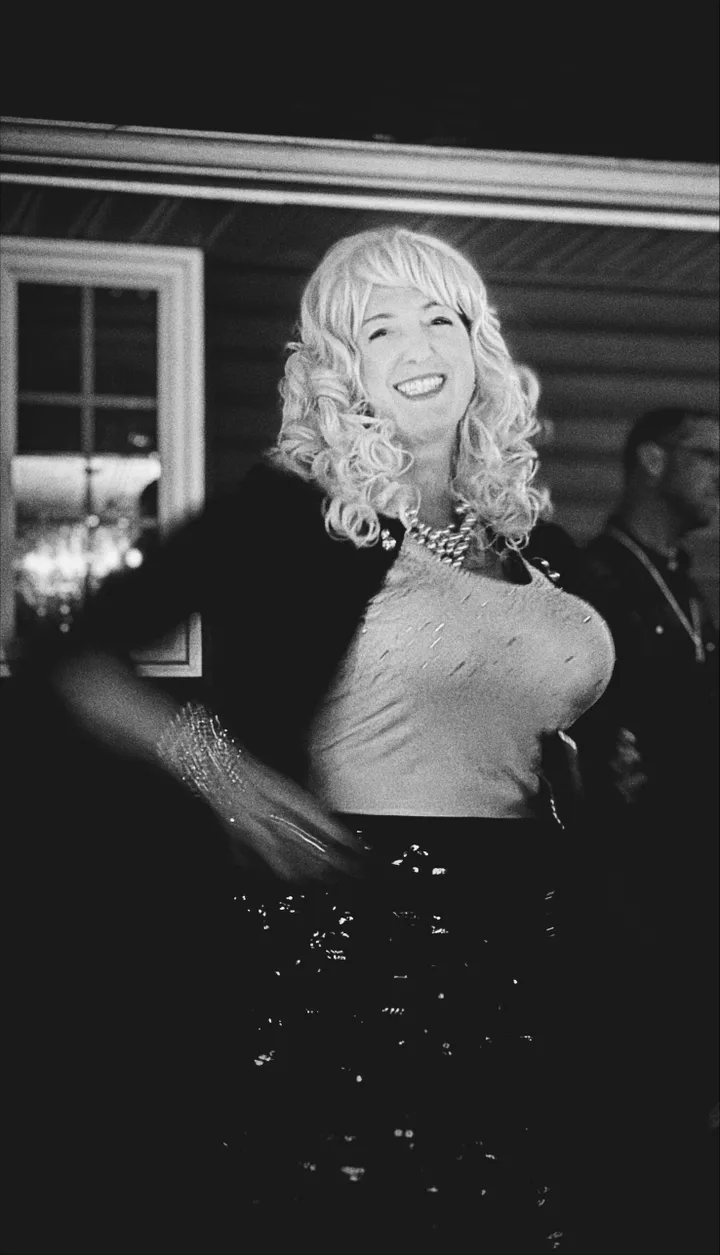
One week before my double mastectomy, I stood in a friend’s living room wearing a platinum-blonde wig, fake eyelashes, a sequined mini skirt and two enormous pink balloons, which were masquerading as Dolly Parton’s breasts.
There was something wonderfully absurd about it because in seven days, surgeons would remove the breasts I’d lived with for 47 years and attempt to reconstruct them with silicone implants.
And here I was, voluntarily doubling down on the cleavage, singing off tune and bringing everyone in a makeshift karaoke house to their feet.
It wasn’t exactly how I’d imagined spending my last Halloween with my breasts.
Two days earlier, a Halloween costume had been the furthest thing from my mind. I was preparing for a risk-reducing bilateral mastectomy with immediate direct-to-implant reconstruction – trying to organise my family, my work, my home and the countless details that suddenly seemed urgent before I surrendered my body to surgeons followed by six to eight weeks of recovery.
My brilliant friend was hosting a Halloween karaoke party. Guests were instructed to dress as a musical artist, prepared to belt out their greatest hits in a raucous sing-along in her family room, which she transformed into a spooky Japanese-style karaoke box.
I hadn’t given my costume a moment’s thought. But I didn’t want to miss one of my last opportunities to let loose before surgery.
And then I thought of Dolly.
Photo Courtesy Of Barbara Meskin
I’d spent the summer rediscovering Dolly Parton’s enormous catalog of music after news of her brief battle with cancer sent many into deep mourning and reflection. I found myself listening to Dolly Parton Radio on long weekend drives to the lake, belting out lyrics with my daughter, oblivious to my son’s eye-rolling in the backseat.
There was the original “I Will Always Love You,” “It’s All Wrong, But It’s All Right,” “Backwoods Barbie” and, of course, “Jolene” and “9 to 5.”
Along with a family history of breast cancer, there is considerable musical talent in my family. Much to my chagrin, I am not a talented singer by any reasonable definition. There is nothing I would love more than the confidence to belt out my favourite songs in public, but doing so in the privacy of my car or shower is about as far as I usually venture.
But something happened when I pulled on that platinum wig and assembled my improbable bosom from pink balloons.
I became Dolly. Or, more accurately, I became the version of myself who believed that in a world of rhinestones, I had a right to be a Dolly.
The woman I embraced was loud, glamorous, theatrical and completely unselfconscious. Her breasts were ridiculous. Her confidence was not. And when she approached the microphone, she did so with the same authority of a woman who had sold more than 100 million records.
Did I hit every note? Absolutely not.
Did everyone sing along with the same joyful abandon my daughter and I had practiced all summer in the car? 100%.
At one point in the evening, a woman I’d never met sat down beside me on the couch and simply rested her head on my enormous balloon bosom. I didn’t mind. In fact, I was delighted.
For one evening, I took up space. Considerably more than usual.
The irony of dressing as Dolly Parton a week before having my breasts removed wasn’t lost on me. But as the evening unfolded, I began to appreciate something more meaningful than the obvious joke.
Dolly Parton spent decades making an art form out of being unapologetically herself. Her towering blonde hair, extravagant curves, rhinestones, long nails and larger-than-life persona were as recognisable as her voice. She never pretended that her appearance was entirely natural. In fact, she made a career out of laughing about it, but she never allowed anyone else to decide what her appearance meant.
Dolly’s breasts may be iconic, but they were never the source of her power.
Her death deeply affected both adoring fans and those who merely knew her name. In an increasingly polarised world, Dolly was unconditionally kind, unabashedly inclusive and quietly philanthropic. That was why the world loved her. Her talent, wit, ambition, generosity and extraordinary capacity to connect with people of all types is what made her Dolly Parton.
The rest was decoration. Spectacular decoration, certainly, but decoration nonetheless.
Photo Courtesy Of Barbara Meskin
A woman can embrace artifice without sacrificing authenticity. She can be glamorous without being frivolous, sexual without surrendering her authority and funny without becoming the punch line. Dolly was never interested in defending her femininity. She simply defined it for herself.
I am about to face a very different challenge.
My breasts have been part of my body for nearly half a century. They developed alongside my identity as a woman. They changed with age, pregnancy, motherhood, weight gain, weight loss, and all the other indignities and miracles of living in a female body.
And soon they will be gone.
Not because I have cancer, but because I have decided I am not willing to keep living with the high odds of developing it.
My estimated lifetime risk of breast cancer is 43%. After over a year of research, medical consultations, difficult conversations, insurance nonsense, labs and imaging, I have chosen a preventive surgery that will reduce that risk by over 90%.
I know why I am doing it. I believe in my decision, but knowing I’ve made the right decision doesn’t make it any easier to imagine what comes afterward.
I don’t know how I will feel when I first look in the mirror. Will I recognise myself? Will my reconstructed breasts feel like mine? Will I grieve the ones I’ve lost, even though I willingly chose to remove them?
Will I still feel feminine? Beautiful? Me?
I approached the medical decision with spreadsheets, risk calculations, second and third opinions, with all the analytical discipline I’d spent a career in Marketing and Innovation sharpening to a fine point. But there is no mathematical model for how it will feel to inhabit a changed body.
For all my certainty about the surgery, I can’t calculate my way into feeling comfortable with the woman who will emerge from it. Perhaps that is what made my evening as Dolly so unexpectedly meaningful.
I spent months thinking about my breasts as a source of risk. They were something to monitor, evaluate and ultimately remove. Between mammograms, MRIs, bloodwork, lifetime probabilities, surgical options and insurance codes, my body had become a problem to solve.
But this Halloween, my breasts were something else entirely.
They were two pink balloons bouncing around a karaoke stage, inviting strangers to laugh, sing and even rest their heads on them.
I am still a high-risk patient and a woman preparing for major surgery. But on Halloween, those pieces of me receded just far enough to make room for a woman having an extraordinarily good time in an extraordinarily ridiculous costume.
We place enormous cultural weight on women’s breasts. They are symbols of beauty, sexuality, fertility, motherhood, desirability and femininity. We scrutinise their size, shape, symmetry and firmness. We celebrate them, shame them, sexualise them, conceal them, augment them.
And sometimes we remove them to save our lives. Even then, we still treat them as though they define something essential about the women attached to them.
Dolly Parton offered a different possibility. There is no moral superiority in being natural, and no shame in choosing to alter your body. Dolly showed us that authenticity isn’t measured by how much of your original anatomy you preserve.
I am choosing to have my breasts removed to protect my future. I am also choosing to have them reconstructed, because I want to. Neither decision requires an apology or even an explanation. And neither decision determines how much of a woman I remain.
A night of karaoke didn’t resolve all my fears about surgery. I still don’t know how I will feel when the bandages come off, or how long it will take for my reflection to become familiar again. I may grieve bitterly for my old breasts. I may love and embrace my new ones. I may feel both things on the same day.
I hope I remember the woman who stood in that living room, dressed in a ridiculous wig and an even more ridiculous pair of balloons, singing badly and laughing without restraint. That woman was not confident because her breasts were enormous. She was confident because, for that moment, she decided to be.
In a matter of days, I’ll say goodbye to the breasts I’ve known for 47 years, but I won’t be saying goodbye to my femininity. Being Dolly helped me see that the things that make me a woman were never contained in those two pieces of anatomy in the first place.
I thought Halloween might be my last chance to celebrate the body I was about to leave behind. Instead, it became a dress rehearsal for the woman I intend to be afterward.
And if she needs a little help finding her confidence, I know where she can borrow a wig. The balloons are optional.
Do you have a compelling personal story you’d like to see published on HuffPost? Find out what we’re looking for here and send us a pitch at pitch@huffpost.com.