In the last few years, there’s been an influx of authorised documentaries centred around celebrities. From Robbie Williams and Kylie Minogue to both David and Victoria Beckham, these series re-examine their famous subjects’ places in the pop culture pantheon, while taking us back through the highs and lows of their lives in the spotlight.
Here in the UK, few celebs in the 21st century have been through highs as dizzying or lows as crushing, dramatic and public as Tulisa, so her new Paramount+ series, The Reckoning, felt like something of an inevitability.
Speaking to HuffPost UK ahead of the documentary’s release, the singer and TV personality explains that the three-part series “represents truth in a lot of areas – not just in my personal life and my story, but the British press”.
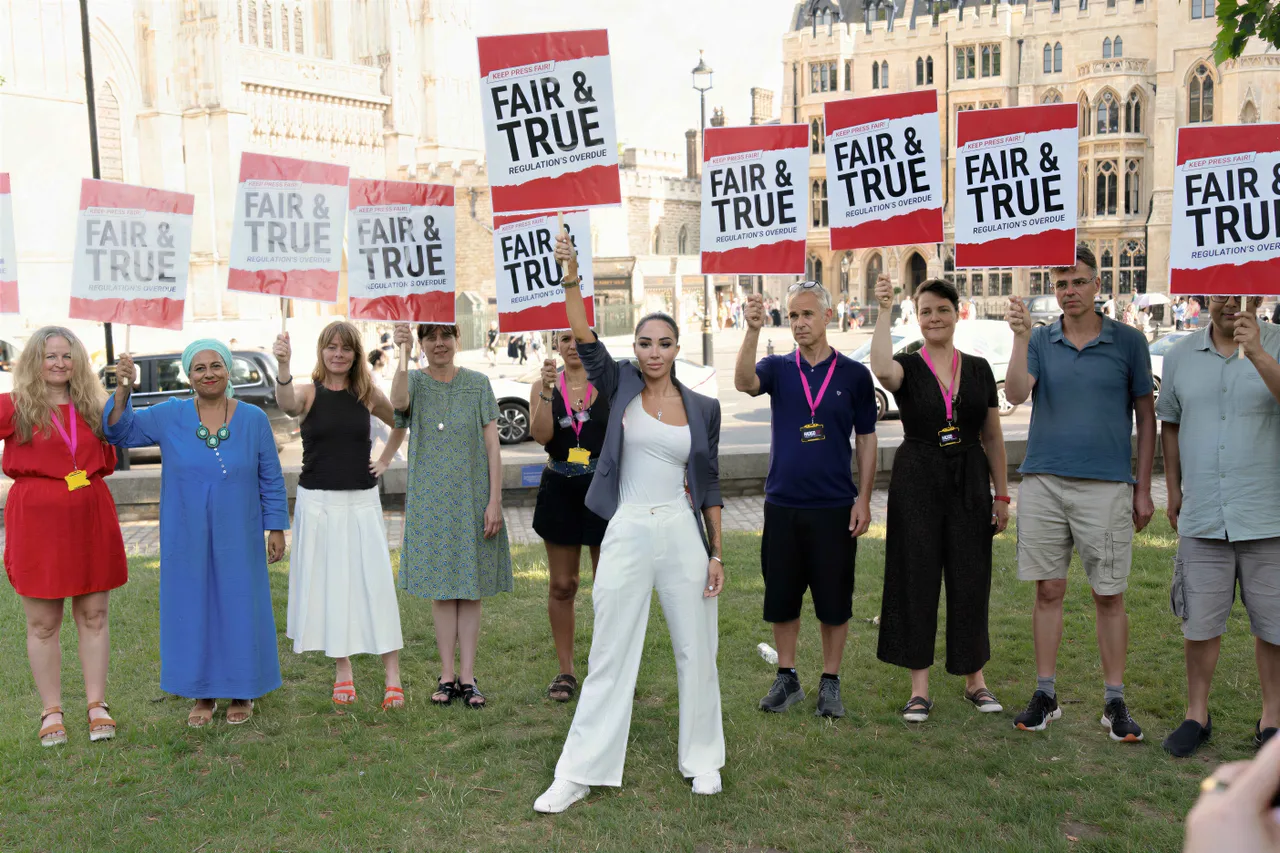
Indeed, as much as the doc dives into the headlines, scandals and, notably, grave injustices that have been thrown Tulisa’s way over the course of her career, in the Reckoning, she’s also in full freedom-fighter mode, using her own past experiences as fuel to campaign for greater regulation to be introduced in the world of British journalism.
“When I first spoke about doing a documentary, I was like, ‘I don’t want to sit and talk about any more of my trauma, I’ve had enough!’,” she admits.
“And then, when I knew I was allowed to do the campaign and try and make some change, that’s when I was like, ‘OK, yeah, now I’ll talk about it. Now it’s got some purpose behind it’.”
“That’s where I got the juice from,” she claims. “Then I was absolutely buzzing about the project.”
Over the course of The Reckoning, we see Tulisa not just picking at well-healed scars for the sake of viewers’ amusement and titillation, but attempting to use her own story to try and effect change, attending demonstrations, swotting up on media law and meeting with activists, politicians and others whose lives have been affected by press intrusion, in a bid to effect change.
“I don’t want to take away the truth, I don’t want to put a cap on freedom of speech,” she insists of her campaign. “I just want a level of humanity to come with it. And empathy! That’s it!”
Before we can look to the future, though, we have to go back to where it all started for Tulisa.
As we approached a new decade in the 2010s, she was already well on her way to becoming one of the most recognisable faces in the UK music scene, thanks to her work as the lead singer (and sole female member) of the British hip-hop trio N-Dubz.
During their original run, N-Dubz racked up five UK top 10 singles (including a number one), won four MOBO Awards and sold out venues around the country.
However, despite their achievements, Tulisa has said that, partly because of their youth, but also their background, she doesn’t believe they were ever taken especially seriously by the powers that be.
As the band continued to go from strength to strength and reach new levels of success, Tulisa says that, much to the chagrin of the establishment, they became increasingly impossible to ignore.
This, she explains in The Reckoning, is how she found herself in the presence of Simon Cowell, talking her way into a role on what was, at that time, the most-watched show on TV, The X Factor, where she became its youngest ever judge at the age of 22.
Ken McKay/Talkback Thames/Shutterstock
Backlash to Tulisa’s appointment was swift and vicious, both in the press and on social media platforms like Twitter, which was still in its infancy at that time.
“I definitely felt like I was the black sheep, I was the underdog,” she recalls. “In my eyes, I was like, ‘I’m that girl from the hood’, you know?”
Even at the time, Tulisa was able to recognise this as classism and misogyny, which only fuelled her more to succeed.
“At that time I was in my Female Boss energy,” she reminds us. “I was ready for it! As soon as the narrative started of ‘chav, this, that’, I was like, ‘OK, this is what we’re going with? OK, that’s what we’re going to go with then, I’m going to chav it up for you guys, if that’s what you want!’.”
Throughout this period, though, Tulisa acknowledges that there were people who felt she needed “taking down a peg or two”.
“Everyone was kind of sucking it up,” Tulisa says of these early years of success. “They didn’t like me particularly – or value me. It was just, ‘it works for the moment’ kind of thing.
“But really, when I rose too high, it was like, ‘get back to the gutter’.”
“I am telling you, 90% of the reason people would come for me is because I was so indestructible and unapologetic,” she insists.
“To have that as a woman – not even a woman, a girl, at 22 years old – the energy, especially from the men in the industry, was ‘who the fuck does she think she is? This bitch! She will not die! She’s the cat with nine fucking lives’.”
She was seen as “too much”, she claims, and eventually, her detractors got what they wanted.
In March 2012, with her first season of The X Factor behind her, and her debut solo single a month away, an intimate clip of Tulisa and her ex was shared online and quickly became widespread. This, she recognises now, was the first domino to fall in a sequence of events she would still be feeling the repercussions of more than a decade on.
“Nothing hurt until the tape,” Tulisa claims. “When the tape came, that’s when a switch happened, and then everything felt more painful, you know? All of it.
“Before that, I was very much in my Female Boss energy […] ‘I’m good, I’ve got this, cool’. But then, when I started to experience such a high level of trauma off the back of this level of fame, that’s when I was like, ‘oh woah, this is something deeper here’. And that’s when it started to become really difficult for me.”
What’s shocking to reflect on in the documentary is just how young Tulisa was when all of this happened to her, even if she didn’t feel it at the time.
“I look at 22-year-olds and what I would do to protect them and guide them and take care of them, and I’m just like, ‘god, there are a lot of arseholes out there!’” she laments.
“Seriously… I feel like 22-year-olds need a lot more protection, put it that way, than what I received.”
At that time, she jokes, “I thought I was like an 80-year-old woman in a 22-year-old’s body. I thought, ‘I know it all’. Little did I know…”.
Unfortunately, things for Tulisa were only just beginning to take a downward turn.
By 2013, she’d made front page news after being targeted in a sting operation by a group of journalists from the tabloid The Sun On Sunday, led by undercover reporter Mazher Mahmood. Told she was in the running for a major film role, Tulisa was flown back and forth to Las Vegas for fake “negotiations”, and encouraged to play up to certain aspects of the character she thought she’d be playing.
After being plied with alcohol over the course of a day, she was repeatedly asked to supply the group with cocaine, despite neither using the class-A drug herself nor having any contacts who could offer any up.
Made to believe it could affect her chances of being cast if she couldn’t do what was asked of her, she eventually supplied the so-called producers with the phone number of a friend who was not a drug dealer, and who she didn’t ever intend to provide the group with anything.
This was enough, though, for the whole thing to be splashed across tabloid headlines, resulting in an arrest, a charge of “being concerned in the supply of Class A drugs” and a high-profile court case that turned Tulisa’s life upside down.
A year later, the case was dropped when it emerged that Mahmood had lied to the court, and she was acquitted.
In her documentary, Tulisa describes the whole thing as a “witch hunt”, and tells us she was targeted as a result of “the level of confidence, the classism, the misogyny, all combined into one”.
Ben Pruchnie via Getty Images
With hindsight, she says now, the message was: “There’s a game to be played, and you will play it. You will not break free of the matrix.”
The trial was over, ending in Tulisa’s favour, but the damage to her career and reputation was done, and she believes now that the whole affair has “defined the rest of my entire life”.
For years, she retreated from the limelight, only recently stepping back into her power, via a 2022 N-Dubz reunion, an appearance on I’m A Celebrity in 2024 and, last year, the publication of her book Judgement, in which she lifted the lid on her traumatic experiences in the eye of a media storm.
At various points in The Reckoning, Tulisa discloses that she doesn’t think that even as recently as a year ago, she’d have been confident enough to push through with her campaign for press reform – or front a documentary about it.
She tells us that there was a “turning point” in November of last year, that represented another “leap forward”.
“I went on a sort of self-explorative journey,” she shares. “I went travelling, had therapy, and a new me evolved – a new butterfly out of a cocoon that was just ready for something like that.”
“It’s been absolutely exhausting,” she laughs. “I feel bloody great for it. But you know, it’s hard work!”
She’s “a lot more fearless” as a result, she explains, and all of this progress “riled” her up to want to use her lived experiences for good.
It’s also made her feel more able to look back on the good times she experienced at the height of her fame, that had previously been too wrapped up in the painful lows.
Tulisa explains: “I am detached from the trauma aspect now. For me, the pain is my power.
“I’m probably in a space where I’m able to look back more fondly on it than ever. Whereas, any time before this, I just related it to PTSD.
“It would ‘ugh’ me to even think about any time on X Factor, because it was connected to the tape and the sting. Like, ‘I can’t even go there’. And now, it’s like, ‘oh yeah, I did that’.”
“There were some serious highs and amazing moments that I can still look fondly on and go, ‘hey, I did that!’, you know!” she enthuses. “At the age of 22 years old!”
All of this brings us up to the present, and her ongoing fight for tighter regulations in the British press.
While she’s happy that the media landscape has changed somewhat since the days when she and many other famous women were picked apart in the press for sport, she’s adamant it “still happens” more than people might realise, albeit more covertly.
Nowadays, she suggests, a “selective few” celebrities will be the subject of “back-to-back” negative stories, offering Jennifer Lopez as one such example.
“It’s all, ‘be kind, be kind’ – but once they get the claws into one person for a period, it’s just a barrage,” she states.
And she’s also keen to point out that the changes she wants to see don’t just affect the rich and famous, but regular people whose lives can be turned upside down by press intrusion.
In the documentary, she meets with the mother of a girl who was killed in a road accident, only for footage of the incident to be posted in the tabloid press.
“Celebrity is only [part of] what I’m trying to get across,” Tulisa insists. “It’s [the part] everyone sees – but there’s this whole other deeper layer to it, where the press are controlling the narrative of so much going on in this world. And then you have regular individuals that you wouldn’t even think [about], their lives have been completely turned upside down.”
“You see a story, and tomorrow it’s chip paper and all forgotten,” she suggests. “But someone’s life has been destroyed, you know? And that’s what the main part of this has all been about for me. I just hate seeing people in pain. I hate seeing people treated badly.
“I’m essentially fighting for people’s mental health and happiness and peace. I don’t want to see people in pain, because there are malicious individuals that have free rein to do whatever they want.”
The campaign, the documentary and Tulisa’s whole outlook speak to her ability to turn a negative into a positive and make lemonade out of the many lemons that have been thrown her way.
“If I don’t take every single one of my experiences and turn them into a positive then what has it all been for?” she questions in the show.
“That’s the motto of everything in my life,” she says now. “I will find a positive in everything. Nothing is negative unless I choose it to be, and if I choose it to be rainbows, unicorns and fairytales, so it shall be.
“I’ve managed to take a very traumatic and painful – but insightful and enlightening – period of my life and utilise that to align more with my higher self and be the greatest version of myself.”
“People don’t get it,” she claims, saying many question whether she’s still bitter towards those who tried to wrong her in the past, but she stresses “the way that I feel about it now is very different to how I felt about it the past 10 years”.
What “started off as a trigger point”, she now considers a “journey”.
“I’m really grateful for all of my experiences, good and bad,” she concludes. “The only feeling that can be put towards it is the feeling you choose. And I choose greatness.”
Tulisa: The Reckoning is now streaming on Paramount+.