In politics, as in life, it is often better to be lucky than good.
Andy Burnham has received his fair share of criticism, including from within his own party, over his decision to float the possibility of the UK going back into the European Union.
The prime minister shook hands with EU leaders last week on a deal removing trade barriers with Brussels, but has been very clear that he wants to go much further.
One senior Labour insider said: “The worry in the party is that Andy has accidentally fired the starting gun on a Rejoin vs Stay Out campaign that will consume politics for years to come.
“Downing Street are trying to walk it back, but it feels like the genie is out of the bottle.”
Other Labour figures say overturning Brexit remains way down the list of things voters would like to see Burnham’s government focus on, behind the cost of living, immigration and bolstering the UK’s defences.
Downing Street have rightly insisted the PM is not, at this stage at least, proposing that Britain should go back into the EU, even though he has previously said he would like to see that happen in his lifetime.
Nevertheless, it is clear that the next Labour election manifesto will contain a bold offer on Europe, and could well promise voters another referendum on whether or not to reverse Brexit.
Some in Burnham’s party see this as a huge risk that could potentially lose Labour the support of millions of their traditional voters who backed Leave in 2016.
However, this week has shown that another, perhaps fortuitous, consequence of the PM re-opening the Brexit debate is to further widen the divide on the right of British politics and therefore consolidate Labour’s lead in the polls.
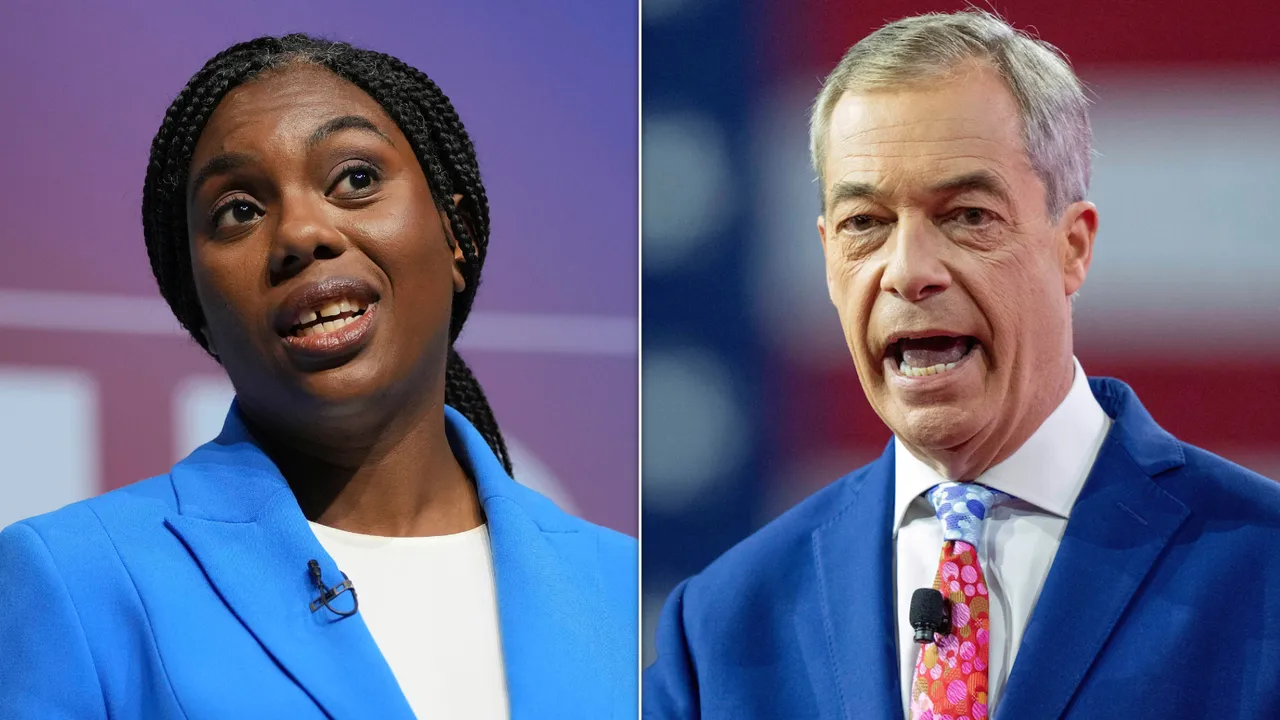
To be blunt, Kemi Badenoch and Nigel Farage have spent the week knocking lumps out of each other rather than training their guns on the government.
It began on Tuesday when the Reform UK used a press conference to paint the Tory hierarchy as a bunch of unrepentant Remainers, despite the fact that Badenoch herself voted Leave.
In a move which particularly irked the Conservative leader, he took aim at her husband, Hamish, who he described as a “well-known Remain campaigner”.
Hitting back in a video posted on X, Badenoch said: “My husband voted Remain, like 16 million people in this country, and I voted Leave.
“I know my own mind, I don’t need anybody telling me what to think – certainly not Nigel Farage.
“I don’t believe that politicians’ families are fair game, and neither does Nigel Farage. So why is he doing this? It’s because he’s now realised he’s never going to be prime minister.
“As he slides into irrelevance, his attacks on me get more and more personal, dragging my family into it.”
Farage then responded by accusing the Tory leader of being “angry about the wrong thing”.
He said: “She should be angry about [Burnham’s EU] deal and the sell-out, on that she said nothing.”
The Reform leader was speaking as he launched his “Keep Britain Out” campaign alongside fellow Brexiteer Arron Banks, a clear sign that he believes there is plenty of political mileage for him and his party in playing the old anti-EU tunes.
Farage even signed up to a list of 10 pledges, including keeping the UK out of the EU, opposing “mass immigration” and backing the farming and fishing industries.
A former Tory cabinet minister told HuffPost UK that the latest salvos in the civil war on the right of British politics are playing right into Burnham’s hands.
“Burnham’s tactic is obvious,” the veteran MP said. “He wants to unite the Remainers around him while dividing the Brexiteers.
“It could work for him, but it is a big gamble.”
A Reform UK insider agreed with some of that analysis, but insisted the PM has also presented Farage with an opportunity to turn around the party’s fortunes.
He said: “Burnham’s strategy is helping him cement a pro-EU caucus of voters, which gets him to 30-35% at a general election.
“But I do think it’s a lifeline for Reform as well, because it helps to frame that election as a straight fight between us and Labour.”
However, a senior Conservative said Farage’s decision to effectively re-run his Leave.EU campaign from a decade ago would not work – not least because one of his key MPs, former Tory minister Robert Jenrick, was a Remainer in 2016.
The source said: “It feels desperate. He’s only playing to the people who already support him. They’re not going to vote any other way so it’s just fodder for the faithful.
“Most normal people have no desire to fight the Brexit wars again and the performative pledge signing is so Trumpian it puts off most normal Tories.
“Plus, the heir apparent in Reform, Honest Bob, was a Remain supporter so any pointing of fingers leads to an ‘enemy of the people’ in his own camp.”
But another Conservative insider said Burnham’s fixation with the EU “provides an opportunity” for the parties on the right.
“Party politically, especially for the Conservatives, the debate does give a fresh chance to double down on their position on Europe and in particular, flush out the wets, like those pushing the clapped-out agenda of rejoining the EU,” they said.
Chris Hopkins, political research director for Savanta, said Burnham’s strategy could end up being a double-edged sword for his chances of re-election.
He said: “Anything Labour can do to reinforce divides on the right of British politics will only help them electorally, with opinion polling stubbornly split between Labour on the left and Reform and the Conservatives on the right.
“However, Labour may have its own Brexit divides, especially after regaining much of its Leave-leaning Red Wall at the last election.
“MPs in those seats, irrespective of their personal views on the EU, may not thank the prime minister for reigniting the Brexit debate, potentially alienating Leave voters in those seats that Labour needs to hold onto if it’s to have success at the next general election.”
A new poll this week put Labour eight points ahead of Reform and 10 in front of the Conservatives.
That would, according to one calculation, give Labour 372 seats at an election, with the Tories on 137 and Reform on 46.
Burnham’s flirtation with the EU does not come without political cost, but the electoral benefits appear pretty obvious too.
Listen to Commons People, the podcast that makes politics easy. Every week, Kevin Schofield and Kate Nicholson unpack the week’s biggest stories to keep you informed. Join us for straightforward analysis of what’s going on at Westminster.