After record-breaking temperatures swept the UK and Europe this year, it’s fair to say next summer will likely be even worse due to a climate phenomenon called El Niño.
The phenomenon develops every few years, and involves the eastern and central equatorial Pacific Ocean becoming hotter than normal, according to Professor Bill McGuire, a professor specialising in climate hazards.
An El Niño is declared when sea temperatures in the tropical eastern Pacific rise 0.5°C above the long-term average.
Yet forecasts predict sea surface temperatures will rise to more than 3°C in the coming months, peaking in December. Some forecasts suggest it might even reach nearer 4°C.
It means this year’s event is set to be the strongest in 1,000 years, the Guardian reported.
UN secretary general António Guterres has now warned that El Niño “is being supersized before our eyes”.
“The science leaves no room for doubt: the planet is in uncharted waters, and those waters are heating up,” he continued. “The world is in the danger zone of extreme weather. The race now is between rising risks and our commitment to take climate action and protect people. We must win that race.”
Back in August, Professor Adam Scaife, head of long range forecasting at the Met Office, called this year’s event “unprecedented”.
“I have never seen an El Niño signal this intense in our forecasts,” he said. “A typical El Niño leads to an equatorial Pacific sea-surface temperature rise of between 1-2 degrees, with 2C being a really big event.
“This implies that if the forecast is accurate – and other forecast systems show similar extreme values – then 2026 will far exceed our recent experience of El Niño and its worldwide climate influences.”
What will it mean for UK weather?
Globally, it is expected the world will see more floods, drought and extreme levels of heat which will continue into next year. It’s already been linked to a worsened monsoon season in India, as well as increased wildfires.
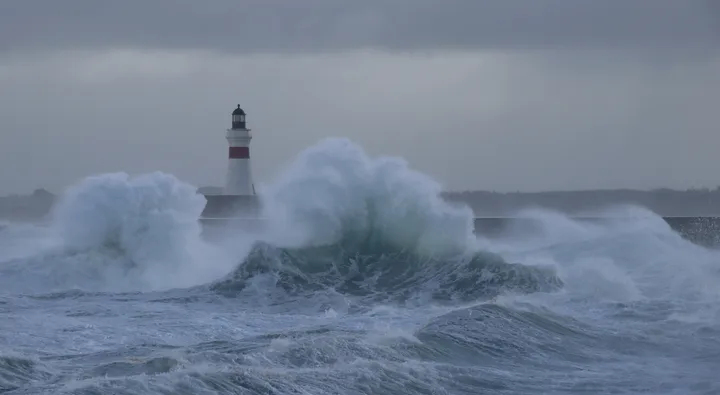
In the UK, the Met Office said it’s expected we’ll experience wetter, stormier conditions throughout autumn and winter.
This could mean flooding and strong winds are more likely which can, in turn, impact people’s homes, businesses and disrupt travel.
A strong El Niño was also recorded in 2015, which was linked to extreme flooding in the UK. You might remember that was the year of Storm Desmond.
Prof Hayley Fowler, Professor of Climate Change Impacts at Newcastle University, said “it is likely we will see similar storms [to Storm Desmond] this coming winter”.
Flash flooding is also a risk. Dr Akshay Deoras, of the National Centre for Atmospheric Science and Department of Meteorology at the University of Reading, suggested this is because after an exceptionally dry summer, dry soils can struggle to absorb intense rainfall.
“Heavy downpours could therefore run off quickly, increasing the risk of flash flooding, surface water flooding and disruption. Strong winds could also cause damage and put additional pressure on transport and infrastructure,” he said.
After an unbearably hot summer (the hottest ever in the UK, per the Met Office) which resulted in widespread drought, 2027 could also follow suit.
Dr Nick Dunstone, an expert in climate prediction, told the Met Office: “During large El Niño events, significantly more heat is released from the ocean to the atmosphere leading to an increase in global average temperature – particularly in the calendar year following the winter peak of the El Niño.
“Hence, 2027 is very likely to replace 2024 as the warmest year on record and be another year to temporarily exceed +1.5 C above the preindustrial period.”
In addition to weather impacts, there’s also a risk of El Niño impacting the UK’s food supply chain and energy security, said Professor Amanda Maycock, Joint Chair of the Met Office Academic Partnership and Professor of Climate Dynamics at University of Leeds.
“We should be preparing for imminent effects worldwide, including heavy rain and flooding in south-western US, East Africa and south-east China as well as drought in the Amazon basin, Southern Africa and eastern Australia,” she said.
“Although these seem like far flung places, these regions can affect what happens in the UK through global food supply and energy security.”
This might mean food and energy prices rise once more.