By Travis Andersen and Shelley Murphy, Globe Staff
Judge William Sullivan warned the parties after the jury exited that anyone who makes “inappropriate comments” would be ejected from the courtroom.
There would be no warnings or “yellow cards,” he said.
”You’re out” if you flout the directive, Sullivan said.
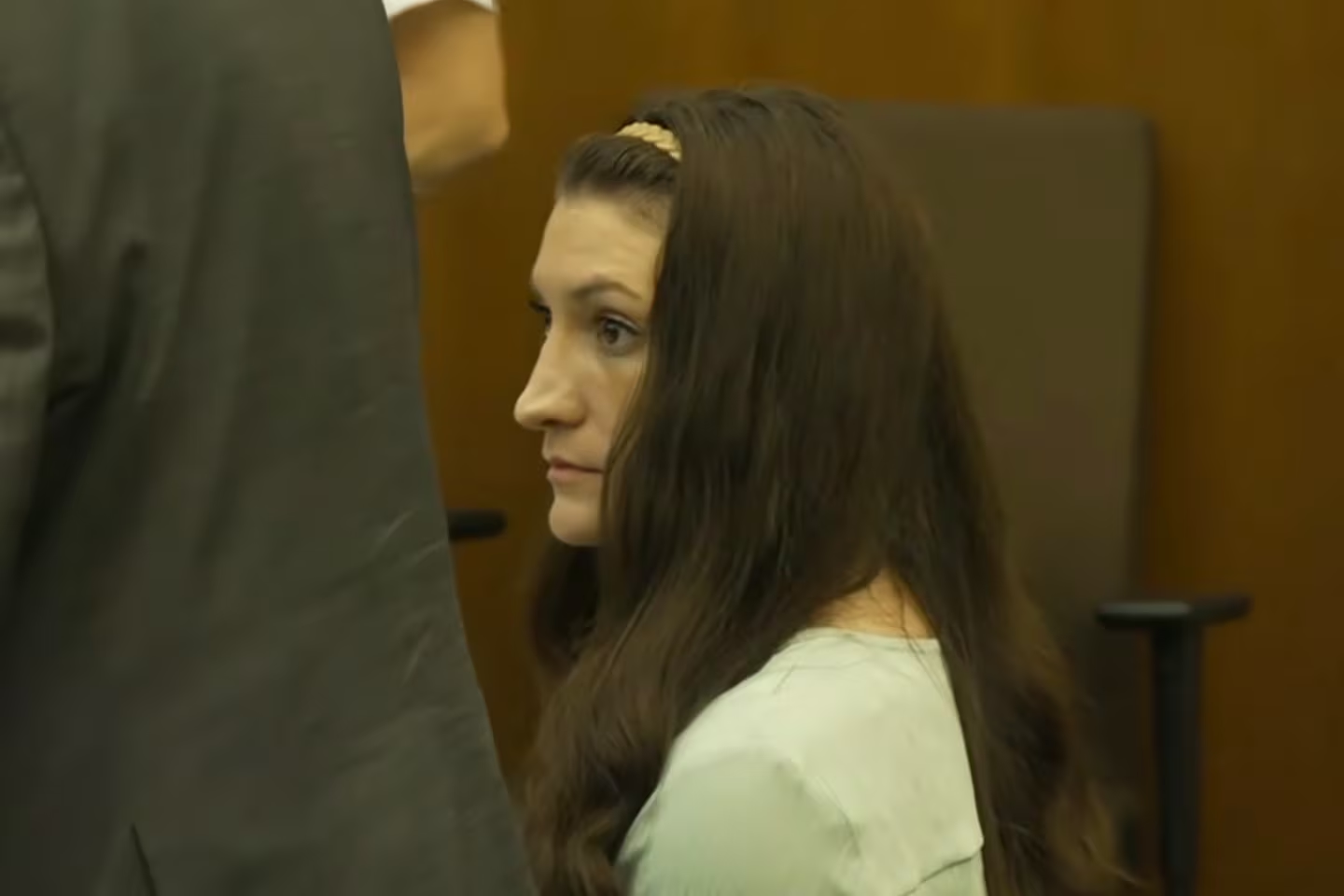
The warning came after Lindsay Clancy’s lawyer, Kevin Reddington, complained in open court, without the jury present, that a prosecutor was picked up on a hot mic by the video camera in the courtroom saying, “Shut her up,” referring to Clancy.
By Travis Andersen, Globe Staff
Dr. Jennifer Tufts said Clancy’s treatment goals included symptom reduction and improved functioning.
She said Clancy was reluctant to go on medication due to concerns over side effects.
After they discussed side effects, Tufts said, “she might have needed some time to think about” going on Zoloft.
Tufts said she initially diagnosed Clancy with a “generalized anxiety disorder” as well as “adjustment disorder with depressed mood.”
Judge Sullivan called a lunch recess at 1 p.m. Testimony resumes at 2 p.m.
Clancy registered for therapy, psychiatrist testifies — 12:56 p.m.
By Travis Andersen, Globe Staff
Dr. Jennifer Tufts said she initially prescribed Clancy 25 milligrams per week of Zoloft.
She also recommended Clancy enroll in therapy, which she did.
Tufts said she was the Aster provider in charge of Clancy’s treatment, which was informed in part by her records.
Tufts works with Aster Mental Health in Braintree and Peabody.
Clancy found Tufts through an online search, according to court documents.
Clancy began seeing Tufts in September 2022.
Clancy indicated her ‘biggest concern was about anxiety,’ psychiatrist testifies — 12:53 p.m.
By Travis Andersen, Globe Staff
Dr. Jennifer Tufts said she noticed nothing abnormal about Clancy’s movements during their first meeting, which lasted about an hour.
She said Clancy indicated her “biggest concern was about anxiety.”
Tufts said she recommended Clancy try Zoloft as part of her treatment.
“I recall that she was generally reluctant to take medications, but at this point she was considering it,” Tufts said.
Tufts said she recommended Zoloft because it’s a “first-line” med for anxiety as well as for women who are breastfeeding.
Clancy did not report hearing voices, psychiatrist testifies — 12:48 p.m.
By Travis Andersen, Globe Staff
Dr. Jennifer Tufts said Clancy denied hearing voices as well.
She said she assessed Clancy for additional factors, including judgment, insight, and orientation, or knowing where she was.
Clancy had no issues with any of those factors, or with her memory or ability to concentrate.
She said Clancy reported she felt “OK” during their first meeting, but Tufts felt she appeared anxious.
Clancy showed no signs of psychosis, psychiatrist testifies — 12:44 p.m.
By Travis Andersen, Globe Staff
Dr. Jennifer Tufts said she also assessed Clancy for signs of psychosis, such as a disheveled appearance, agitation, overly loud or fast speech, limited speech, disconnected thoughts, and paranoia.
She said she noted no signs of psychosis in Clancy.
Clancy indicated frequent feelings of hopelessness on patient questionnaire, psychiatrist testifies — 12:41 p.m.
By Travis Andersen, Globe Staff
Dr. Jennifer Tufts said Clancy’s patient questionnaire indicated “she should be assessed for depression,” since she indicated frequent feelings of hopelessness.
Tufts said her initial meeting with Clancy was a telehealth appointment, and patients can request to meet only in-person.
She said she asked Clancy if she had suicidal or homicidal intent, and Clancy denied both, and also denied auditory hallucinations.
Tufts said none of Clancy’s responses indicated that she had experienced any prior manic episodes.
Clancy reported having anxious thoughts ‘nearly every day,’ psychiatrist testifies — 12:37 p.m.
By Travis Andersen, Globe Staff
Dr. Jennifer Tufts said Clancy did not appear to “significantly” struggle with ADHD, and she didn’t suspect that she had that condition.
Another anxiety screening, Tufts said, was “highly suggestive of anxiety” and an “anxiety disorder.”
Clancy, she said, answered “nearly every day” when asked in the screening about various anxious thoughts.
Psychiatrist discusses Clancy’s reported symptoms — 12:33 p.m.
By Travis Andersen, Globe Staff
Dr. Jennifer Tufts said Clancy reported drinking one to two alcoholic drinks at a time, possibly five times per week.
Clancy indicated that she felt guilty about her drinking, Tufts said.
She also reported symptoms that included anxiety attacks, decreased appetite, being easily distracted, excessive worry, being unable to feel pleasure or fall asleep, and racing thoughts, Tufts said.
She said Clancy did not report any risky behaviors or impulsivity, nor did she report wanting to end her life or having a specific plan for suicide. Clancy also reported no access to weapons, and no prior suicide attempts.
She also said she did not hear voices telling her to hurt herself or others.
Dr. Jennifer Tufts discusses treatment of Clancy — 12:29 p.m.
By Travis Andersen, Globe Staff
Jennifer Tufts said she works as a psychiatrist at Aster Mental Health in Braintree.
She ran through her training and professional background before confirming that Clancy was among her patients, beginning in September 2022.
On Sept. 15, she said, they had their first appointment, and Clancy had filled out extensive paperwork regarding her medical and personal history.
The paperwork, Tufts said, “is fairly lengthy,” and Clancy completed it three days before her initial appointment.
Tufts said she learned from the records that Clancy had previously tried the medication Prozac, as well as Wellbutrin, while she was in nursing school with no side effects.
Next witness is Dr. Jennifer Tufts — 12:24 p.m.
By Travis Andersen, Globe Staff
Prosecutors next called Dr. Jennifer Tufts, one of the first medical professionals Clancy consulted as she struggled with increasing anxiety ahead of returning to work after the birth of Callan, her youngest child.
Psychiatrists ‘treat the patient in front of you,’ McLean doctor testifies — 12:22 p.m.
By Travis Andersen, Globe Staff
Dr. Alia Goodheart said postpartum depression and psychosis appear in the psychiatric diagnostic manual in sections related to bipolar issues.
She said providers rely on tools such as the manual, as well as patient observation and personal history and “other records if available.”
Her diagnosis does not have to agree with that of another provider’s, Goodheart said, adding that psychiatrists “treat the patient in front of you.”
McClean psychiatrist discusses blood tests, suicide hotline — 12:20 p.m.
By Travis Andersen, Globe Staff
Dr. Alia Goodheart said she didn’t evaluate Clancy’s blood for levels of medications.
She said Clancy was observed by nurses to have improved memory and concentration during her stay at McLean in early January 2023.
Goodheart said suicide hotlines assess for risk and try to “help [callers] through it.”
She said Clancy never indicated she had a plan to end her life.
Clancy’s sleep and mood improved during stay at McLean, psychiatrist testifies — 12:17 p.m.
By Travis Andersen, Globe Staff
Dr. Alia Goodheart, a psychiatrist at McLean Hospital, said she observed Clancy’s symptoms for multiple days, and that her sleep and mood improved.
Goodheart said “no” when asked if she had enough time to determine the root causes of Clancy’s insomnia and other issues.
She said she doesn’t always ask patients to sign releases for prior medical records, basing that decision on how reliable a patient appears.
“She was telling us what she liked and what she disliked about what the [prior] providers were doing,” Goodheart said.
McLean psychiatrist testifies that Clancy was deemed a low safety risk at time of her discharge in early January 2023 — 12:14 p.m.
By Travis Andersen, Globe Staff
On redirect examination by the government, Dr. Alia Goodheart discussed Clancy’s discharge packet, with numbers for if she needed any immediate help, as well as additional instructions for follow-up care.
Clancy “stated that she was going to be assigned a therapist” by the South Shore Hospital staff.
The discharge packet also contained information for additional community resources that would be available to Clancy, Goodheart said.
Goodheart said Clancy participated in group sessions at McLean Hospital, but Sullivan sustained a defense objection when she was asked about the specific themes of the sessions.
Goodheart said Clancy was deemed a low safety risk.
McLean psychiatrist returns to stand after break, testifies that Clancy’s discharge was not against medical advice — 12:11 p.m.
By Travis Andersen, Globe Staff
Following the sidebar, the jury returned and Dr. Alia Goodheart got back on the stand to continue her cross-examination.
Goodheart told Kevin Reddington that Clancy’s discharge from McLean was not against medical advice.
Clancy, she said, was urged to follow up with outside providers, and Clancy “made an appointment with Dr. [Jennifer] Tufts” soon after.
Clancy lawyer complains about hot mic moment — 12:07 p.m.
By Shelley Murphy, Globe Staff
Lindsay Clancy’s lawyer, Kevin Reddington, complained in open court, without the jury present, that a prosecutor was picked up on a hot mic by the video camera in the courtroom saying, “Shut her up,” referring to Clancy.
Judge Sullivan ordered him to come to a sidebar, and Reddington pushed back, saying he wanted it on the public record. But the judge ordered all of the parties to a sidebar, and no more information was shared with those sitting in the spectator section.
Clancy’s lawyer raises issue with judge — 12:06 p.m.
By Travis Andersen, Globe Staff
Following the morning break, Kevin Reddington said he wanted to “raise an issue” with Judge William Sullivan, who called the parties to a sidebar.
Reddington said he didn’t want to go to a sidebar, and Sullivan, his voice rising, said, “I need to know what you’re going to talk about.” He said there are “privileged issues” that must be discussed at a sidebar.
The parties then came to a sidebar.
Psychiatrist faces aggressive questioning from Lindsay Clancy’s defense attorney, raising issues central to the case — 12:02 p.m.
By Lea Skeane and Shelley Murphy, Globe Staff
The first psychiatrist to take the stand, Dr. Alia Goodheart, came under intense questioning from defense attorney Kevin Reddington, who suggested McLean Hospital staff should have done more to obtain a fuller picture of Clancy’s mental state and psychiatric history before they discharged her in early January 2023.
The exchange, which in many ways analyzed issues at the heart of the case, raised significant questions about how psychiatric providers interact with, diagnose and treat their patients.
“You ever heard of patients that minimize their symptoms and lie about their symptoms sometimes?” Reddington asked as the doctor’s testimony stretched into its second hour Friday morning.
Goodheart said providers also consider body language and other factors to get a sense of whether someone is lying. But ultimately, she said, patients are “going to tell us what is bothering them and what they’re concerned about. That’s why they’re in the hospital.”
Goodheart said she believed Clancy was accurately representing her medical and psychiatric histories.
“Lindsay was cooperative and she was forthcoming,” she said. “I had no reason to believe that she was not a reliable reporter.”
The doctor’s statements came in response to questions from Reddington about whether psychiatric patients sometimes misrepresent their diagnoses, symptoms, and more. He also questioned what steps McLean staff had taken to access Clancy’s medical records and verify the information she provided.
Other than what McLean staff learned from talking to Clancy and calling her husband, Patrick, “what, if any, investigation did you do?” Reddington asked.
In addition to her verbal statements, providers would consider “how she presents, how she’s observed,” Goodheart replied.
“So you’re suggesting to this jury that it’s not a valid medical step … to take blood from a person who is on a cocktail of drug medications to find out what their levels are?” Reddington said.
Goodheart responded that it’s “not a regular procedure at all.”
“Psychiatry as a field is not dependent on blood tests,” she said, musing if only “it was that simple.”
McLean psychiatrist faces sharp questioning from Clancy’s lawyer — 11:35 a.m.
By Travis Andersen, Globe Staff
Alia Goodheart told Kevin Reddington that McLean Hospital did not use the Edinburgh Postnatal Depression Scale when assessing Clancy.
“The psychiatrist makes the diagnoses” based on a patient’s presentation, Goodheart said. “We did not do any additional collateral contact” besides contacting her then-husband, Patrick, she said.
She told Reddington that McLean did test Clancy’s blood, but “there was no testing” for prescription drug levels in her system.
She said there were no substances of abuse in Clancy’s blood.
“Medications have different half-lives,” she said, noting that some prescriptions she had been taking may have been out of her system when she arrived at McLean.
Reddington read from a medical record at McLean indicating that Clancy had said she was hoping to make it home for her daughter’s birthday, and that Callan wasn’t taking his bottle around the time she was scheduled to go back to work.
The record also noted Lindsay’s “situational anxiety” that Dr. Jennifer Tufts had prescribed Zoloft for, leading to her insomnia within a week.
“It could be a side effect, yes,” Goodheart said.
She said the records indicate that Clancy had been told to discontinue the Zoloft.
Judge William Sullivan called a morning recess around 11:35 a.m.
Clancy lawyer presses psychiatrist on how postpartum psychosis is categorized — 11:26 a.m.
By Lea Skeane, Globe Staff
During his questioning of McLean psychiatrist Alia Goodheart, defense attorney Kevin Reddington held up a copy of the Diagnostic and Statistical Manual of Mental Disorders, which is published by the American Psychiatric Association, and asked her about its contents pertaining to postpartum conditions.
Goodheart said she believed postpartum depression was included as a subcategory of depression. She said she didn’t recall whether postpartum psychosis is listed.
She said she was “vaguely” aware of discussions about including postpartum psychosis in the next edition of the manual and where it should be categorized.
McLean psychiatrist testifies that postpartum symptoms can last weeks to up to a year — 11:25 a.m.
By Travis Andersen, Globe Staff
Alia Goodheart told Kevin Reddington that she uses guidelines in a diagnostic manual for forming diagnoses of patients.
She said she believes postpartum depression is a “subcategory” of depression in the manual, and that she’s unclear about references in the manual to postpartum psychosis.
She said various medical organizations say postpartum symptoms can last anywhere from weeks to up to a year.
Goodheart told Reddington that “it’s clear that there is [a] question about where” postpartum psychosis should be categorized in the upcoming addition of the diagnostic manual.
She said “the thyroid can affect one’s mood and anxiety, whether one is pregnant or not.”
Thyroid levels, she said, are a “tiny component” of an overall assessment, and that Clancy’s levels were “at the normal limit” based on prior screenings she had undergone, according to her medical records.
McLean psychiatrist testifies that she hasn’t treated anyone with postpartum psychosis — 11:17 a.m.
By Travis Andersen, Globe Staff
Alia Goodheart told Kevin Reddington that Clancy had previously stopped taking Zoloft.
“Because she wasn’t able to sleep and she discussed it with Dr. Tufts,” Goodheart said. Jennifer Tufts was one of the first medical professionals Clancy consulted.
Goodheart said she doesn’t think she’s treated any patients suffering from postpartum psychosis. She said she couldn’t say how many patients she’s treated with postpartum depression over the last 20 years.
Clancy was struggling with anxiety and sleep troubles, McLean psychiatrist testifies — 11:14 a.m.
By Travis Andersen, Globe Staff
McLean Hospital psychiatrist Alia Goodheart told Kevin Reddington that Clancy was also “struggling with anxiety” and “wasn’t able to sleep.”
She said staff could observe her sleep on the unit.
Goodheart said she would have wanted to observe her sleep if she were continuing to monitor her once she left the unit.
Goodheart said she’s aware patients sometimes minimize or lie about their symptoms.
She said staff reached out to Patrick Clancy for corroboration of what Lindsay reported, and that providers assess factors beyond a patient’s words, such as their body language.
Reddington asked if Clancy was “very sick” at McLean, and Goodheart said she didn’t know what he meant by that characterization.
She said records indicated Clancy had previously reported intrusive thoughts of suicide, as well as being foggy mentally.
Goodheart said Clancy did not describe herself as feeling like a zombie while at McLean.
McLean psychiatrist said she was aware of Clancy’s struggles with ‘suicidal ideation’ — 11:09 a.m.
By Travis Andersen, Globe Staff
Alia Goodheart told Kevin Reddington that she wasn’t aware if Clancy had undergone any prior psychological testing.
She also told Reddington she didn’t know how many times Clancy had contacted a suicide hotline.
Goodheart said she did know Lindsay struggled with “suicidal ideation.”
She told Reddington she didn’t know Lindsay had twice called a suicide hotline.
Goodheart also said she didn’t recall Clancy specifying that she’d gone 48 hours without sleep after initially going on Zoloft.
McLean psychiatrist said she had ‘no reason to believe’ that Clancy wasn’t representing her medical history accurately — 11:06 a.m.
By Lea Skeane, Globe Staff
Alia Goodheart said she believed Clancy was accurately representing her medical and psychiatric histories.
“Lindsay was cooperative and she was forthcoming,” Goodheart said. “I had no reason to believe that she was not a reliable reporter.”
The doctor’s statements came in response to questions from Kevin Reddington about whether psychiatric patients sometimes misrepresent their diagnoses, symptoms, and more. He also questioned what steps McLean staff had taken to access Clancy’s medical records and verify the information she provided.
McLean psychiatrist testifies about Clancy’s Zoloft dosage — 11:05 a.m.
By Travis Andersen, Globe Staff
Alia Goodheart told defense lawyer Kevin Reddington that it depends on individual cases when determining whether Zoloft is appropriate for bipolar issues.
She said Clancy was “forthcoming” at McLean, so she assumed she would disclose what she’d been prescribed previously.
She said Clancy indicated that Dr. Jennifer Tufts had increased her Zoloft dosage from 25 milligrams to 50 milligrams.
Goodheart said she “had no reason to believe” that Clancy “was not a reliable reporter.”
McLean psychiatrist says she ‘wouldn’t know’ why Clancy saw previous doctor — 11:02 a.m.
By Travis Andersen, Globe Staff
Alia Goodheart told Kevin Reddington that Clancy was on “Seroquel and Valium” when she first arrived at McLean.
Goodheart said she “wouldn’t know” why Clancy previously saw Dr. Jennifer Tufts, who initially prescribed her the antidepressant Zoloft.
Tufts was one of the first medical professionals Clancy consulted as she struggled with increasing anxiety ahead of returning to work after the birth of her third child, Callan, in May 2022.
Patrick Clancy voiced displeasure with care his wife had received before McLean, psychiatrist testifies — 11:00 a.m.
By Travis Andersen, Globe Staff
Alia Goodheart told Kevin Reddington “there’s a full psychiatric evaluation” when patients arrive on the unit, including medication history and family history and a patient’s “chief complaint,” among other factors.
Goodheart said she reviewed multiple sources including Clancy’s admission notes at McLean.
Goodheart said a social worker “contacted Patrick” about his wife when she was initially admitted, and that he had voiced displeasure with the care she had previously received.
She said Clancy was highly cooperative at McLean; no one asked her to sign a release to allow staffers to obtain her medical records from prior providers, Goodheart said.
McLean psychiatrist testifies under cross-examination — 10:53 a.m.
By Travis Andersen, Globe Staff
Alia Goodheart told defense lawyer Kevin Reddington that Clancy was provided information upon discharge about a website for locating psychiatric providers, as well as the contact information for a case manager who could help her find providers.
Goodheart said “the fact that she had a case manager at Blue Cross & Blue Shield” was an “added benefit,” since the manager could help her locate doctors.
Goodheart said Clancy was a voluntary patient at McLean; she was not ordered committed there by a judge.
Goodheart said she couldn’t speak to staffing levels on the McLean unit around the New Year’s holiday, when Clancy was admitted.
Alia Goodheart told defense lawyer Kevin Reddington that psychiatrists on the McLean unit “are not assigned shifts” like other support staff.“
She met [with] two psychiatrists on Jan. 1,” Goodheart said.
Psychiatrist describes Clancy’s discharge from McLean Hospital — 10:47 a.m.
By Travis Andersen, Globe Staff
Alia Goodheart said Lindsay Clancy was discharged on the afternoon of Jan. 5, 2023.
Clancy told a social worker she felt comfortable managing at home, and that she was provided with outside resources that could offer help.
Goodheart said she prescribed 14-day supplies of Ativan and Trazodone upon her discharge.
Clancy denied wanting to commit suicide, having a plan to kill herself, or having thoughts of harming others upon discharge, Goodheart said.
Clancy was ‘future-oriented’ and ‘a caring mother,’ psychiatrist testifies — 10:43 a.m.
By Travis Andersen, Globe Staff
Alia Goodheart said Clancy was “future-oriented” and a “caring mother” and had family support, all factors that led her to believe she was safe for discharge.
She said Clancy had no history of suicide attempts.
Clancy “had never stated that she had any thoughts of harming anyone else” while at McLean, she said.
Goodheart said she “assumed she would take what I had prescribed,” noting that Clancy remained on Ativan and had access to Trazodone as needed.
She said she was aware Patrick Clancy had told a social worker that he felt his wife was taking medications due to social pressure, since many of her friends were on such drugs.
McLean Hospital psychiatrist testifies she ‘did not have any concerns’ about Clancy’s safety or as risk to others — 10:38 a.m.
By Travis Andersen, Globe Staff
Alia Goodheart said she wanted Clancy to have a psychiatric follow-up to assess her thinking and related issues.
Clancy was able to schedule a follow-up appointment with a provider herself on Jan. 4, Goodheart said.
She said the plan was for Clancy to continue tapering off the Seroquel, and that she was also on Ativan and Trazodone, which can also be used as a sleep aid.
Goodheart said she “did not have any concerns about her safety or a risk for anybody else.”
McLean psychiatrist said she considered postpartum issues as a potential factor in Clancy’s condition — 10:35 a.m.
By Travis Andersen, Globe Staff
Alia Goodheart said she considered postpartum issues as a potential factor in Clancy’s condition.
Following that meeting, Goodheart said, “I gave her a diagnosis of insomnia with a mental health” condition. She said she didn’t have enough information after the initial meeting to further diagnose the condition.
Also on Jan. 3, Goodheart said, Clancy met with a social worker and a nurse.
She also participated in group sessions that day and met with other mental health workers, but declined a third group session in the evening, Goodheart said.
McLean psychiatrist testifies about Clancy’s medication — 10:30 a.m.
By Travis Andersen, Globe Staff
Alia Goodheart, a psychiatrist who treated Clancy at McLean, said she suggested Clancy begin taking Cymbalta, an antidepressant, after she came off Seroquel.
She said she also “switched” Clancy from Valium to Ativan, which “in my experience … manages anxiety well.”
Clancy also indicated that her husband was concerned about her being on a benzodiazepine medication.
Goodheart said she detected no signs of psychosis at the time.
McLean psychiatrist testifies that she was monitoring Clancy for potential bipolar disorder — 10:28 a.m.
By Travis Andersen, Globe Staff
Alia Goodheart said Clancy also mentioned that she was hoping to attend an upcoming family birthday party.
She said she was also monitoring Clancy for potential bipolar disorder.
“Sleep is important” for people struggling with such issues, she said. “Sleep deprivation can lead to … a hypomanic episode.”
Clancy indicated she had no plan to end her life, psychiatrist testifies — 10:25 a.m.
By Travis Andersen, Globe Staff
McLean psychiatrist Alia Goodheart said Clancy repeatedly used the phrase “numbness” when they met on Jan. 3, 2023.
Numbness can be one of the side effects of Seroquel, an antipsychotic medication Clancy was taking, she said.
Goodheart said Clancy indicated she had no plan to end her life, due to “her children” and “her mother.”
Goodheart said she continued the plan to taper Lindsay off Seroquel and “to really observe symptoms and mood.”
McLean psychiatrist describes meeting with Clancy on Jan. 3, 2023 — 10:23 a.m.
By Travis Andersen, Globe Staff
Alia Goodheart said that Clancy appeared “anxious” when they spoke on Jan. 3, and that her affect appeared to match her mood.
Her thinking also appeared to be linear and goal-oriented, Goodheart said.
“She did not want to be dependent on an antipsychotic medication … to be able to fall asleep,” Goodheart said.
One of Clancy’s providers suspected she had bipolar disorder, McLean Hospital psychiatrist testifies — 10:21 a.m.
By Travis Andersen, Globe Staff
Alia Goodheart said one of Clancy’s providers had suspected bipolar disorder.
“She disagreed with the diagnosis,” Goodheart said.
One of the drugs Clancy was on is used for “several purposes” besides treating bipolar, such as treating insomnia, she said.
Goodheart’s colleague had recommended reducing that drug and monitoring the symptoms. Her colleague saw Clancy again on Jan. 2., she said.
On that day, she said, Clancy reported she slept well on a lesser dose of the drug and reported no suicidal or homicidal ideation.
Her colleague, Goodheart said, planned to continue reducing dosages of the drug.
Nurses also interacted with Clancy repeatedly on Jan. 1, and she also participated in a group program, Goodheart said.
She had additional interactions with health providers on Jan. 2, Goodheart said, and she met her face-to-face for the first time on Jan. 3.
“She was appropriately dressed, her speech was of normal rate and volume,” Goodheart said, adding that Clancy was polite and cooperative.
Clancy had been diagnosed with ‘major depressive disorder,’ McLean psychiatrist testifies — 10:15 a.m.
By Travis Andersen, Globe Staff
Alia Goodheart said Clancy’s records indicated she had been diagnosed with “major depressive disorder.”
On Jan. 1, a different psychiatrist saw Clancy, Goodheart testified.Goodheart said Lindsay denied suicidal thoughts on Jan. 1 but reported feeling numb, according to her colleague’s notes from that day.“
One of the things she did complain about was the numbness” linked to her medications, Goodheart said.
Clancy was considered a low or minimal safety risk at McLean Hospital, psychiatrist testifies — 10:10 a.m.
By Travis Andersen, Globe Staff
Alia Goodheart said Clancy’s records indicated thoughts of wanting to be dead but no plan to end her life.
She said the records indicated no signs of psychosis.
Goodheart said records showed that Clancy began having intrusive and suicidal thoughts in December 2022 that she attributed to her medication.
Clancy was considered to be a “low” or “minimal” safety risk at McLean, she said.
Psychiatrist describes interaction with Lindsay Clancy at McLean — 10:05 a.m.
By Travis Andersen, Globe Staff
Alia Goodheart said she saw Clancy, who had been referred to McLean by MGH, in the in-patient unit in early January 2023.
Clancy went through an in-patient process when she arrived at McLean around 4 a.m. on Jan. 1, Goodheart said.
She said Clancy was identified at the time as medically stable; her chief complaint was that “she was … finding it hard to sleep if she didn’t take medications.”
Goodheart said Clancy also reported feeling numb and battling side effects of her medications.
Psychiatrist on stand is defendant in Lindsay Clancy’s malpractice lawsuit — 9:59 a.m.
By Lea Skeane, Globe Staff
Alia Goodheart was the attending psychiatrist who authored and signed Lindsay’s physician discharge summary on January 5, 2023, following her five-day inpatient admission to McLean Hospital, according to legal filings.
Goodheart is also a named defendant in Lindsay Clancy’s medical malpractice lawsuit filed in January.
After her discharge from McLean Hospital on Jan. 5, 2023, after a five-day voluntary stay, Goodheart “called Lindsay and spoke for only 10 minutes, offering names of antidepressants,” the lawsuit alleges.
“The staff at McLean suggested Amitriptyline — yet another antidepressant, the very class of medications that had repeatedly caused Lindsay to have adverse reactions,” the complaint says.
After her discharge, Clancy felt like there was “not much hope” because she had just been in the “best hospital in the country,” so she “decided she must appear like she was OK” and tried to “do her best,” she alleged in the complaint.
Psychiatrist who treated Clancy at McLean Hospital testifies about in-patient unit — 9:54 a.m.
By Travis Andersen, Globe Staff
Alia Goodheart, a doctor at McLean Hospital where Clancy was voluntarily committed for four days weeks before the killings, said she worked in the in-patient psychiatric unit there.
Goodheart said the different medical providers in the unit care for patients under a “team approach.
”The in-patient unit takes referrals from surrounding emergency departments, she said.
“You can come voluntarily or you can be sent involuntarily,” she said of the patient population in the unit.
Nurses, mental health workers, and social workers also work on the unit, Goodheart said.
Psychiatrist discusses her work history — 9:46 a.m.
By Travis Andersen, Globe Staff
Alia Goodheart said she’s worked in several different settings including at Beth Israel.
She said she has also worked in the in-patient psychiatric unit at Emerson Hospital, the state women’s prison in Framingham, and McLean Hospital, among other places.
Psychiatrist called to stand — 9:44 a.m.
By Travis Andersen, Globe Staff
Prosecutors next called Dr. Alia Goodheart, a psychiatrist.
Family friend testifies on cross-examination — 9:42 a.m.
By Travis Andersen, Globe Staff
Sarah Carney said the Clancy family left the bonfire gathering because “I think it was … nap time with the kids.”
She told defense lawyer Kevin Reddington on cross-examination that she has a “social” relationship with Lindsay Clancy.
She said she saw Lindsay Clancy alone in fall of 2022 “just the one time at drop-off.”
Carney said the bonfire was held around lunchtime, and the Clancys stayed for a few hours.
Lindsay appeared quieter and thinner that day, Carney told Reddington.
Family friend discusses Lindsay Clancy’s demeanor two days before killings — 9:39 a.m.
By Travis Andersen, Globe Staff
Sarah Carney said she recalled Lindsay Clancy posting exercise videos from the home.
Her other children were observed “playing with toys” in the background of the video.
Carney said she may have indicated previously that she observed the children playing with exercise bands “if that’s what I said.”
In the fall and winter of 2022, she said, she noticed at one point that Lindsay Clancy appeared thinner, but that they never discussed postpartum issues or sleep problems.
Two days before the killings, she said, she and her husband hosted a bonfire at their home with Patrick, Lindsay, Cora, and Dawson.
“Just quiet but fairly normal,” she said of Lindsay’s demeanor that day.
She said she asked Lindsay how she was doing at one point, and she said, “good.”
Friend of Patrick Clancy takes stand — 9:35 a.m.
By Travis Andersen, Globe Staff
Prosecutors next called Sarah Carney, a Duxbury resident who along with her husband, Kyle, went to college with Patrick Clancy.
Sarah and Kyle are both friends of Patrick, she said.
Carney said she first met Lindsay “a few years after college.”Carney said she also became friendly with Lindsay Clancy.
She said her family and the Clancy family went to the beach together and went to one another’s houses to socialize.
She said she noticed no changes in Lindsay after the births of Cora and Dawson and Callan.
Clancy ‘seemed happy to be with her children,’ former sports club employee testifies — 9:31 a.m.
By Travis Andersen, Globe Staff
Kimberlee Hardy told Clancy’s lawyer Kevin Reddington on cross-examination that she “seemed happy to be with” her children whenever she saw them.
“She always picked them up on time,” Hardy said.
She told Reddington she’s aware people are sometimes urged to work out for health reasons.
Former sports club employee testifies about interaction with Clancy family in January 2023 — 9:30 a.m.
By Travis Andersen, Globe Staff
Kimberlee Hardy said Lindsay Clancy had workout gear on when she dropped off her children and was never late picking them up.
She said she last saw Lindsay Clancy and her two oldest children in January 2023, and they were “just their usual selves.” She said Cora and Dawson were dropped off on the mornings of Jan. 13 and Jan. 17 of 2023.
That was about a week before the children were killed.
“They liked to color, they would play with the dolls” and other toys, Hardy said.
Former sports club employee testifies about Clancy family — 9:27 a.m.
By Travis Andersen, Globe Staff
Kimberlee Hardy said there’s a two-hour time limit for children being in the playroom.
She said she often saw Cora and Dawson Clancy at the playroom, and Patrick Clancy mainly picked them up, but Lindsay Clancy sometimes did also.
“She just seemed very shy,” Hardy said of Lindsay Clancy. “Just shy.”
She said she asked why Callan didn’t come to the playroom, and Lindsay Clancy told her “she was nervous about colds, because it was cold and flu season.”
Former athletic club employee discusses drop-off policy — 9:25 a.m.
By Travis Andersen, Globe Staff
Kimberlee Hardy said parents sign in at the club and can drop their children off in the playroom while they work out.
She said parents have to remain at the club, which includes a gym, pool, and spa, while their children are in the playroom.
A camp program and swim lessons are also available for children, she said.
Former employee of sports club that Clancy family visited called to stand — 9:23 a.m.
By Travis Andersen, Globe Staff
Prosecutors next called Kimberlee Hardy, a former employee of an athletic club in Kingston that also has a playroom for children.
Jury enters the courtroom — 9:20 a.m.
By Travis Andersen, Globe Staff
Following a brief sidebar conference, the 18 jurors were led into the courtroom.
Six will serve as alternates once deliberations start. Judge William Sullivan ran through his standard questions to ensure jurors watched no outside coverage of the case overnight.
Sullivan also told jurors that the “intention” is to hear testimony for “most of the day.”
By Travis Andersen, Globe Staff
Lindsay Clancy and attorneys on both sides entered the courtroom around 9:15 a.m. before the jury was brought in.
Judge William Sullivan called the lawyers to a sidebar.
In a case like Clancy’s, jurors may carry emotional toll long after the verdict — 8:50 a.m.
By Emily Spatz, Globe Staff
Those assigned to especially grisly or high-profile cases, like the trial of Lindsay Clancy, can carry the psychological effects long after the trial concludes. But the support available to help them process varies by jurisdiction and is sometimes limited, experts said.
“It’s a high price to pay for doing your civic duty,” said Harold Bursztajn, a psychiatrist and associate professor at Harvard Medical School.
Who is Dr. Jennifer Tufts, one of the first psychiatrists to treat Lindsay Clancy postpartum? — 8:21 a.m.
By Sarah Rahal, Globe Staff
Prosecutors on Friday could potentially call Dr. Jennifer Tufts, one of the first medical professionals Clancy consulted as she struggled with increasing anxiety ahead of returning to work after the birth of her third child, Callan, in May 2022.
The extensive list of psychiatric medications Clancy was prescribed in the months leading up to the deaths of her three children has drawn public attention to the medical professionals who oversaw her care.
Several witnesses could be called to testify about those medications beginning Friday, the ninth day of trial, including Tufts.
Here’s how Thursday’s testimony unfolded — 8:03 a.m.
By Travis Andersen and Jenna Reyes, Globe Staff
On Thursday, the jury heard from Lindsay Clancy’s former father-in-law, her ex-colleagues and friends, and several people who cared for the Clancy children.
Chris Clancy, the father of Lindsay’s former husband Patrick Clancy told the court that Lindsay was a “loving and caring mother,” echoing testimony from previous witnesses in the trial.
Lindsay Clancy trial: Ex-father-in-law testifies that he knew she was struggling
Lindsay’s former colleagues and friends testified that Lindsay had expressed to them that she was in a “difficult mental place,” feeling “tired and anxious,” and receiving psychiatric care.
Lindsay Clancy trial: Ex-coworkers say she spoke of brain fog, sleep trouble
The Clancy children’s former pediatrician and several of their former preschool teachers also took the stand and described Lindsay as a loving mother who did not show obvious signs that she was struggling. The former pediatrician treated the oldest Clancy child on the day she was found dead.
Travis Andersen can be reached at travis.andersen@globe.com. Jenna Reyes can be reached at jenna.reyes@globe.com. Follow her @jennaelaney and Instagram @jennaelaney. Lea Skene can be reached at lea.skene@globe.com. Follow her on X @lea_skene.