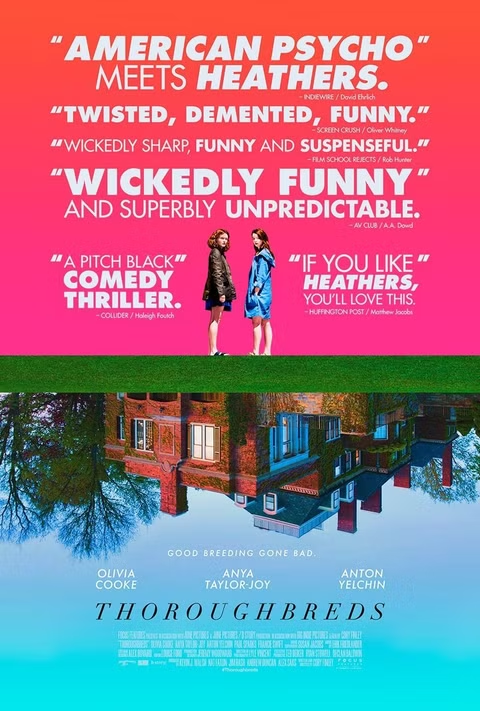
Anya Taylor-Joy burst onto the scene in a spell-binding performance that no one is likely to forget for some time. Robert Eggers’ feature film debut, The Witch, showcased the performer’s talents, and she instantly rose to the top. Roles in Furiosa and Dune: Part Two have defined her career thus far, but there may be one movie that passed viewers by. In 2017, Taylor-Joy co-starred with House of the Dragon’s own Olivia Cooke in a crime thriller unlike anything else.
Throughbreds was a directorial first for Cory Finley and is utterly unique. Many creatives have attempted to pull off psychopathic teenage girls in the past, but this attempt was startling and extremely specific. The characters in the mystery aren’t caricatures but fleshed-out people who just happen to be in an extremely heightened story.
‘Thoroughbreds’ Captures the Viciousness of Teenage Girlhood
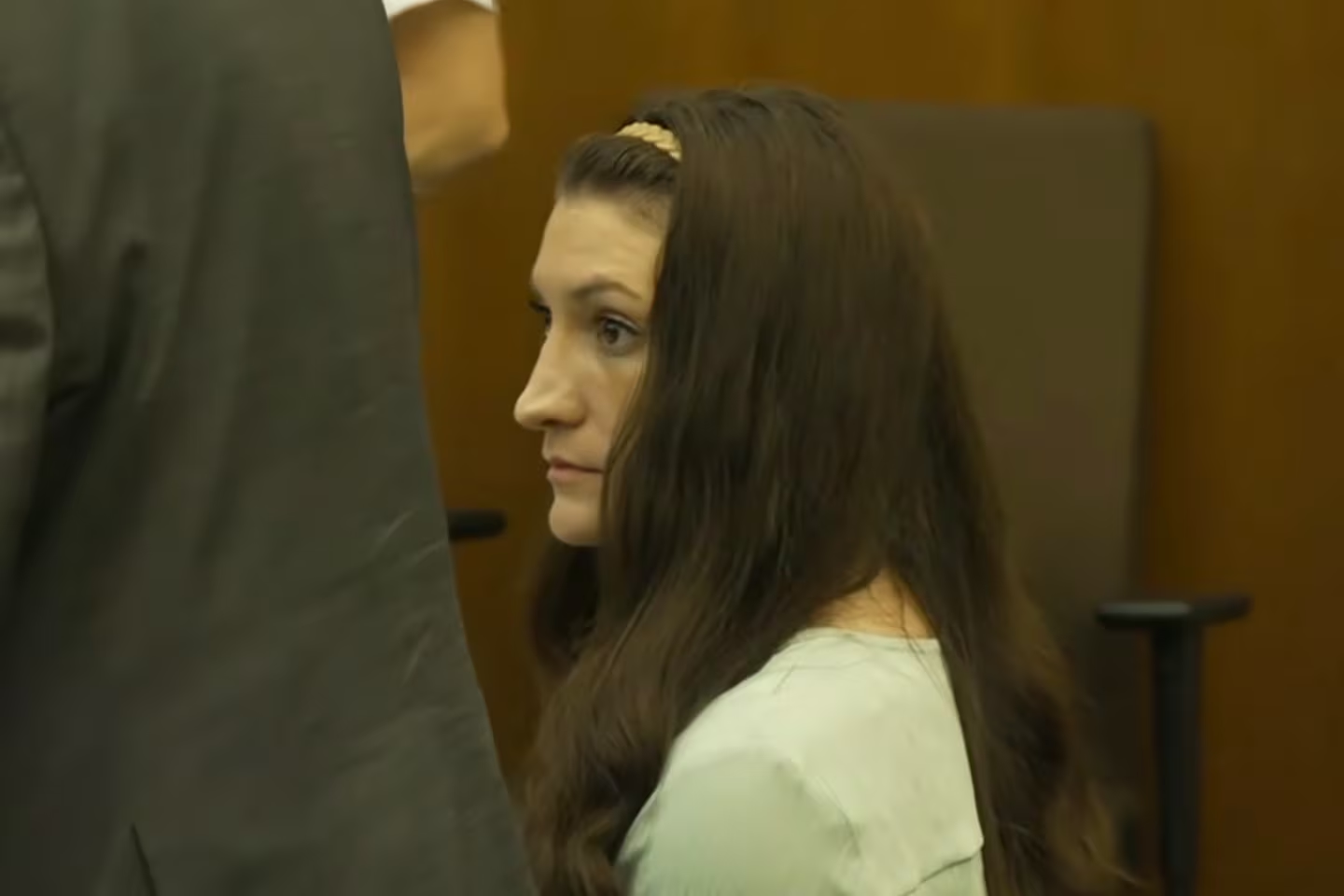
Cory Finley is one of the rare male directors who writes female characters who are complex and believable. Only comparable to Ari Aster’s depiction of Dani Arbor (Florence Pugh) in Midsommar. Finley also portrays women not just as set pieces or vehicles for plot, but in their complex and sometimes terrible glory. Thoroughbreds’ entire concept depends on how difficult these girls are, and it pulls it off spectacularly.
The narrative is a thrilling mystery about two teenage girls in the upper-class of suburban Connecticut. Lily (Anya Taylor-Joy) is a popular student who agrees to tutor an outcast, Amanda (Olivia Cooke). Because of a mental disorder, Amanda has no emotions, but she and Lily find common ground and form a tight bond. When Amanda suggests they kill Lily’s abusive stepfather, Mark (Paul Sparks), the affluent girl is disturbed, but it doesn’t take long for her to come around to her line of thinking.
Mark enrolls Lily in a boarding school for girls with behavioral issues, putting a ticking clock on the plan. The tight, 93-minute film wastes no time in establishing the stakes for these characters and showing the unbreakable and sometimes inscrutable bond between teenage girls. Unlike similar dark fare such as Heathers, which leans more into comedic territory, Thoroughbreds relishes the darkness of female friendships. This bond leads up to an ending that has to be seen to be believed.
Collider Exclusive · Horror Survival Quiz Which Horror Villain Do You Have the Best Chance of Surviving? Jason Voorhees · Michael Myers · Freddy Krueger · Pennywise · Chucky
Five killers. Five completely different ways to die — if you’re not smart enough, fast enough, or self-aware enough to avoid it. Only one of them is the villain your particular set of instincts gives you a fighting chance against. Eight questions will figure out which one.
🏕️Jason
🔪Michael
💤Freddy
🎈Pennywise
🪆Chucky
01
Something feels wrong. You can’t explain it — you just know. What do you do? First instincts are the difference between the survivor and the first act casualty.
Where are you most likely to find yourself when things go wrong? Setting is everything in horror. Where you are determines which rules apply.
03
What is your most reliable survival asset? Every survivor has a quality the villain didn’t account for. What’s yours?
04
What kind of fear is hardest for you to fight through? Knowing your weakness is the first step to not dying because of it.
05
You’re with a group when things start going wrong. What’s your role? Horror movies are brutally clear about who survives group situations and who doesn’t.
06
What’s the horror movie mistake you’re most likely to make? Honest self-assessment is a survival skill. Denial is not.
07
What’s your best weapon against something that can’t be stopped by conventional means? Every horror villain has a weakness. The survivors are always the ones who find it.
It’s the final scene. You’re the last one standing. How did you make it? The final survivor always has a reason. What’s yours?
Your Survival Odds Have Been Calculated Your Best Chance Is Against…
Your instincts, your strengths, and your particular way of thinking under pressure point to one villain you actually have a fighting chance against. Everyone else — good luck.
Camp Crystal Lake · Friday the 13th
Jason Voorhees
Jason is relentless, but he is also predictable — and that is the gap you would exploit.
He moves in straight lines toward his target. He doesn’t strategise, doesn’t adapt, doesn’t outsmart. He simply pursues.
Your ability to keep moving, use the environment, and resist the panic that freezes most victims gives you a genuine edge.
The Crystal Lake survivors were always the ones who stopped running in circles and started thinking about terrain, water, and distance.
You think like that. Which means Jason, for all his indestructibility, would face someone who simply refused to be where he expected.
Haddonfield, Illinois · Halloween
Michael Myers
Michael watches before he moves. He is patient, methodical, and almost impossible to detect — until it’s too late for anyone who isn’t paying close enough attention.
But you are paying attention. You notice the shape in the window, the car parked slightly wrong, the silence where there should be sound.
Michael’s power lies in the invisibility of ordinary suburbia — the fact that nothing ever looks wrong until it already is.
Your spatial awareness and instinct to map every room, every exit, and every shadow before you need them is precisely the quality Laurie Strode had.
You are not a victim waiting to happen. You are someone who already suspects something is wrong — and acts on it.
Elm Street · A Nightmare on Elm Street
Freddy Krueger
Freddy wins by getting inside your head — using your own fears, your own memories, your own subconscious as weapons against you. That strategy requires a target who can be destabilised.
You are harder to destabilise than most. You’ve faced uncomfortable truths about yourself and you haven’t looked away.
The survivors on Elm Street were always the ones who understood what was happening and chose to face it rather than flee from it.
Freddy’s greatest weakness is that his power evaporates in the presence of someone who refuses to give him the fear he feeds on.
Your psychological resilience — the ability to stay grounded when reality itself becomes unreliable — is exactly the quality that keeps you alive here.
Pennywise is ancient, shapeshifting, and feeds on terror — but it has one critical vulnerability: it cannot function against someone who genuinely stops being afraid of it.
The Losers Club didn’t survive because they were braver than everyone else. They survived because they faced their fears together, and faced them honestly.
You ask the questions others avoid. You look directly at what frightens you rather than turning away.
That directness — the refusal to let fear fester in the dark — is Pennywise’s worst nightmare.
It chose the wrong target when it chose you. You are exactly the kind of person whose fear tastes like nothing at all.
Chicago · Child’s Play
Chucky
Chucky’s greatest advantage is that nobody takes him seriously until it’s already too late. He exploits the gap between how something looks and what it actually is.
You don’t have that gap. You take threats seriously regardless of how they present — and you never make the mistake of underestimating something because of its size or appearance.
Chucky relies on surprise, on the delay between recognition and response. You close that delay faster than almost anyone.
Your instinct to treat every unfamiliar thing with appropriate scepticism — rather than dismissing it because it seems absurd — is the exact quality that keeps you breathing.
Against Chucky, not laughing is already winning. You are very good at not laughing.
The story embraces the darkness and, in some ways, celebrates it as a form of love attachment. Lily and Amanda show each other their affection by extremely violent acts. Even though Amanda allegedly has no emotions, she clearly has some sort of loyalty to Lily. She sacrifices everything to prove herself to the other girl in perhaps the only form of genuine attachment she has ever had. These deep character facets are fascinating and only appear in other fare featuring darkly motivated women, such as Amy Elliott-Dunne in Gone Girl.
Thoroughbreds refuses to judge its characters in a way that is refreshing in this day and age. Male-written stories such as The Last of Us are so afraid of showing that women are irredeemable monsters that it is breathtaking when someone pulls the trigger on such a story. Thoroughbreds is one of the best mysteries out there, not just because of the narrative, but also because of the colorful characters that populate the story.