If you had to hazard a guess at just how often Brits are getting down to business each month, which number instantly springs to mind?
You might think you’d be able to count it on a couple of hands… But actually, a once-in-a-decade survey has revealed sex in Britain is changing significantly.
And, overall, we’re having less of it than we were in the nineties.
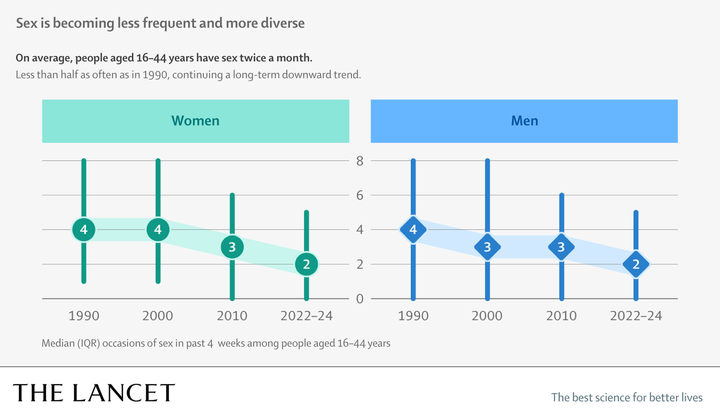
British adults under 45 years old are having sex twice a month on average, according to the fourth National Survey of Sexual Attitudes and Lifestyles (Natsal-4), published in The Lancet journal.
So, monthly sex has halved. In 1990, the average was four times a month.
Fewer young people report having sex at all, per the survey. One in three 16- to 24-year-olds now report never having had sex, up from around one in five between 1990 and 2010.
Around 6,700 people aged 16-59 were randomly selected from across Britain (England, Scotland and Wales) to take part in interviews or online surveys for Natsal-4 between September 2022 and January 2024.
Three previous Natsal surveys took place in 1990, 2000 and 2010. To compare them, like for like, the researchers looked at changes among 16- to 44-year-olds in particular, as this age range was covered by all four surveys.
The latest survey revealed more people are reporting having sex with a partner of the same sex. Among 16- to 44-year-olds, the number of women who reported this doubled (from 7% to 14%), while in men, this figure tripled (rising from 4% to 12%).
Online sexual activity (ie. watching porn) is also “now part of everyday life for many”, said Soazig Clifton, Academic Director for Natsal, at University College London (UCL), especially among young people.
The survey found half (50%) of young women and almost nine in 10 (86% of) young men reported watching pornography in the past year.
On average, survey participants reported having five sexual partners in their lifetime.
Why are Brits having less sex?
Dr Wendy Macdowall, Associate Professor at the London School of Hygiene & Tropical Medicine (LSHTM), said surveys like Natsal “can document changes, but can’t tell us what’s driving these shifts”.
That said, among 16- to 24-year-olds, the decline is largely thought to be as a result of fewer young people reporting ever having had sex.
But the drop isn’t limited to young people: among 35- to 44-year-olds who have had sex, the average frequency of sex also fell over the past decade, from three times a month to twice.
Dr Macdowall said “it’s likely there are multiple, complex factors at play, especially for young people”.
“On the one hand, more open discussion of consent may mean young people feel better able to decide whether and when to have sex,” she said.
“On the other, these findings coincide with broader changes in young people’s lives, including rising rates of mental health conditions, declines in drinking alcohol, more time spent online and a greater proportion living at home with their parents.”
For couples in relationships, experts previously told HuffPost UK that life changes can “push sex further down the priority list”. For example, welcoming a new baby, undergoing fertility treatment, perimenopause, menopause, illness, grief, caring for ageing parents, money issues and stress. Exhaustion and the mental load can also contribute, as can unspoken resentment.
For the first time, Natsal-4 also measured sexual wellbeing, defined as “feeling respected, safe and comfortable with sex and sexuality and having self-esteem, agency and support in one’s sex life”.
Low sexual wellbeing was more commonly reported among young people, those from LGBTQ+ communities, and people on lower incomes. It was also linked to having sex less often and to behaviours associated with STI risk.
One in seven women (14%) reported ongoing upset with others about things done to them in their sexual past, and one in seven men (14%) reported feeling shame about some of their sexual thoughts and desires.
“The survey finds that having good sexual health is not always the same as having good sexual wellbeing,” said Prof Kirstin Mitchell, Professor of Social Science and Public Health, University of Glasgow.
“Yet sexual wellbeing concerns are rarely discussed by healthcare professionals. Doing so would address a broader range of patient concerns and might improve engagement with services.”