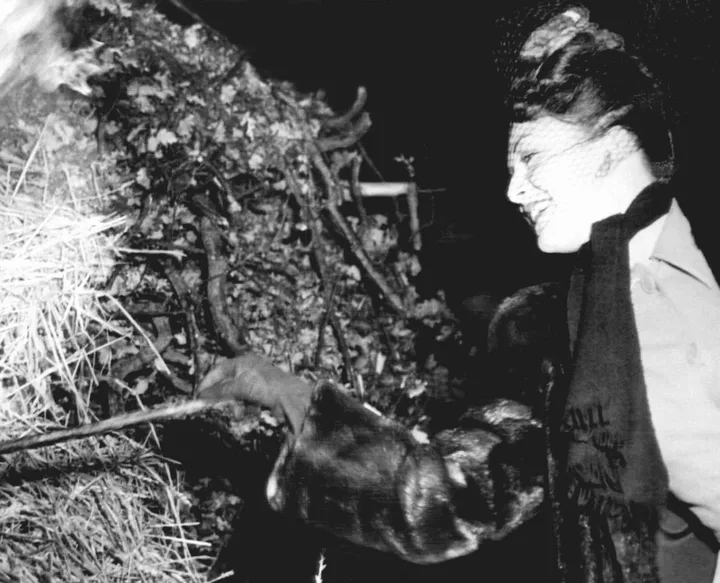
Halloween has just passed, which, in the UK, means we’re set for another spooky event: bonfire night.
“Remember, remember, the fifth of November”, the rhyme goes. But as you watch fireworks scream into the flame-licked sky, it might be hard to, well, remember just how gory the fire’s origins really are.
As it turns out, that dark history is probably linked to our modern term – “guy”, or its plural “guys” – too.
How is Bonfire Night connected to the word ‘guys’?
You probably know that the bonfire itself traditionally contains an effigy of Guy Fawkes, who was linked to the 1605 Gunpowder Plot to take down the Houses of Parliament.
It wasn’t always this way, though. During Charles I’s reign, some used a figure representing the Pope instead – a trend that peaked in 1625-49, during the succession crisis surrounding James II, and which the UK Parliament said probably only ended when laws against Catholic worship were removed.
The people involved in the plot (yes, people – Guy wasn’t even the ringleader), like mastermind Robert Catesby, were “fanatical” Catholics, per English Heritage.
Nor was Guy Fawkes always called “Guy”. When he fought on the Catholic side of Spain’s Eighty Years’ War, he changed his name to Guido. After his capture following the Gunpowder Plot, he gave his name as John Johnson.
We know that King James I gave dispensation for Guy Fawkes to be tortured before his execution in Old Palace Yard, where he died with Thomas Winter, Ambrose Rookwood and Robert Keyes.
The note authorising his torture read: “If he will not other wayes confesse, the gentler tortours are to be the first usid unto him… God speed youre goode worke. James”.
And it was Guy who became the effigy burned on the 5 November celebrations years later.
This, the Washington Post suggests, may have led to the term meaning “man” or “person”.
“Years after Fawkes’ plan was foiled, British children paraded his effigy around on 5 November – a custom that, over the course of decades, made ‘guy’ a sort of slang, first for a poorly dressed person, and then more generally for a man ( … of any wardrobe,” the publication shared.
Dictionary Merriam-Webster agrees. Their entry for “guy” reads: “The human likenesses burned on the fires came to be called guys. The verb guy ‘to ridicule’ is derived from this story also”.
Over time, they said, the term became a shorthand for a scruffy or odd-looking person – but it only seems to have reached its modern meaning in the US.
It now refers to a person or people of any gender, and (thankfully) has no suspicious undertones.