Evercore ISI, the investment research arm of Evercore, outlined the challenges facing the property and casualty (P&C) insurance industry in its first-quarter 2026 preview, citing increasing cyclical pressures in commercial, personal and reinsurance markets.
Evercore ISI highlighted that soft pricing conditions and continued technology disruption are weighing on industry valuations, with concerns about artificial intelligence (AI) reducing the role of brokers and advances in autonomous driving affecting major personal auto insurers.
Evercore ISI said that while commercial insurers and reinsurers have outperformed broader financial stocks and the S&P 500 so far this year, these dynamics have limited the traditional defensive appeal of auto and brokerage stocks during recent macroeconomic volatility.
Evercore ISI expects commercial product line results to reflect a clear continuation of the weak cycle. The company said pricing weakness at large customers is starting to trickle down to small and mid-sized segments, with Hartford and Travelers likely to see a more pronounced impact.
The report predicts that first-quarter revenue numbers from several insurers, including Hartford, Travelers, White Mountains and American International Group, are likely to be weaker than expected, with White Mountains being particularly affected as it takes a strict stance on underwriting volumes to maintain pricing. Looking ahead, Evercore ISI sees the second quarter as a more important test for real estate pricing as year-over-year comparisons become more challenging.
While Evercore ISI expects casualty pricing to provide some support for weakness in real estate and other short-tail lines, it warned that continued strong returns across the industry could encourage increased competition. Evercore ISI also noted that broader inflationary pressures, including social inflation, may prevent the economic cycle from deteriorating as sharply as in previous periods, potentially shortening the duration of the downturn while still achieving acceptable returns.
In personal lines, Evercore ISI expects a divergence between volume and premium growth. The company expects policy volumes from leaders such as Progressive and Allstate to remain strong, but believes overall premium growth in the segment could be impressive. Evercore ISI attributes part of this to favorable seasonal conditions in early 2026, which it believes could delay margin normalization.
Despite its relatively attractive valuation, Evercore ISI maintains a cautious stance, suggesting margin pressure may emerge sooner over the remainder of the year. The company further observed that the scale advantages established by the largest insurance companies, including Progressive, Allstate, State Farm and GEICO, could increase market concentration, which could limit growth opportunities for smaller competitors.
The Evercore ISI suggests brokerage results should remain broadly stable, with organic growth broadly in line with expectations. The company pointed to its own survey data pointing to strong nominal GDP growth in the first quarter, which it said could help offset an ongoing slowdown in pricing. Evercore ISI also highlighted that completed mergers and acquisitions have meaningfully contributed to the growth of companies such as Aon and Marsh, which are expected to increase significantly in reported figures.
A central theme identified by Evercore ISI is the need for brokers to address investor concerns about artificial intelligence. The company stressed that brokers need to clearly quantify their exposure to market segments considered more vulnerable to automation, particularly personal accounts and small business accounts, while demonstrating the value they provide through risk management, data insights and claims support.
Evercore ISI cited Arthur J. Gallagher as a positive example, noting that the firm estimates its exposure to only 3% of brokerage revenue, lower than Evercore ISI’s own previous assumptions, while Marsh, Aon and Willis Towers Watson’s exposure levels are even lower.
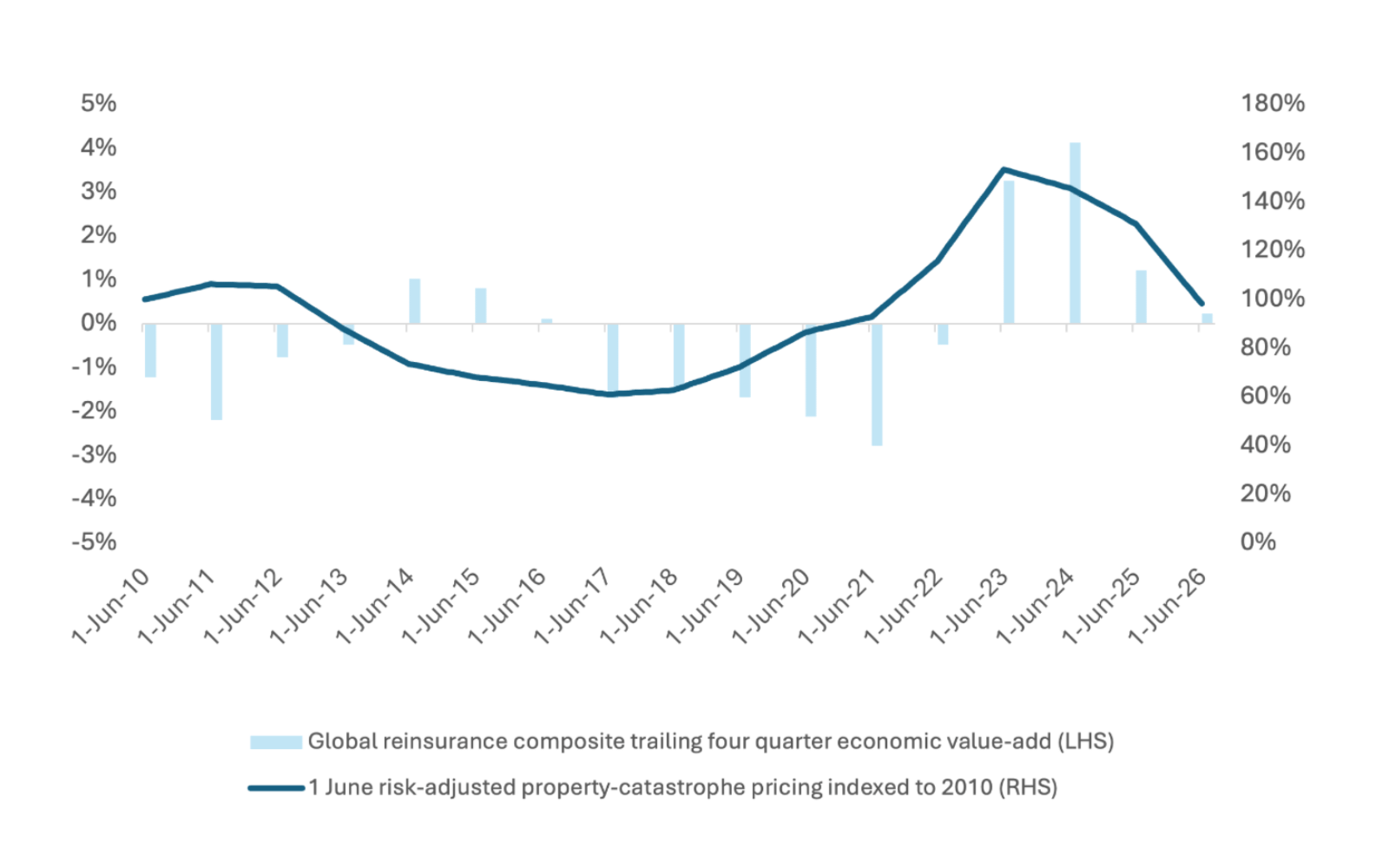
On the reinsurance front, Evercore ISI expects pricing trends to remain under pressure, with renewals down about 15% to 20% in April and likely to weaken further later this year, especially in disaster-prone areas such as Florida. Nonetheless, Evercore ISI observes that current valuation levels are broadly in line with previous weak markets, although returns are still higher.
The company highlighted that major catastrophe pricing indices continue to remain above levels recorded between 2013 and 2017, and said that even with further interest rate cuts, U.S. market pricing is likely to remain structurally high relative to the same period. Evercore ISI also expects capital management activities, including share repurchases, to remain consistent with recent trends despite weak revenue performance.
Finally, Evercore ISI expects first-quarter catastrophe losses to fall within typical seasonal ranges. The company estimates that geopolitical developments, including a conflict involving Iran, could result in relatively limited insured losses in the $30 million to $50 million range, which Evercore ISI believes the industry can contain.