On her daughter’s first day of third grade, Holly Ostrout sent a few photos to her stepmother. One showed her daughter and her best friend standing in front of the school, its name clear in the background.
Less than 20 minutes later, Ostrout’s stepmother sent back a series of AI cartoons of the two girls. “The school name was huge in all of them and so were their own names, as if it was cartoon Glamour Shots of the two of them in different poses and classes,” Ostrout said.
“I felt so weird about it because I don’t put my kid’s face or name on the internet, much less her school,” she said. “I had a stalker about 20 years ago, and I operate under the assumption that he is always out there, scoping. And then suddenly, my kid, her personally identifying details, and her friend were delivered right into ChatGPT.”
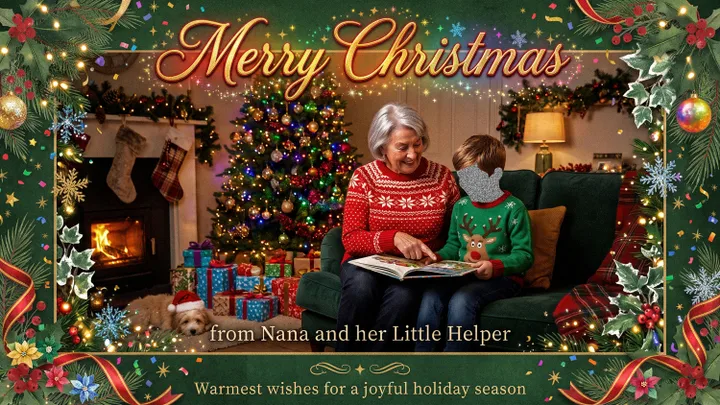
The trend has a name online: “grandmaslop.”
The term gained traction from a Reddit thread where adult children swapped the AI pictures their parents were making of grandkids. The grandparents mean well, but parents often find out only when the finished picture arrives.
Katherine Fleischman’s mother thought she was doing something fun for her grandson Leo. Last holiday season, she used ChatGPT to make a picture of him hugging Chase from Paw Patrol for a school project.
She printed it and hung it on the wall. “He was so happy,” Fleischman said. “He loved it so much.”
The picture still made her uneasy. When Fleischman told her mother it felt “a little weird and very public information being put out there,” her mother laughed. Her mother has also made an AI birthday invitation and, just recently, a collage of all her grandkids. “My child’s photos are out in the abyss,” she said.
Steve Case turned to AI images because he rarely sees his grandchildren. The grandfather of six lives in England, and his children and grandkids live in Ireland and Scotland. “I barely see my grandkids, around once a year,” he said.
Three days before Christmas last year, he sent his children a photo he’d made with ChatGPT of the whole family together, as if they’d had a reunion. “I just did it because I miss my grandkids.”
He didn’t ask his children first. “There were no complaints of any sort about it. In fact, they got so happy seeing it,” he said. Both posted it on Instagram. This Christmas, he plans to write each grandchild a letter and attach a ChatGPT picture, such as one of him and his grandson Luke in a gingerbread house or riding a reindeer.
“But this time, I think I would now ask their parents if that would be OK,” he said. He is “not naive by any means” about AI, but he wasn’t sure about the risks of uploading his grandchildren’s faces. “I’m not a tech guru,” he said.
These photos can be used in ways beyond your imagination
People may assume an uploaded photo is used and then discarded, said Tiffany Shogren, senior director of AI modernisation at the cybersecurity company Optiv. “Once a photo leaves the phone, it lands on the AI tool’s servers, attached to the grandparent’s account,” she said.
On ChatGPT, Gemini and Claude, the photo can also be used to train the companies’ AI models unless the grandparent has changed “a setting most people have never seen,” Shogren said.
“The important part to understand is that this only runs one direction. Turning the setting off or deleting the chat stops future use. Nobody is reaching back into a model that’s already been trained and pulling your grandchild’s photo out of it.”
That matters more when the photo is of a child. “When I upload my own face, I make a decision and I live with it. A four-year-old doesn’t decide anything, and in this scenario with grandparents, neither did the parent. And the photo rarely comes alone.
“The prompt usually says, ‘Make a storybook about Zoe’s 5th birthday,’ and the picture has a school shirt or a house number in it. Put those together and you’ve uploaded a profile, not a snapshot.”
ChatGPT isn’t the only place these photos are going. DeeDee Moore runs More Than Grand, a site for grandparents, and companies selling these keepsakes have “inundated” her with pitches.
Six emailed her in the past two weeks alone, pitching colouring pages and hardcover storybooks. “I’ve gotten storybook pitches for several years. The colouring pages and animation are new,” she said. “The requests have ramped up significantly in the last four to five months.” She has turned them all down. “I can see how tempting it might be to someone who isn’t aware of privacy concerns,” she said.
LaVonya Reeves, a grandmother in Houston, bought an AI storybook in 2024, before she had thought much about the privacy implications. She would normally give money for Christmas, but she wanted something more personal for her grandson, JJ. “My only intention was to give my grandson something special for Christmas,” she said.
Asked if she had thought about where his photo went, Reeves said, “The honest answer is no. I really didn’t think about it, and looking back, perhaps I should have.” As grandparents, she said, “we sometimes focus so much on creating happy memories that we don’t stop to consider the technology involved”.
Her twin granddaughters are due around Christmas. Reeves’ plan was to surprise their parents with something personalised, the way she had surprised JJ’s. Now, she said, “I would absolutely speak with my daughter and her husband first.”
Of the photos, she said, “we hope they’re used only for the product we’ve purchased, but hope isn’t the same as knowing”.
But what if you REALLY want to use AI to make cute photos?
Grandparents who want to keep making these pictures can leave out more than they think, said Stanislav Kazanov, head of cybersecurity and sustainability at Innowise.
“The specific information about the child does not matter because ‘a boy who loves dinosaurs’ produces the exact same picture book as if you used the child’s full name, age and hometown,” he said. Grandparents can also skip the photo entirely, he said, and “write the description and have the program create a character”.
Case’s AI reunion ended up on two Instagram accounts, a step Shogren ranks among the realistic risks. “The holiday card that was generated gets posted, forwarded, and reshared far beyond what anyone intended, and the upload gets blamed for what the share did,” she said.
“Deepfakes and exploitation are a real threat to kids, but that content overwhelmingly starts from photos posted publicly on social media, not from a private AI chat upload.”
Before Christmas, Ostrout plans to remind her stepmother not to post her daughter’s photos on social media, AI versions included. She still hasn’t raised the cartoons with her, because her stepmother “would take any feedback very personally”.
“I’m anticipating more of it in December,” Ostrout said, “and I’m going to have to figure out how to stop it without starting a nuclear war.”