Though I think Victorian novelist Elizabeth Gaskell deserves more love, I have to concede she’s not exactly obscure: her work was on my university curriculum, and her novel North & South was even adapted by the BBC.
But after picking up my first Dorothy Whipple book recently, I had my first true “how have I never heard of her?” double-take. That’s not just because of how much I enjoyed her writing, but also because she used to be a bestseller – and is now all but forgotten.
Who is Dorothy Whipple?
Born in 1893 in Blackburn, Lancashire, she was the daughter of an architect.
She finished the first of her eight successful novels in 1927, when she was 34. But Dr Cynthia Johnston, a Senior Lecturer in the History of the Book at the School of Advanced Study, University of London who is working on a biography of the interwar writer, said she’d caught the writing bug early.
Aged just 12, she started publishing work in The Blackburn Telegraph under its “children’s corner”.
Two of her “immensely popular” novels (They Knew Mr Knight and They Were Sisters) got turned into feature films, and many were Book Society Choices or Recommendations.
This success came even though she lacked some of the social connections her contemporaries made in universities like Oxford.
Partner in Austen publishing firm, John Murray, Ronald Barnes, the Third Lord Gorrell, helped to secure her success: he published her second book High Wages, after rejections, and suggested she was quite like Austen.
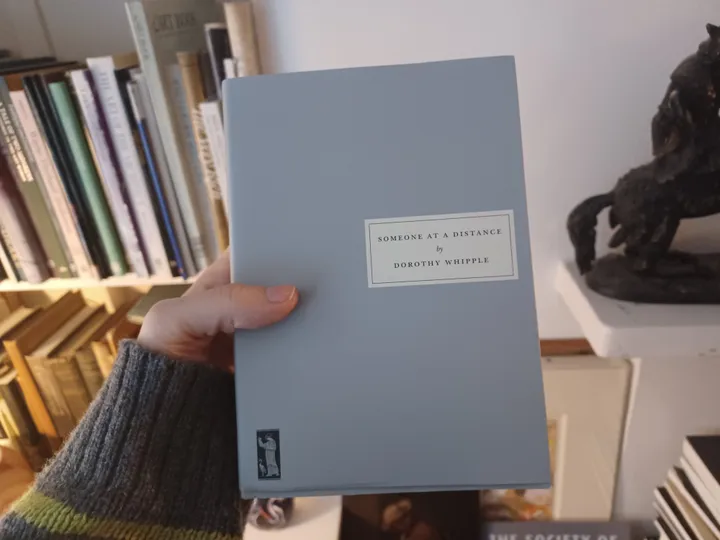
This book was one of her many hits. Dorothy’s last novel, Someone At A Distance, however, was somewhat critically ignored.
What books has Dorothy Whipple written?
- Young Anne (1927)
- Greenbanks (1932)
- High Wages (1932)
- They Knew Mr. Knight (1934)
- The Priory (1939)
- They Were Sisters (1943)
- Because Of The Lockwoods (1949)
- Every Good Deed (1950)
- Someone at a Distance (1953)
- Tale of Very Little Tortoise (1962)
- The Smallest Tortoise of All (1964)
- Little Hedgehog (1965)
- Mrs. Puss and That Kitten (1967).
Why should I read Dorothy Whipple?
Speaking to HuffPost UK, Dr Johnston said: “I find her subjects and writing to be compelling and realistic. She has the elusive quality of ‘umputdownableness’, although she always said she was much better at character than plot.
“She is certainly ‘proto-feminist’, and her contemporary readers certainly recognised that in her writing. Readers identified with her characters; there is a realism to the novels that may have led readers both male and female to feel that these books spoke to their lived experiences.”
My first Whipple book, A Stranger at a Distance, was filled with the domestic politics and wry humour I loved as a long-time Austen reader. It was also more explicit about the work of running a house: it is clear who does all the planning and hard graft, and who sacrifices in a nuclear family.
Whipple “has a following (which apparently includes Queen Camilla), but I would argue that she is largely ‘forgotten’ by those who aren’t part of the Persephone catchment, as lovely as those readers are,” Dr Johnston added.
Publisher Persephone Books has released multiple editions of the author’s work (it’s how both Dr Johnston and I first encountered the writer).
Perhaps it’s time she was more widely recognised.
“Last year I gave a talk then held a discussion with sixth formers at Blackburn Central Library (where Whipple was from),” Dr Johnston recalled.
“We read a few of the short stories, and they absolutely loved them. So many of the female readers identified with [the] feelings of the young protagonists. I thought it was such a shame that this author, who still spoke so strongly to modern teenage readers, should be unknown to them, especially in her hometown.”
I’m already a huge fan, and can’t wait to get stuck into more of her novels.
If you’re wondering where to begin, the professor said: “I would start at the very beginning and read all eight novels, but not too quickly!
“My favourite is probably Greenbanks, but They Were Sisters is an astonishing proto-feminist work”.
Wherever you start, we doubt you’ll be able to stop.