My daughter is leaving for college next year, and although I am enormously proud of the young woman she has become, my mind keeps drifting from the questions a sensible parent ought to be asking about her education and toward questions of a more urgent nature.
For example: Who is going to make her spinach?
Aurelia was born on Halloween, two weeks late and entirely on her own terms, which turned out to be an accurate preview of the next 17 years. On her 17th birthday, Universal Studios refused to admit her to Halloween Horror Nights because her makeup was so convincing that the staff assumed she was a member of the cast, and she was sent back to our hotel to make herself look less “accomplished”.
While she and a friend regrouped, I settled beside the pool with a children’s PB&J, contemplating whether the bathroom upstairs, which had vanished beneath a quantity of makeup that would humble the cosmetics floor at Macy’s, would require professional intervention.
I texted her, “Are you having fun?” and two hours later, I was joyful to receive back, “Yea!”
Photo Courtesy Of Elizabeth Faidley
I would have appreciated a slightly more comprehensive account, ideally with timestamps, but I took what I could get. And then I sat there for a long time, thinking about how strange it is that the very thing I have spent 17 years working toward could also leave me feeling homesick for a person who hasn’t even left yet.
Since she was six months old, it has been just the two of us. I do have a mother whom I have turned to in times of various disasters, traumas and credit cards that didn’t work, but that’s it. It would be inaccurate, however, to describe our life as a mother raising a daughter, because for most of it we have been something closer to partners: a small, devoted, occasionally reckless firm of two.
The partnership began early. Before she was born, Yo-Yo Ma gently rested his hands on my enormous pregnant belly and told me a cellist was coming soon. I laughed and laughed. Eight years later: THANKS, YO-YO. You owe me a lot of money for cello plane tickets.
Since then, we have divided the labour in ways no parenting book would endorse. I supply the ambition and the elaborate plans; she supplies the judgement and, when the plans collapse, the consolation.
When she was eight and passionately determined to own a reptile, I hired a private herpetologist and rented a sketchy $15-an-hour rehearsal studio on Broadway, confident that one close encounter with a snake would cure her. Instead, she lay on the floor and cuddled a boa constrictor named Big Yellow.
I then bought her a one-inch tortoise named Tallulah, along with the Buckingham Palace of tortoise habitats, and spent the following week waking at 6am to touch the tiny tortoise and check for signs confirming that Tallulah was still alive.
At the end of that week, I surrendered her to a middle school science teacher, head hung in shame. Aurelia patted my cheek. “It’s OK, Mom,” she said. “Not everyone has what it takes to own a reptile.”
I was granted exactly five Christmases of Santa. At six, Aurelia conducted an independent investigation involving long division, a working knowledge of time zones and a globe, and determined that one elderly man of considerable girth could not possibly visit every chimney on Earth in a single night, particularly given the reindeer situation.
She presented her findings, with calm authority, approximately 30 seconds into a violin lesson I was teaching with a very young student. I did not attempt a rebuttal. Later that year, she outed the Easter Bunny to a 12-year-old, who I can only assume has never fully recovered.
When Aurelia asked me that Christmas for a baby mermaid (Ariel, being a grown woman, was not an acceptable substitute), I ordered a handmade merbaby on Etsy. Pearl arrived with green hair, strange veil-like skin, and eyes that suggested she had witnessed something unspeakable. On Christmas morning, Aurelia was horrified.
Photo Courtesy Of Elizabeth Faidley
I tried two kinds of drugstore hair dye, failed and shipped Pearl off to a doll hospital in New Jersey run by very serious Germans. Aurelia wrote on the box, “Please, please help this doll. She has so many problems.”
Several weeks later, a detective called to inform me that the doll hospital had removed Pearl’s head and found two ounces of cocaine inside. Once the detectives determined I was not a willing participant in a drug smuggling scheme, the conversation took a more personal turn.
He wanted to know why anyone would go to such lengths for such an unattractive doll, and had I heard of Ariel? I explained that my daughter had requested a baby mermaid, not an adult mermaid, and that I considered the distinction important even under police questioning.
When I told Aurelia that Pearl would be staying at the hospital a bit longer because she did, it turned out, have many problems, she nodded.
“I told you, Mom. That doll is messed up.” Pearl never came home, and to this day I would like her returned.
This partnership, I should note, is not always consensual. At 13, Aurelia bought a $1,300 hairless cat on my credit card, having sweetly persuaded my mother that she was buying me a special gift and then persuading a breeder named Kim that she was an adult.
Confronted, she first denied buying a cat, then allowed that perhaps she had bought one, but he was completely hairless, so neither of us would be allergic. “Kim is, like, my BFF now,” she explained.
Eventually, I managed to convince Kim that Aurelia was a child and to please not ship a live, hairless animal to our apartment. She reluctantly agreed, but continued to share photos and videos of cats with Aurelia for two more months.
These stories have become our private family mythology, the shared history that needs no explanation because we were both there, and I suspect one of the things I will miss most is having another person in the house who remembers everything.
Photo Courtesy Of Elizabeth Faidley
I have always loved having my daughter beside me: in a theatre seat, a museum line or the back of a taxi in a foreign city, partly because I wanted her to see as much of the world as I could show her, and partly because I discovered early that she was marvellous company.
We held hands on the night Hamilton reopened after Covid-19, when Lin-Manuel Miranda welcomed live theatre back, and the entire audience screamed and clapped for 10 full minutes. We also cried together through Alfie Boe’s final Les Misérables.
Some of the most moving moments of my adult life have involved glancing over at my daughter and discovering that she was moved by precisely the same thing.
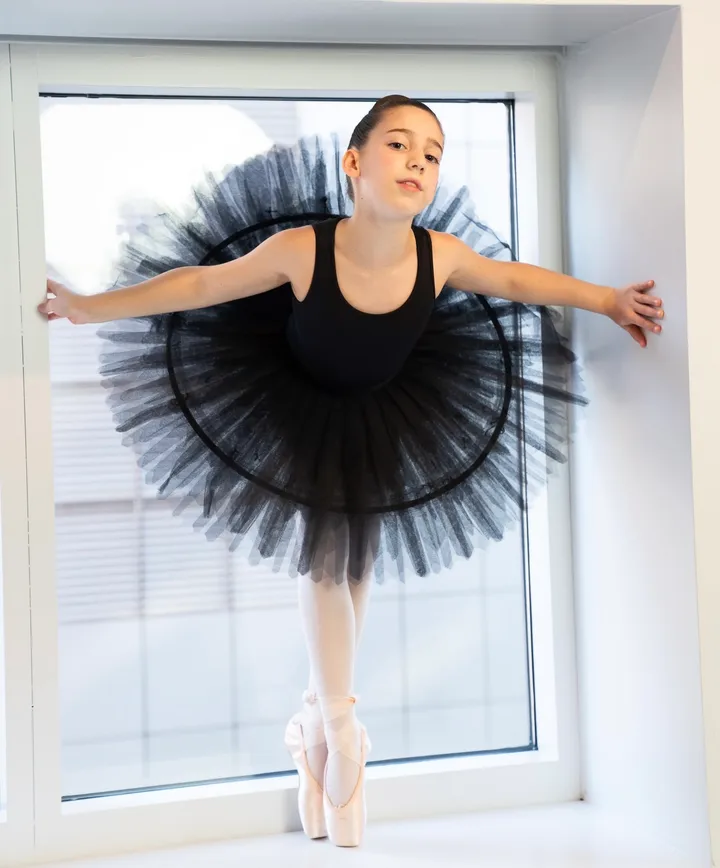
For years, our lives were also shaped by ballet. Aurelia was accepted into the School of American Ballet at eight and became a lovely dancer, with clean technique, strong pointe work – and particularly gorgeous feet, which is a high compliment in ballet and a deeply peculiar thing to say about a child in any other context.
Those were not pink-tutu years; the auditions for A Midsummer Night’s Dream ran eight hours on each of two days. And it was wonderful. She danced with New York City Ballet in front of 3,000 people, so joyfully that my heart left my body.
Eventually, Aurelia chose the cello, and the firm expanded to include a third member who requires her own airplane seat. The cello is named Hestia, and Hestia travels by the window and prefers ginger ale and pretzels. For years, the three of us have crossed the country and the Atlantic with gowns of every colour, far too much luggage, and a cello and bow that, together, are worth considerably more than the car I drive, the furniture I own and possibly me.
And now, almost without my noticing, the little girl who built enormous cat amusement parks, conducted science experiments involving urine and a microscope, and left a messy trail of art through every room of our apartment, is getting ready to leave.
Certain aspects of her independence, such as the ability to acquire a cat without adult assistance, arrived earlier than necessary. What I did not anticipate was how thoroughly her leaving would rearrange the architecture of my life. It is not the grand philosophical implications of an empty nest that threaten to undo me. It is the snacks.
There will be no one whose cereal must sit until it reaches the consistency we call “soggying”, no one for whom to buy large quantities of Smartfood White Cheddar Popcorn to eat while watching dreadful reality television, and no one who expects her spinach prepared according to seven essential steps, each of which apparently only I have mastered.
Photo Courtesy Of Elizabeth Faidley
In our family, one departure reduces the population by 50%, which strikes me as a significant demographic event. For 17 years, I have been the world’s leading expert on one person, down to the nearly invisible difference between a silence that means she is content and one that means something is wrong, and I have no idea what an expert is supposed to do when her entire field of study moves away.
I got a preview this summer, when Aurelia spent seven weeks at the Meadowmount School of Music and proved remarkably uninterested in filing the comprehensive daily reports I would have appreciated. The long, uninterrupted evenings I had fantasised about for 17 years were not nearly as pleasant as advertised.
I mostly wished she would wander into my room and ask me something completely unrelated to whatever I was doing, such as, “Mom, where’s the beanbag chair I had nine years ago? I need to rip it apart and use the beans.”
So I have been preparing for how I will behave when she goes off to live her big, beautiful life. I will almost certainly text too much, and DoorDash things to her dorm that she did not request. What I will not do is make her responsible for my sadness.
I want her to be gloriously happy, to make friends I have never met, to fall in love with music she has never played, and to become so absorbed in her own life that she occasionally forgets to call, although I would like to establish some reasonable parameters around that last one, in writing, in the presence of a lawyer and a notary.
Above all, I want her to know how much I have enjoyed being her mother, and her partner. Children hear a great deal about what their parents sacrificed, but I hope she understands that even in the hardest stretches, her company has been one of my greatest pleasures.
I have spent so much of her childhood preparing for departures, packing suitcases, checking passports and making sure Hestia had her window seat, always knowing that wherever we were going, we were going together. Next year, for the first time, she will go somewhere without me. I will help her pack, offer far too much advice and try very hard not to cry until after I have said goodbye.
Photo Courtesy Of Elizabeth Faidley
I would never ask her to make her life smaller. Still, I think I am entitled to be a little heartbroken by my own success.
Before she leaves, I will write down the spinach recipe, all seven essential steps, and we will make it together, and I will try very hard not to intervene when she performs one of them out of order.
And when she comes home, I will make it for her again, hoping she will linger in the kitchen while I cook, telling me about the wonderful life taking shape beyond the part I know. There will be so much I want to hear.
There is, of course, an eighth step. I am keeping it to myself, so that she will have to come home for it.
Do you have a compelling personal story you’d like to see published on HuffPost? Find out what we’re looking for here and send us a pitch at pitch@huffpost.com.