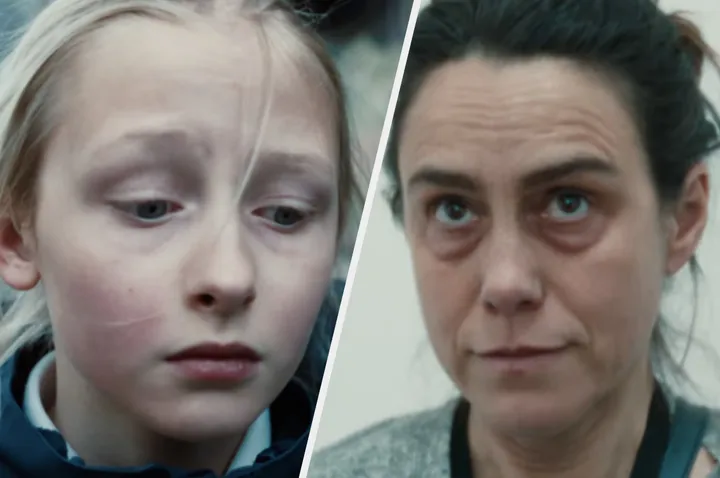
Parents are reacting to an emotional new short film about a mother and her neurodivergent daughter’s struggle within the school system.
The 15-minute drama, Unauthorised Absence, follows single mum Anna and her undiagnosed autistic daughter Thea, who struggles to attend school because of severe anxiety and sensory overwhelm.
We watch as nine-year-old Thea becomes extremely distressed about going to school. Her mum, meanwhile, is seen trying to get support for her child, but is met with comments from teachers like “she’s really settled here” as well as suggestions that she attend a parenting course to improve her child’s attendance.
As her daughter remains stuck on a three-year waiting list for an autism assessment, mum Anna still receives repeated phone calls, fines and even the threat of prosecution because her child is repeatedly absent.
The harrowing film ends with a parent and child overwhelmed, exhausted, mentally and physically harmed, and desperate to be seen, heard and supported, instead of punished and treated as a problem by the system.
The powerful storytelling has left many parents of neurodivergent children in tears after seeing their own struggles reflected back at them.
Lisa Lloyd, a content creator known online as ASD With A G&T, and author of Raising The SENbetweeners, has two autistic children, and said “every single person needs to watch” the short film – especially those working for schools, local authorities and in government – “because this is what so many parents and children are living through”.
In England, all schools are required to consider fining parents when a child has missed 10 or more sessions for “unauthorised reasons” over a rolling 10-week period. A full day at school – morning and afternoon – is considered two sessions.
Parents can be fined twice before other action is taken, like a parenting order or prosecution.
The government says children can only miss school if they’re “too ill to go in” or “you have advance permission from school”.
While schools and local authorities are “required to work together to provide the right support” where children face barriers to attendance due to special education needs or disabilities (SEND), waiting lists for assessment and diagnosis can be long.
So, for families of undiagnosed neurodivergent children who may be overwhelmed and distressed in their school environment, this means they are often left with two options: force their child into school, or let their child stay home and suffer the consequences.
Holding back tears, Lloyd said the short film had made her “so emotional” because it “brought back a lot of memories of my eldest at school, before he got an EHCP [education, health and care plan], and we went through absolute hell”.
“I felt like I was letting him down every single day by dragging him in,” she said, her voice wobbling.
“And I knew he was so desperately unhappy and falling apart, and it was breaking him – and nobody was listening to me. I was told it was my parenting, I was told he was fine in school, he’s clever, but I knew what it was doing to him because I saw it at home and I could see so much of that in the film I’ve just watched…”
Directors Notes and MIMESIC Films on YouTube
She added: “The worst part of it all is we are supposed to be our children’s safe person, and we are forced to become an unsafe person to them. We’re forced to let them down, and we’re helpless, we have to force them into environments that are not correct for them.
“It’s disgusting that so many families are being let down and ignored like this.”
Gemma Sharp, founder of Hummingbird Life Academy, also echoed that feeling of needing to be her child’s safe space, but not being able to, because she had to force her child into an environment that distressed her.
She told HuffPost UK: “We went through an absolutely horrendous time with my daughter, who was experiencing severe mental health difficulties at just seven years old.
“It was heartbreaking, and as a parent, I felt completely helpless at times, particularly when so few people understood what was really going on behind the scenes.”
Sharp said she was told: “She’s just being difficult. You need to be tougher with her.” And so, she and her husband became firmer, “because when you’re already questioning yourself as a parent and people around you keep telling you it’s a behavioural issue, you start to believe that maybe they’re right”.
But “the screaming, the distress, the desperation… it all got worse”, she recalled in a video on social media.
“What nobody saw was the mum crying in the car after school drop-off. The arguments at home. The dread of another morning. Or what it was doing to the relationship between me and my daughter. I was supposed to be the person she felt safest with.
“Yet I was the person making her go somewhere she was absolutely terrified of being.”
She said watching Unauthorised Absence “brought back some of the most traumatic memories of our lives” yet she’s “incredibly grateful they’ve told this story”.
“I wish every teacher, school leader, family member and friend who has ever judged a parent struggling with school attendance would watch it,” she said. “Because there’s often so much more going on than you can see.”
You can watch Unauthorised Absence on the Directors Notes YouTube channel.