Rod Mitchell, the oldest child in his family, remembers being nine when his seven-year-old sister reached for a large Lego tower he’d spent all afternoon building.
When he grabbed it back, a piece flew off, and she started crying. Instead of asking what happened, their parents said: “You’re older. You should know better.”
“That’s the same sentence I now coach parents to replace,” said Mitchell, who is a registered psychologist and clinical director at Emotions Therapy Calgary. “I clearly remember anger at feeling unfairly treated, and underneath that a lesson formed in my mind: her tears were proof of something, and my account of what happened wasn’t.”
As a parent, it may seem like you’re teaching your kids responsibility or how to get along, but you could also be assigning them roles within the family without realising it.
When certain expectations repeatedly fall on the same child, they can shape how siblings see themselves, and each other, long after childhood, influencing sibling relationships for years to come. Here, family therapists break down what they want parents to know about these patterns.
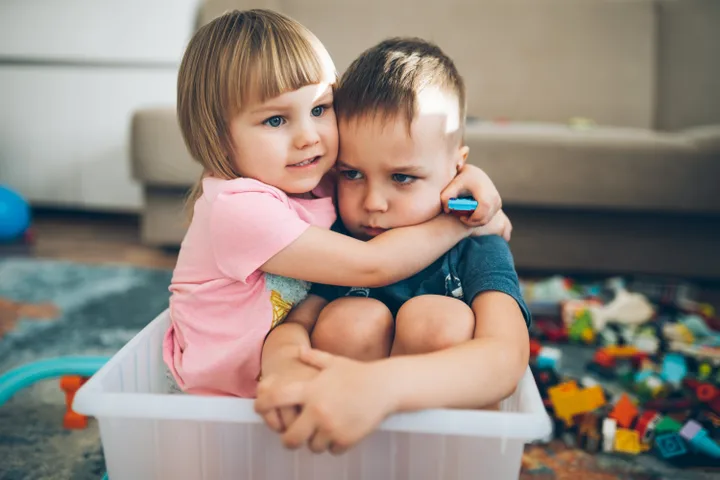
Anastasiia Sienotova via Getty Images
The Sibling Roles That Can Take Shape In Families
Role assignment is common in families. Patterns naturally develop when you start dividing responsibilities, managing differences between children and keeping daily life running smoothly.
Over time, these patterns can become familiar sibling roles, from the responsible child and caretaker to the peacemaker, the rebellious child or one who avoids creating additional stress.
“Sibling roles typically emerge organically in response to personality, birth order, family stress and the ways parents react to each child,” said Emily Waitt, clinical director of Kincove, an adolescent, young adult and family-focused mental health and wellness centre.
“One of the most common dynamics occurs when one sibling becomes the family’s identified ‘problem,’ while another is viewed as the ‘easy’ child or the one who ‘has it all together.’ The child perceived as easy typically receives less attention or support because adults assume they’re doing fine.
How You’re Unintentionally Reinforcing Sibling Roles
As a parent, you may not mean to assign roles to your children, but it can happen unintentionally. The language you use and expectations you place on them can reinforce those roles over time, even when you’re trying to teach responsibility, empathy or consideration.
Parents often give the youngest more leeway, excusing their behaviour because of their age rather than asking them to take responsibility.
Meanwhile, the oldest might hear, “You’re so much more mature than your brother, so I need you to let it go” during a conflict.
“This may sound like praise, but it can teach one child that their feelings and needs matter less because they’re expected to be more accommodating,” Waitt said.
That expectation can also show up in the pressure placed on the oldest to set an example for younger siblings. Mitchell, who was labelled the responsible one in his family, remembers: “My parents used to say things like, ‘We expect better of you,’ and ‘Your sister is watching you.’ My behaviour was never just mine; it was a demonstration, graded on what it taught my sister. My parents stopped saying things like that as we grew older, but I had already internalised the role.”
Parents might also give the oldest more responsibility than they’re ready for, such as expecting them to make sure a younger sibling gets ready for school or remembers their homework.
Waitt notes that it becomes problematic when the child feels responsible for preventing a younger sibling’s distress, managing their behaviour, keeping them safe or ensuring they make good choices, particularly at the expense of their own needs, activities or well-being.
“At that point, the child is no longer simply helping or fulfilling an age-appropriate role as an older sibling; they’re being placed in a parental role,” Waitt said.
How Role Assignment Can Create Sibling Resentment
Experts agree that assigning and reinforcing sibling roles can create resentment, particularly when children feel compared with one another, fuelling emotions like anger, fear and jealousy.
“If one child is seen as the favourite, the responsible one, the mature one and the other one is labeled less favourably, it inevitably sets up competition between them for parental love and attention,” said Raffi Bilek, family therapist and director of the Baltimore Therapy Center.
Role assignment can also leave siblings carrying burdens they never asked for. One sibling might resent always having to be the caretaker, while another might feel unfairly labelled as the troublemaker.
“They may have held these roles throughout their childhoods against their will, and yet they may perceive the other sibling as having wanted and benefited from their particular role,” Bilek said. “That’s fertile ground for long-term bitterness.”
Why Roles Can Be So Hard To Break Free From
Because parents have years of experience interacting with their children in particular ways, it can be hard to see them outside of their assigned roles, even as their personalities, abilities and circumstances change with age.
“On the whole, knowing which children play what role and having a predictable system has kept the family going, and considering something different risks upending that structure,” Bilek said.
It can be just as difficult for siblings to see each other outside of those roles, even as adults living apart. They may have internalised childhood expectations, while past hurts and unresolved resentment can make it harder to see a sibling as they are today rather than through the lens of those experiences.
“When [you] come back together for family events, the same old patterns play out, and the same pain points get triggered,” Bilek said.
Signs You May Be Reinforcing Sibling Roles
There are a few signs that can help parents recognise when they’ve assigned or reinforced sibling roles, like knowing which child you’re about to correct before you’ve even asked what happened, for example.
“Parents can often hear this reflected in the language they use to talk about their children. Phrases like ‘as usual,’ ‘typical,’ or ‘once again’ are common,” Mitchell said.
Another is hearing those labels come directly from your kids. “A child who says ‘I’m the bad one’ or refers to their sibling as ‘the smart one’ has internalised the roles you’ve assigned them,” Mitchell said.
How To Help Your Kids Break Out Of Their Sibling Roles
If you think the dynamic between your kids could use a reset, experts say change is possible, even when roles have become entrenched. Start by naming the pattern clearly: “We’ve been treating you like the responsible one, and you like the wild one. That wasn’t fair. It’s changing.”
“Keep it under two minutes and don’t beat yourselves up,” Mitchell suggested. “Stating the pattern out loud is important … kids don’t renegotiate a role no one has admitted exists.”
Mitchell also suggests telling your kids that a particular role is getting a vacation, saying something like, “I’m taking care of your brother tonight, you’re on vacation!”
“Then assign the other child something concrete to manage: pet food or family movie choices are good options. The announcement is what tells both kids the roles can move,” Mitchell added.
Finally, consider your language so you don’t inadvertently reinforce those labels. “Praise the effort, not the identity, like ‘you worked so hard on that,’ instead of ‘you’re my responsible one,’” said Mitchell, adding that parents should also swap “You’re the older sibling, so you should know better” for “You knew our rule about grabbing, and I need you to follow it.”
“You can still ask them to act responsibly; just drop the reference to birth order,” he said.