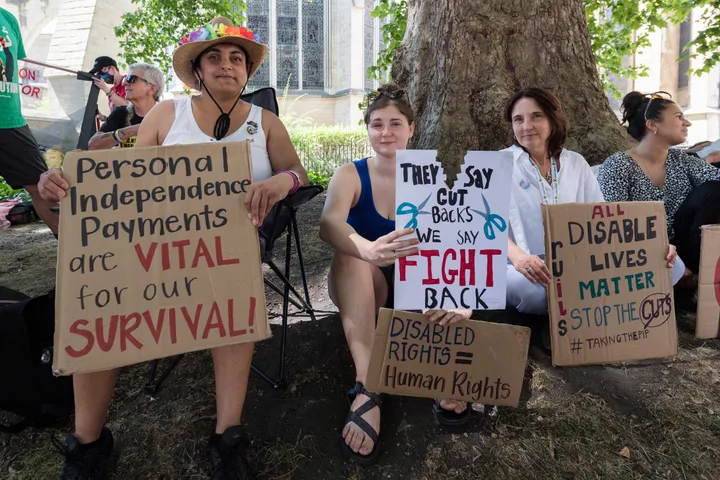
Calls for the government to cut young people’s benefits in a bid to push them into work have been criticised for being far too extreme.
Former Labour cabinet minister, Alan Milburn, will release his report into the one million 18 to 24-year-olds who are not currently in employment, education or training (also known as NEETs) next Tuesday.
He has already revealed that he thinks that the current system prioritises young people’s shorter-term finances rather than their “longer-term life chances”, according to The Times.
Milburn has suggested young people should be completely moved off the main sickness and disability benefits to overhaul the welfare state, while also calling for more investment in employment support.
That would mean cutting the main working-age health and disabilities benefits, like Personal Independence Payments (PIP) and the Universal Credit Health Element, for those under 25.
Prime minister Andy Burnham is widely expected to accept Milburn’s recommendations, even though the ex-minister has warned they will not be “pain-free”.
It’s part of the government’s drive to cut the growing welfare bill – estimated to go up by £19 billion in the 2026–27 financial year – though ministers have vowed they will bring it down in a “Labour way” rather than via crude cuts.
Implementing Milburn’s ideas would involve the largest overhaul of the welfare system in more than a decade, with both existing and new claimants impacted.
However, anti-poverty charity Toynbee Hall has raised the alarm over these suggestions, with benefits already failing to cover the basics for disabled people.
In a survey of 2,000 disabled people, only 16% told the charity that PIP covered their additional costs of disability.
One respondent said: “Being alive is beyond my budget.”
Disability charity Scope estimates disabled households need an extra £1,095 per month on average just to have the same standard of living as non-disabled households.
However, the average monthly PIP payment across households is £465 per month, while the new lower rate of the Universal Credit Health Element is £217 per month – meaning many end up struggling to make ends meet.
Under Milburn’s new proposals, under-25s wouldn’t receive any of this.
Toynbee Hall also warned that cutting income support will reduce the likelihood that young disabled people will be able to engage with education, employment or internships.
For the most advantaged children, the probability of becoming Neet is 1%, but for the most disadvantaged it’s 25%, according to data collected by Connected Bradford.
Wiktor Szymanowicz Wiktor Szymanowicz/Future Publis
A disabled peer researcher with Toynbee Hall and parent-carer, Jenny, warned about the consequences of cutting the benefits her 24-year-old son receives.
James, which is not his real name, has a specific language impairment, ADHD, autism and hypo-mobility (which is characterised by decreased joint mobility).
He did undergo a supported internship with the NHS, but none of the young people on that scheme secured the follow-up job afterwards.
Jenny said: “We want James to have the opportunity to learn, develop his skills, and find suitable work with the right support. But we are deeply concerned that any proposal could weaken his access to the social security he needs because of his disability.
“Removing the support that helped him stay in education could undermine the very progress employment reforms should build on.”
She added: “James is not a statistic or a problem to be solved. He is a young man whose effort, achievements and future matter. He deserves a system that gives him a fair chance without putting his dignity and security at risk.”
Milburn’s suggestions are already causing some consternation among Labour MPs, too.
Bell Ribeiro-Addy told BBC Radio 4’s Today programme: “I’m not sure I could vote for cuts, unless it’s very clear what we’re voting for.”
She said some MPs “would be concerned that the suggestion is that we apply it [changes to entitlements] to existing claimants”.
A backbench rebellion from Labour MPs forced Keir Starmer into a U-turn in 2025 after he tried to cut the welfare bill by also reducing PIP.
Yet, one of the rebels, Labour’s Meg Hillier, told the BBC she was willing to consider these new proposals.
“What happened last year was a cut was being proposed and none of us could explain to people what would happen to them. Milburn has done some very good work on this so I’m giving him a fair wind,” she said.
Housing minister Matthew Pennycook also told Times Radio that the government is “not running for the hills” over Milburn’s early suggestions.
“If there is intensive wraparound support that’s given to young people that genuinely expands their life chances, not just writes them a cheque in the here and now, that is absolutely the right thing to do for them, for the country, and in the long term for bringing the benefits bill down,” he said.
“Because – and we’ve said this since coming into office – it is unsustainable on its current trajectory.”
Responding to Milburn’s proposals, a Downing Street spokesperson said: “As you know, our focus is on creating jobs and opportunity, not crude cuts that push young people into crisis and simply move costs elsewhere in the system.
“We will always maintain the safety net for the most vulnerable and those who are unable to work.”
The government is expected to fully respond to his recommendations in the coming weeks.
Another report looking into the value of PIP is expected from disability minister Stephen Timms later this month, too.
Listen to Commons People, the podcast that makes politics easy. Every week, Kevin Schofield and Kate Nicholson unpack the week’s biggest stories to keep you informed. Join us for straightforward analysis of what’s going on at Westminster.