When moviegoers head to cinemas these days, they usually want big-screen spectacles. You know, superhero blockbusters, action-packed thrillers, the latest Christopher Nolan epic. A three-hour documentary about a notorious corporate fraudster doesn’t exactly fit the bill.
And yet, You Can See Everything, Nathan Fielder and Lance Oppenheim’s mind-bending film about convicted Theranos founder Elizabeth Holmes, proved to be an exception this autumn.
Much of that credit goes to the film’s endlessly fascinating subject, whose controversial story was already well known to the masses, but its unconventional rollout certainly helped.
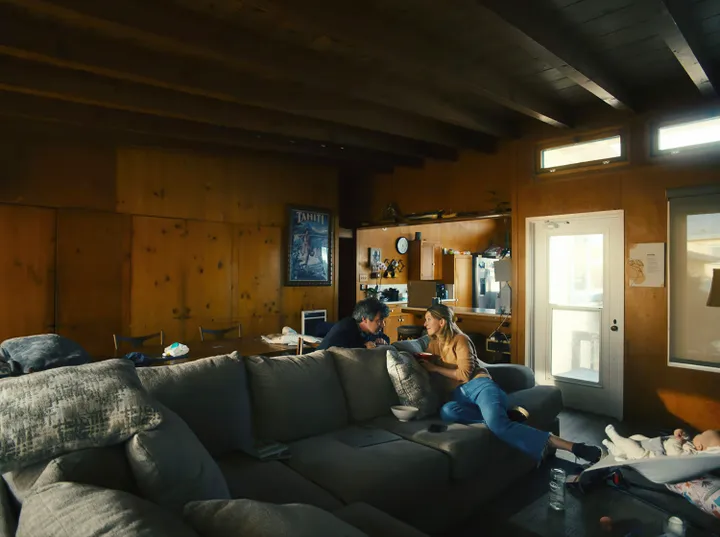
Until the film made its festival debut in September, very few people knew Fielder and Oppenheim had been secretly working on an all-access documentary for A24, following Holmes and her partner, Billy Evans, in the weeks before her 11-year prison stint.
Even more surprising, the barely announced project was set to hit theatres nationwide just a month later.
Still, it didn’t take long for You Can See Everything to become one of the year’s most talked-about documentaries. And it’s not hard to see why.
A cryptic teaser trailer gave audiences plenty to speculate about in the weeks before the film’s release. But those who finally got a look were left with perhaps even more questions than they came in with.
Part psychological analysis, absurdist comedy and fever dream, You Can See Everything is difficult to categorise – and even harder to mistake for a traditional portrait of one of Silicon Valley’s most infamous figures.
Mostly because there are no talking-head interviews with experts dissecting Holmes’ Theranos scandal, nor a tidy recap of the fraud that brought her once-lauded blood-testing company crashing down. Just Fielder, the deadpan provocateur behind acclaimed projects like Nathan For You and The Rehearsal, turning his brand of docu-comedy into investigative journalism.
Stepping from behind the camera, he questions, observes, stages and probes his subjects, all while searching for answers through some of the most uncomfortable close-ups you’ve ever seen in a documentary.
Moments from the film have since become prime meme material and a favourite topic of conversation both online and off. The buzz has also put Holmes – and her puzzling relationship with Evans – squarely in the spotlight. Not to mention the documentary’s meta twist: Amanda Seyfried reprising her Emmy-winning portrayal of Holmes from Hulu’s The Dropout.
Blame it on FOMO, the enduring fascination with Holmes, or Fielder’s unique take on nonfiction filmmaking. Whatever brought audiences out in droves to see You Can See Everything turned the film into a rare box-office hit this year and a cultural phenomenon few saw coming.
The documentary’s explosive success, experts say, came down to an “interesting mixture of ingredients,” starting with the element of surprise.
“The filmmakers were really deliberate about protecting the experience of seeing it for the first time, particularly among other people in theatres,” Kaitlin Fitzgerald, an assistant professor in Penn State University’s media studies department, told HuffPost. “And then if you were among the early viewers who got to see it, you really played a part in keeping it secret.”
“We don’t tend to see that preservation of a media experience [with many films],” she added. “We protected spoilers almost on a social level.”
The documentary offered an exclusive glimpse into Holmes’ life, and left audiences with even more questions.
But perhaps the biggest draw for audiences was the wonderfully bizarre pairing of Fielder and Holmes in an A24 production, which, as Fitzgerald put it, gave people “some reason to expect something unexpected”.
“Even before you begin watching or engaging with the media itself,” she added, “you have this combination of, I have no idea what I’m going into, but I want to know.”
If that wasn’t interesting enough, the documentary’s first teaser trailer seemed to seal the deal. Featuring little more than an excruciatingly trippy stare-down between Fielder and Holmes, the clip quickly went viral, sending the internet into a frenzy over what, exactly, the rest of the documentary would entail.
A second trailer, released just two weeks later, reportedly pulled in nearly 4 million views in its first 24 hours. It’s since surpassed 23 million.
Both clips teased a level of access to Holmes that audiences rarely get, particularly after she spent nearly a decade largely avoiding the media. And despite her rise and fall being chronicled in countless articles, podcasts, films and a television series, You Can See Everything offered a perspective on Holmes that felt entirely new.
Naturally, audiences wanted in.
“The hardwiring of the human brain is like, if this is unusual to get, it must be worth it,” said Cat Armstrong Soule, a marketing professor at Western Washington University. “I don’t want to give up the opportunity to get that exclusive access.”
As Fitzgerald noted, Fielder takes the promise of exclusivity to an almost surreal extreme in the film, using his close proximity to Holmes to bring viewers face-to-face with “someone who, collectively, we’re trying to understand”.
“The way that he communicates with her, a lot of it is trying to read her expressions. It’s also having the opportunity to be in her home and see her with her children, her family, her parents and experiencing these really human moments before we all know she has to go [to prison],” Fitzgerald said.
“We are used to narratives, especially fictionalised ones, giving us the opportunity to see something that we wouldn’t [normally] be able to,” she continued. “But in this case, it’s this experience. It’s this opportunity to experience something that we’re already so invested in, in terms of our curiosity.”
Still, for all its intimate access, the film leaves one question lingering: Does Holmes genuinely believe her own claims of innocence, or is she knowingly manipulating those around her? Or better yet, is her partner, Evans, pulling the strings?
That’s the big mystery the filmmakers initially set out to solve. However, the documentary never quite settles the matter. Even Fielder admitted, “I still am not sure to this day what I experienced” with Holmes. But experts say that lack of a definitive answer is precisely what makes You Can See Everything so compelling.
“The open-endedness of it is so interesting for a documentary,” Soule said. “Usually people have their perspective where they’re like, ‘I’m going to show how this person is not guilty of this crime,’ or, ‘We’re going to solve what happened here and go behind the scenes.’ But … this really did break the mold of that.”
She added: “I think that taps into why it’s so satisfying at the end when you’re like, is she scamming [Fielder]? Is her partner manipulating her? Is Nathan manipulating them? Is he manipulating us?”
Fitzgerald also finds it “quite unique” that Fielder and Oppenheim set out to answer certain questions about Holmes, only to leave viewers with more ambiguity. In doing so, they let audiences draw their own conclusions about the Theranos founder rather than dictating what they should take away from the film.
“Which is interesting from a media psychologist perspective,” Fitzgerald remarked, “because between the narrative and the entertainment piece, they’re blending together in a way that is almost entirely just wanting to show the reality of it.”
The film became a conversation everyone wanted in on
That blurred line helps explain why You Can See Everything became the documentary everyone seemed to have an opinion about. While the film gave viewers plenty to unpack on their own, the real fun seemed to be in debating, trading theories and comparing notes with others.
By the time Saturday Night Live and The Tonight Show got in on the joke, the documentary had become practically impossible to ignore – and perhaps even harder to resist.
“Being part of the conversation is something that most people have an inherent drive to do,” Soule explained, pointing to FOMO as another factor behind the film’s popularity.
“So when something becomes a cultural moment, and a lot of people are talking about it, it really helps that snowball. They don’t want to be left out of it,” she added. “It’s a psychologically negative feeling for people to feel like they aren’t in the know, and they aren’t tapped into what other people in their social groups, and more broadly, society is talking about.”
Steve Rathje, an assistant professor in the Human-Computer Interaction Institute at Carnegie Mellon University, points to a 2014 study published in Psychological Science that found sharing an experience with others can shape how we perceive it, even when it’s something as simple as watching the same film.
“It basically shows that when you share an experience with a friend, it feels more intense,” he said. “So there’s something about the community aspect of this movie that makes the experience more intense.”
That’s, perhaps, the most remarkable part of the film’s success. What started as a simple documentary release (albeit an unconventional one) has since embedded itself in the zeitgeist, showing little signs of letting up even after leaving theatres and landing on streaming.
“It has a whole life after the experience of the documentary itself,” Fitzgerald noted. “We tend to think it’s this individual experience of, I’m going to watch this thing, be engaged in it and it’s going to influence me in some way. But in this case, a lot of it is happening in the aftermath of having watched it, and it’s happening in social spaces.”
“Having the ability to discuss it in these online communities, with your neighbour, family members and friends, it opens up a whole other realm of this experience,” she added, “which is, let’s collectively try to understand what we just saw.”
Whether it was Fielder’s surreal prison reenactment starring Seyfried, his painfully awkward exchanges with Holmes or the many viral moments that have kept the internet buzzing – including the infamous “egg scene” – You Can See Everything delivered no shortage of scenes destined to live on in pop culture lore. Meanwhile, the film itself continues to break box-office records.
While it still feels too soon to tell whether the documentary’s success was a one-off or the start of something bigger, its sweeping awards-season campaign will surely keep it in the conversation.