I was sitting in front of a room full of students at a youth empowerment camp on the Arizona-Mexico border when a disability justice advocate named Naomi Ortiz looked at me and said, calmly but directly, “What you’re doing isn’t helpful, Spencer.”
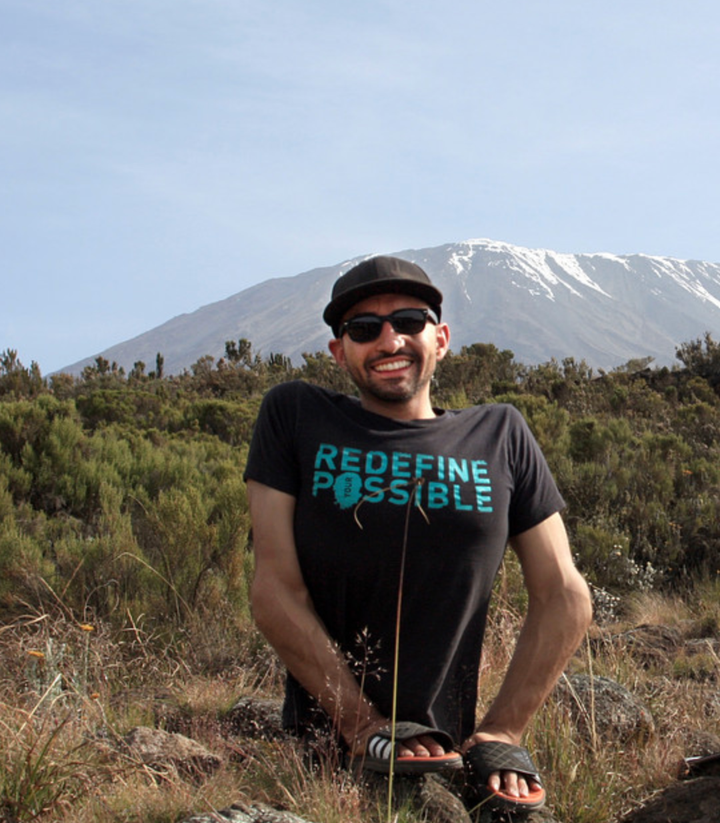
I had just finished describing my proudest professional achievement: summiting Mount Kilimanjaro on my hands and in my wheelchair while raising over half a million dollars for clean water in East Africa. I thought I was inspiring these kids. I thought I was proof of what was possible.
“It’s great you climbed Kilimanjaro,” they said, “but you accomplished this because you had a team of people helping you. And through this experience, you supported them to learn and grow as well, which is interdependence.”
“You’re what we call a ‘super crip,’” they told me. “A super crip is someone who acts like they can overcome who they are, but a lot of disabled people can’t actually do that. As a public figure, sharing how you accomplished this climb as a team can help others understand that when we come together, we often succeed.”
My mouth was on the floor. And after sitting with those words for a long time, I realised Naomi was absolutely right.
My legs were amputated below my pelvis when I was five due to a rare genetic condition. From then on, I navigated the world on my hands and in a wheelchair.
And yet, for most of my life, I had been told by doctors, well-meaning adults, and society at large that I wasn’t really “disabled”.
The message I received growing up in the ’80s and ’90s was that the only thing limiting me was my mind, and that I was “just like everyone else”.
So, I believed them. I worked hard to distance myself from other disabled people. In middle school, I deliberately avoided the other disabled students because I didn’t want to believe I was one of them. If you’re cringing as you read that, I don’t blame you. I am, too.
The first crack in that worldview came on a volunteer trip to Kenya. I was in my 20s and disappointed with the direction of my life when a friend invited me to work with a Canadian nonprofit.
While I was there, I spent an afternoon with local children who were curious about my legs. After I explained what had happened, a young girl looked at me and said something that stopped me cold: “I didn’t know something like this could happen to white people, too.”
I’ve thought about that sentence hundreds of times since she said it. It was the pure, unfiltered observation of a child who had never seen someone like me before. And it hit me so hard because it revealed something I had been hiding for years: my disability was visible, it was specific, and it was part of who I was, not just something that had happened to me.
I had been telling myself I was “just like everyone else” for so long that I had actually started to believe it – and that belief had made me cause harm to the very community I claimed to represent.
Fast-forward a few years to that room in Arizona with Naomi. Human Kinetics Journal defines “super crip” as a stereotypical representation of a disabled person whose accomplishments are framed as inspirational because they’ve “overcome” their disability to succeed.
I had been climbing mountains and receiving standing ovations from non-disabled audiences while having almost no disabled friends, never speaking to disabled audiences and knowing almost nothing about the history of the disability rights movement.
I had been recklessly going through life without a second thought about all the people who had fought to make the world more accessible for me.
Naomi’s words were the beginning of a decade of real work. I read Judy Heumann, Alice Wong and Leah Lakshmi Piepzna-Samarasinha. I watched “Crip Camp” over and over. I went to therapy to unpack my own internalised ableism. I changed the way I talk about myself and used my platform to educate others on disability justice in real time.
In 2022, Heumann, who is widely considered the mother of the disability rights movement, invited me onto her podcast to talk about the intersection of queer and disabled identity. It was one of the most meaningful moments of my professional life, and it never would have happened without Naomi calling me out years earlier.
I said queer and disabled identity because this isn’t the first time I’ve had to do this kind of work.
I came out as gay when I was 21, and I had followed a long, hard road to get to that point. I grew up in Rock Springs, Wyoming, a small, conservative, predominantly Catholic town where queerness simply didn’t exist – at least not out in the open.
The only queer people I saw growing up were exaggerated stereotypes on TV who were only there to provide a laugh. The murder of Matthew Shepard in 1998, when I was a senior in high school in the same state, confirmed what I already feared: being different came with consequences.
Thank God for my best friend, John, who had the courage to come out first. Watching him transform from a shy, uncertain boy into a confident young man gave me the permission I didn’t know I needed. When I finally told him I was gay, the years of tension I’d been carrying simply released. I wasn’t carrying it alone anymore.
But coming out didn’t mean I got to be fully out. When I launched my career as a speaker, one group I was working with made clear that my sexuality wasn’t welcome in my public story. I was advised (and I use that word loosely) not to discuss my sexual orientation in speeches or media interviews.
My first book, Standing Tall, contains no mention of my sexuality at all. That’s a remarkable omission for an autobiography. I understood the business reasoning – some funding came from conservative organisations – but I felt increasingly deceitful. I was building a career based on telling millions of people to live authentically while quietly editing out half of who I was.
It took years of persistent queer colleagues and allies pushing from the inside for things to change. Eventually, they did. I got to tell my coming-out story publicly. Eventually, I was even able to celebrate Pride with this organisation. But I’ll never forget what it felt like to stand onstage speaking to thousands of people while using only half my voice.
I realise many people reading this may not identify as queer and disabled, but we all live in a world full of expectations that quietly pressure us to be smaller, safer and easier to categorise. Those expectations can create harmful narratives that we then, often without realising it, pass along.
Sometimes we need a Naomi Ortiz in our lives – someone who cares enough to call us in and help us understand how to do better. And sometimes we have to lean into the identities we’ve been hiding to change people’s minds, policies and hearts.
I often think about that little girl I met in Kenya. She didn’t know that something like this could happen to someone like me. I didn’t know, for a very long time, that I could be fully disabled and fully queer and fully myself, all at once, out loud, without apology.
Now I do. And that knowledge is the thing I most want to share.
Are there parts of you that you keep hidden? Are there moments when you stay quiet when everything in you wants to speak up? Are there identities you haven’t fully claimed yet – not because they aren’t real, but because the world made you feel they weren’t safe?
Now might be the time to find out what happens when you stop hiding them. It changed my life. It could change yours, too.
Spencer West is a globally renowned keynote speaker, author, content creator and disability and 2SLGBTQ+ advocate whose life embodies resilience, creativity and the power of redefining what’s possible. Born with a rare genetic condition that resulted in the loss of his legs at age 5, Spencer has spent his life challenging expectations – using adversity and lived experience as a catalyst for impact. His latest book, Breaking Free: Stop Following Expectations and Start Following Yourself (Hay House, May 2026), offers a raw and vulnerable look at shedding limitations, embracing identity and living authentically.
Spencer reaches a global audience of over 4 million on social media. Follow him at spencer2thewest.com and on Instagram, TikTok, Facebook, and YouTube.
Do you have a compelling personal story you’d like to see published on HuffPost? Find out what we’re looking for here and send us a pitch at pitch@huffpost.com.