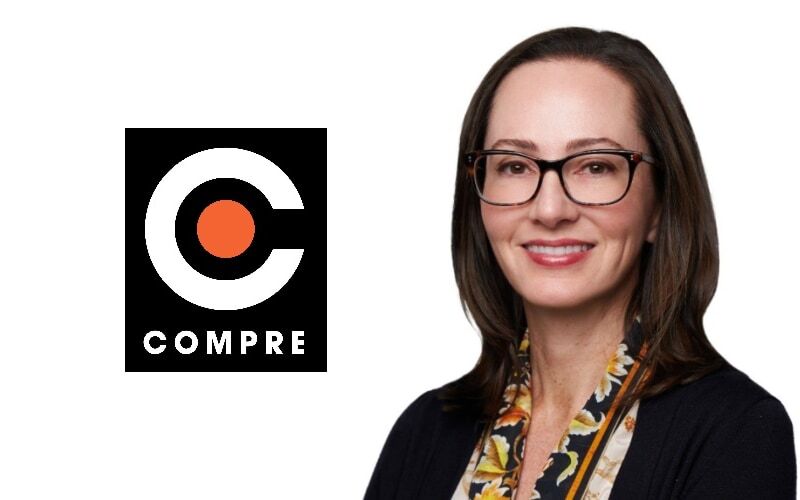
Rachel Bardon, chief underwriting officer (CUO) of international specialty reinsurance group Compre, said that as traditional markets continue to evolve, the company is broadening its interest to include more forward-looking and capital-focused transactions, while remaining rooted in traditional traditional transactions.
Speaking to Reinsurance News at Compre’s Bermuda headquarters, Bardon said the company was focused on cautious, measured expected growth.
Nonetheless, she confirmed that while Compre’s appetite has broadened, it has not strayed from its core focus, stressing that it remains a long-tail specialist providing capital and claims solutions to partners seeking to build long-term and repeat relationships with it.
“We are not abandoning our traditional business. We are still a specialty reinsurer and we spend most of our time and energy on our traditional business, and we are currently growing cautiously in our future business,” Baden said.
She emphasized that traditional deals entering the market have become increasingly “greener” in recent years, moving closer to recent underwriting years. Given Compre’s focus on long-tail liabilities, she said the company is now willing to extend its expertise into this year in some cases.
Borden explained: “In terms of our strategy, we are still primarily a legacy player, so moving towards specialty reinsurers, which includes legacy and prospective transactions as well as other capital and claims solutions. On the legacy side, a big part of that is claims and capital solutions, where they may transfer all claims liability for discontinued blocks of business, which are typically legacy legacy transactions.
“What we’ve seen over the past few years is that some transactions are moving towards more pure capital solutions rather than claims solutions. So the ceding company may choose to maintain its claims processing and they don’t need to hand it over. It’s not a discontinued piece of the business. It may be more of a capital solution and may just be part of the capital stack, which is very similar to the underlying business – we don’t take on the underlying claims but provide the capabilities accordingly.”
Bardon said Compre focuses on opportunities where there are synergies or follow-on potential between the underlying business and its legacy business. This is what is said to be what makes Compre unique – balancing the needs of its customers throughout the life cycle.
“Our focus is on low-volatility, mid- to long-term, diversified business segments where we are aligned with the cedants and there is some kind of package or potential opportunity to do concurrent legacy transactions going forward or related to that. That could be a share of the entire account quota that goes directly onto our balance sheet. At the same time, we also provide ADCs for the legacy business segments and LPT. As we have performed due diligence on the management team and reviewed the claims, we have adapted to the actuarial and credit risks associated with them, so we now have both current-year and prior-year risk through two separate transactions.”
She added that as part of its future strategy, Compre was providing funding from Lloyd’s of London (FAL) to syndicates, with Compre having historically participated in syndicates through reinsurance closing deals.
“For FAL investments, we can come in and offer FAL to a third-party consortium, and if we take a significant portion of FAL, we could potentially become a reinsurance closure provider within three years. So there’s synergy between being a future party and continuing our legacy pipeline,” Baden said.
Boden further emphasized that both futures and legacy businesses are countercyclical, meaning that when one weakens, the other typically strengthens, and vice versa.
“Our business plan and operating platform give us the freedom to choose how we spend our time and capital. Depending on where the best opportunities are, we may decide within a year or two to focus more on potential ventures, or if profits are not strong enough, we may prioritize traditional deals. This flexibility ensures we can always focus our resources on areas of greatest potential,” Boden said.