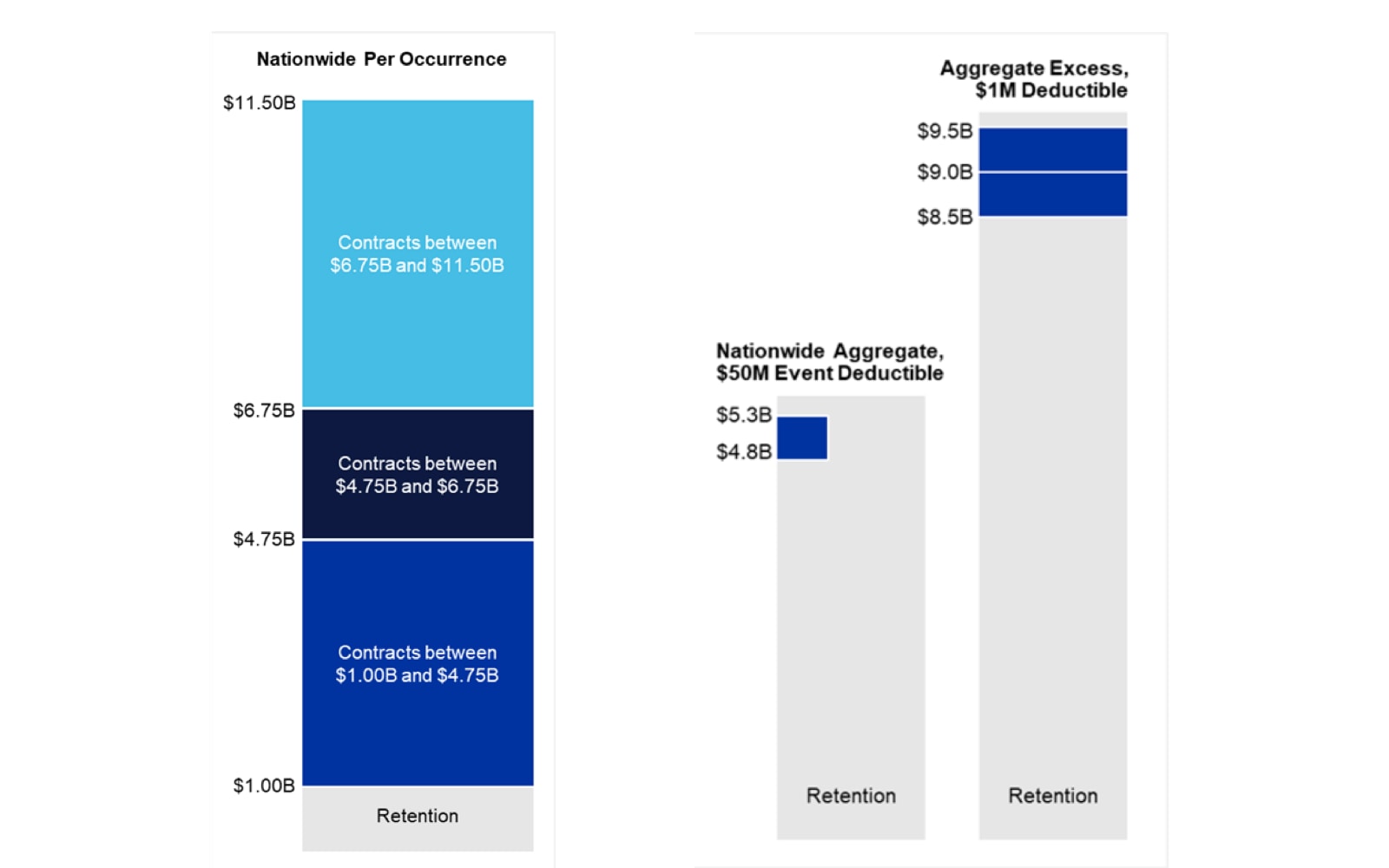
Major U.S. insurer Allstate expanded its national per-occurrence catastrophe reinsurance maximum limits by $2 billion at renewals in April, providing coverage for events of up to $11.5 billion in losses, and made some changes to its overall coverage.
For Allstate’s primary 2026-2027 Nationwide Per Occurrence towers, retention is the same as the previous year at $1 billion, but on top of that there are $1 billion to $4.75 billion in contracts that provide multi-year coverage with traditional reinsurers, including one contract that provides $245 million in limits set by risk (hurricane, fire and all others). Last year, the cost of expanding this portion of the tower was just $4.25 billion.
Beyond that, Allstate has $2 billion in limits up to $6.75 billion in 2026-2027, which includes $1.05 billion in one-time automatic recovery limits (subject to additional premiums) and $950 million in catastrophe bond coverage that does not meet recovery limits. Last year, this portion of the tower also offered $2 billion in limits, but up to $6.25 billion, including $1.63 billion in coverage to traditional reinsurers and $350 million in catastrophe bond coverage.
Contracts of $6.75 billion to $11.5 billion will provide Allstate with $4.75 billion in reinsurance coverage over the next year, with $2.5 billion placed in traditional reinsurers and $2.25 billion in catastrophe bonds. These limits are not eligible for reinstatement. Allstate explained that in the top portion of its towers, where most contracts would move downwards, a $4.75 billion minimum retention level must be adhered to due to eroding constraints on the lower floors. Last year, the tower was just $9.5 billion, with $2.03 billion in catastrophe bonds and $1.21 billion in traditional reinsurance companies.
For each national catastrophe reinsurance tower in 2026-2027, Allstate provided some information on qualifying losses and how those losses benefit from its total coverage.
“For U.S. events with retentions of less than $1 billion, Allstate retains all losses subject to recovery from comprehensive underwriting. For U.S. events with retentions above $1 billion, Allstate retains $1.0 billion of losses plus maturity recovery premiums. Qualified losses in excess of $1 billion will be divided among participating reinsurers up to $11.5 billion and may be recovered from comprehensive underwriting.”
Allstate is also making some changes to its 2026-2027 National Integrated Reinsurance Tower. The same as last year is the $50 million deductible, which means that multi-risk losses (net of reinsurance loss recovery) in excess of $50 million per event apply. However, for 2025-2026, a total limit of $500 million is provided, which is higher than the $4 billion retention and does not include all Florida losses. In 2026-2027, the total provides a $150 million limit for total losses between $4.78 billion and $5.28 billion, but still does not include all losses in Florida.
Allstate explained that for 2026-2027, “existing contracts were placed in the ILS market in 2023 and the risk period from April 1, 2026 to March 31, 2027 was reset based on the current risk profile.”
Last year, Allstate secured U.S. Homeowners Comprehensive Protection, which ran for just seven months and provided $500 million in limits on top of a $3.5 billion retainer, and received 65% protection. In 2026-2027, that limit has been replaced by what appears to be a $1 billion limit, with a reservation higher than $8.5 billion covering the U.S. real estate and automotive industries, including Florida, so the company’s coverage is much broader.
The large U.S. insurer has taken advantage of current competitive reinsurance market conditions and gained additional protection in a soft interest rate environment.
You can view Allstate’s per-occurrence and aggregate reinsurance coverage below:
In addition, Allstate renewed its Canadian catastrophe excess loss reinsurance contract on January 1, increasing coverage to CAD 577 million (from CAD 478 million last year), leaving the retained amount unchanged at CAD 100 million.
The company’s Kentucky earthquake excess catastrophe reinsurance contract was also renewed prior to effective June 1, 2026, providing $28 million in limits and retaining $2 million in 2026-2027, the same as the prior year.
“Total costs for our property catastrophe reinsurance program, excluding recovery premiums, were $308 million in the first quarter of 2026, compared to $257 million in the first quarter of 2025. In 2025, total costs for our catastrophe reinsurance program were $1.23 billion,” Allstate said.