After news of Russell Brand’s imprisonment and the misconduct allegations against David Walliams broke in the same week, Layla Stone found herself thrust into the spotlight.
The author and social worker is the founder of Close The Consent Gap, which is campaigning for a change in the law to protect 16- and 17-year-olds from sexual exploitation by adults.
Under the current law, the age of consent is 16 across the UK, meaning someone aged 16 or 17 can legally consent to sex with an adult, regardless of the age gap.
However, there are exceptions – for example, it is illegal for an adult in a position of trust, such as a teacher or coach, to engage in sexual activity with a young person under their care.
The age of consent for girls was raised from 13 to 16 in 1885, when Parliament introduced the change to provide greater protection against sexual exploitation.
More than 140 years later, campaigners say the law needs to change, arguing that 16- and 17-year-olds are still children and deserve greater protection from older adults.
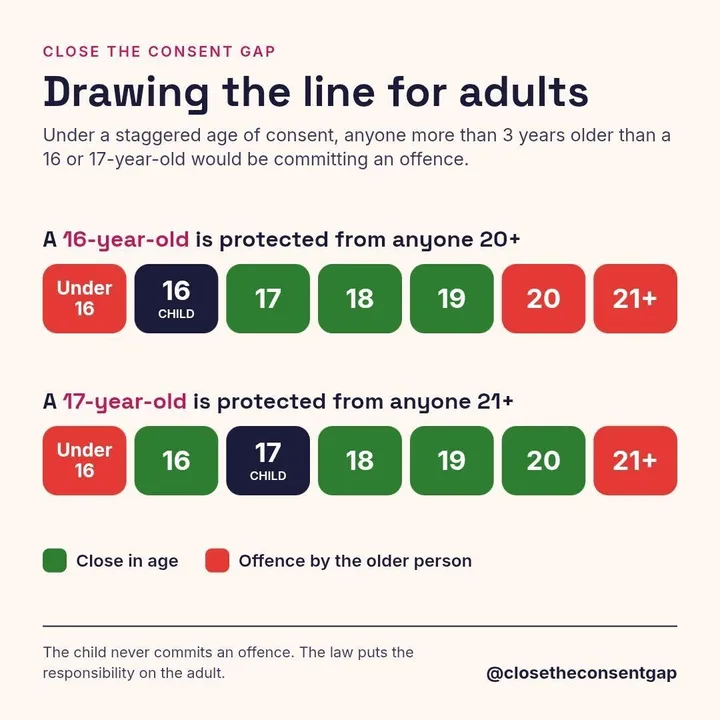
Stone and her team want to see an amendment to the law, which would result in a staggered age of consent. This would mean anyone more than three years older than a 16- or 17-year-old would be committing an offence if they had sex with them.
So, a 16-year-old wouldn’t legally be able to have sex with anyone aged 20 and over, and a 17-year-old would be protected from anyone aged 21 and over.
Importantly, the child would never be deemed to be committing an offence, only the adult.
“It’s a tight line, but we feel that that protects relationships with their peers and criminalises adults who try to have sexual relationships with them,” said Stone, who’s been “thinking about” the need for this law change for years.
She told me age-gap relationships are something she’s come up against time and time again as a child protection social worker.
“When a young person is 15 and you find out they’ve got a 30-year-old boyfriend, there are [legal] powers in place to disrupt that relationship,” she explained.
“As soon as that young person turns 16, your powers are severely reduced – and the predators know that.”
Following a trial, Russell Brand – who had pleaded not guilty to all charges levelled against him – was found guilty of one count of rape and three counts of sexual assault and was sentenced to 10-and-a-half years in prison.
David Walliams, meanwhile, has been accused by multiple women of “grooming”. One woman alleges she met Walliams when she was 15 and claimed he “groomed” her and they had sex when she was 17. Another alleges Walliams “sexually assaulted” her when she was 15. He denies all of these accusations.
Mia Latter, one of Brand’s accusers, has since waived her anonymity in order to campaign for a staggered age of consent.
She’s one of six women who made allegations against the comedian as part of a Times and Channel 4 Dispatches investigation back in 2023. Per the BBC, Brand denied the allegations at the time and none of the six women were complainants in Brand’s recent trial.
Latter had been just 16 years old when she met Brand, then 30, and the pair struck up a relationship.
She told the Sunday Times that Brand had encouraged her to keep their relationship hidden from her school friends and alleged he’d told her not to send intimate photos, which would’ve been illegal. (Under the law, it is an offence to possess, distribute, show and make indecent images of children – and whether you’re in England, Wales, Scotland or Northern Ireland, anyone under the age of 18 is defined as a child.)
“Even at the time, it felt ridiculous to me that I can’t send him photographs of myself naked … but I can have sex with this much older man. It doesn’t quite add up, does it?” Latter said.
Stone described how some predators begin grooming girls at 15 but won’t begin a sexual relationship with them until they turn 16 because of the age of consent.
“It’s exploited so heavily by predators,” she said, “and, of course, a 16-year-old is a child still.”
When she set up Lalala Let Me Explain, which she describes as online social work, and subsequently became a magazine agony aunt, Stone said age-gaps came up “over and over again … whether it was a letter from somebody talking about being in a big age-gap [relationship] or that they were worried about their own child being in a big age-gap relationship”.
And every time they’d touch on that subject, there would be “an avalanche of women writing in to talk about how much a relationship they had at 16 or 17 with an adult had harmed their lives, reduced their life opportunities, caused them ongoing anxiety and depression, lots of different things”, she said.
After watching Russell Brand’s interview with Megyn Kelly just six months ago, where he admitted to having been in a sexual relationship with a 16-year-old when he was 30, Stone felt compelled to push for law change.
“I just thought, we have to make it unlawful,” she said.
Her plan was to go “slow and measured” – building the team (consisting of specialists in sexual violence, public law barristers, and child development experts), conducting literature reviews, and reviewing laws in other areas – but then headlines flashed up on her screen; and interest in the campaign suddenly “snowballed”.
“The public suddenly went: yes these people are right, what is going on, we do need to close the consent gap,” said Stone. “So, we’ve been propelled to stratospheric levels of government now.”
Prime minister Andy Burnham has said he’s giving “careful consideration” to the idea, and Pat McFadden, the work and pensions secretary, confirmed the issue will be discussed in Parliament.
“They’re talking about it in Australia, America, New Zealand … I think what that shows us is just how strongly most people feel about this,” Stone added.
A staggered age of consent already exists in some places. For example, in Florida, USA, the state says 16- and 17-year-olds can consent to sex, but only with people aged up to 23, while in France, minors aged 15 and above can legally sleep with people up to five years older than them.
Stone said she was anticipating backlash from people saying “these laws have been in place for so long, there’s no need to mess with them”, but actually, many people support the idea.
“The criticism we’ve had is that we are still allowing 16- and 17-year-olds, under our law, to have consensual sex with their peers, whereas people like Kemi [Badenoch] are saying to raise it to 18,” said Stone.
“We don’t agree with that because we don’t want to criminalise 16- and 17-year-olds who are having normal peer relationships.”
The next month or so – and indeed, year – are set to be busy for the campaign, with multiple meetings set with major organisations focused on safeguarding and violence against women and girls.
Now, Stone is on a mission to get as many people to write to their MPs (there’s a template to do so on the campaign’s website) to make them aware of the need for a law change and, ultimately, encourage them to support it.
“The more MPs on board, the better for us if it ever gets to a vote in parliament,” she said.
While a law change will take time, the social worker hopes people will continue talking about this so a “cultural shift” can start taking place immediately.
“We want it to be that if your 25-year-old mate brings his 17-year-old girlfriend to the pub, absolutely everyone is looking at him with disgust,” she ended.
“We want the narrative to change.”