1975 was a critical year in film history that changed the industry forever. There are certain years like 1939, 1977, and 2007 that are cited as being particularly influential, but 1975 was unique in how it exemplified many of the best filmmakers and actors alive when they were at the height of their powers. It’s not only the rare year in which all five films that were nominated for Best Picture at the Academy Awards were true masterpieces that were worthy of their recognition, but the singular moment in which Hollywood understood what “blockbuster” releases could look like, leading to Star Wars and Close Encounters of the Third Kind shortly thereafter.
It’s remarkable that 51 years have not aged these films at all, as truly inventive, thought-provoking filmmaking will always stand the test of time and have relevance to those who seek it out.
10
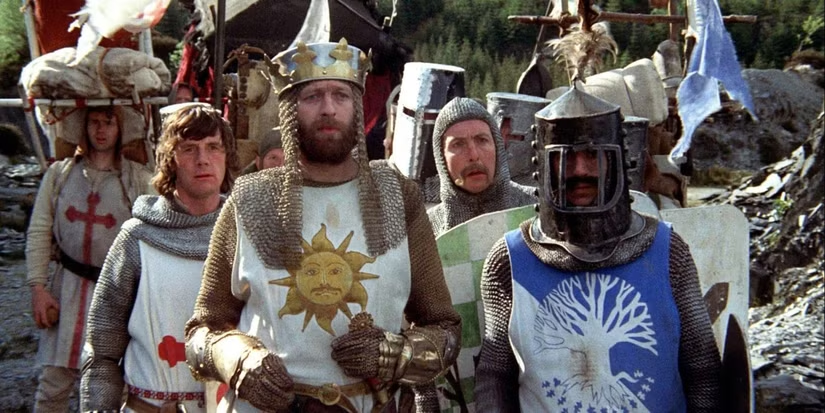
‘Monty Python and the Holy Grail’ (1975)
Monty Python and the Holy Grail is one of the funniest films ever made, and surprisingly one of the best adaptations of the Arthurian legend. While the mythology of King Arthur and the Knights of the Round Table has been surprisingly difficult for Hollywood to bring to life on the big screen, Monty Python and the Holy Grail painted a comic portrayal of the fellowship of chivalrous knights, using purposefully low-budget effects to bring the medieval battles to life.
There’s simply nothing like seeing the original Monty Python members together at the peak of their powers, as Monty Python and the Holy Grail is arguably the best and most consistent of the films that they made together. It became such a phenomenon that it inspired the hit Broadway musical Spamalot, which remains a bestselling show that has frequent modern revivals.
9
‘Dog Day Afternoon’ (1975)
Dog Day Afternoon is a perfect heist thriller that also contained one of the best performances of Al Pacino’s career, as his role could not have been more different than that of Michael Corleone in The Godfather trilogy. Sidney Lumet knew how to craft grounded character dramas better than nearly any other filmmaker, and Dog Day Afternoon was incredibly bold in tackling taboo subjects in regards to sexuality, mental health, and the class divide in New York City; it’s just as relevant today as it was in 1975.
Dog Day Afternoon is one of the best examples of a film set “all in one day,” as Lumet is able to withhold the level of intensity throughout and make the environment feel grounded. It remains so popular that there was recently a Broadway adaptation of the original show that starred Jon Bernthal and Ebon Moss-Bacarach.
8
‘The Rocky Horror Picture Show’ (1975)
The Rocky Horror Picture Show is one of the all-time greatest cult films because it connected with a receptive, niche audience when it debuted in 1975, and continues to be a ritualistic event that draws out crowds all over the world on a consistent basis. Even when looking past the obvious cultural influence and screening parties that it has inspired, The Rocky Horror Picture Show is a downright great musical that creatively satirizes ‘50s science fiction, classic monster movies, and ‘70s kitsch.
The Rocky Horror Picture Show is best remembered for having an amazing performance by Tim Curry as Dr. Frank-N-Furter, a role that he originated in the off-Broadway production, as it would be impossible to imagine anyone else doing it. The film is filled with unorthodox casting choices, including a rare musical role for Susan Sarandon and an early acting role for Meat Loaf.
7
‘One Flew Over The Cuckoo’s Nest’ (1975)
One Flew Over The Cuckoo’s Nest was a deserving Best Picture at the Academy Awards and one of only three films in history to win the “Big Five” awards of Best Picture, Best Director (Milos Forman), Best Actress (Louise Fletcher), Best Actor (Jack Nicholson), and Best Adapted Screenplay, after It Happened One Night and before The Silence of the Lambs.
One Flew Over The Cuckoo’s Nest dared to talk about mental health issues and the conditions that patients faced when they were seeking out help, and the research done by the cast and crew (Nicholson in particular) ensured that it was surprisingly authentic and resonated with the intended audience. It’s not often that a film is able to inspire legitimate change in the world, and One Flew Over The Cuckoo’s Nest was both a landmark social drama and a true acting showcase.
6
‘Picnic at Hanging Rock’ (1975)
Picnic at Hanging Rock is one of the many underrated films by Peter Weir, the brilliant Australian filmmaker who should be mentioned more often when discussing the greatest directors of all-time. Picnic at Hanging Rock was based on the novel of the same name, and created a mysterious, existentialist exploration of inexplicable loss that was as hauntingly beautiful as it was completely unsettling.
Rare is it that a film of this age was able to hold such intriguing and ambiguous qualities that it is still analyzed and debated over a half-century later, as there is still an ongoing discussion as to what Weir’s intentions were with Picnic at Hanging Rock. It solidified Weir as a filmmaker who was deeply interested and respectful of Australian history and culture, and lead him to make more masterpieces about the same subject with The Last Wave and Gallipoli.
5
‘Dersu Uzala’ (1975)
Dersu Uzala was a unique film from Akira Kurosawa, one of the greatest directors of all-time, because it was unlike the feudal adventure epics that he was best known for. The Tuvan actor Maxim Munzuk stars as the titular trapper and hunter, who went on an adventure with the Russian explorer Vladimir Arsenyev (Yury Solomin) whilst attempting to complete a topographical map of the Russian Far East during the days before the Soviet Union.
Dersu Uzala is one of the best of Kurosawa’s “modern films,” as he was adapting more recent events with the same scale used for his medieval epics Seven Samurai or Ran. It’s remarkable that Kurosawa was able to make such a massive film that wasn’t interested in violence, as Dersu Uzala is a respectful and environmentalist work that reflects upon the beauty of the natural world.
4
‘Three Days of the Condor’ (1975)
Three Days of the Condor is one of the best political thrillers of the decade, as this was a time in American history where citizens were intensely paranoid about their government in the wake of the Cuban missile crisis, the series of political assassinations in the ‘60s, the Vietnam War, and the Watergate scandal. No one better embodies American decency and candor than Robert Redford, which made him perfect to play an intelligent CIA asset who is falsely accused of murder when all of his colleagues are killed.
Three Days of the Condor marked another successful collaboration between Redford and director Sydney Pollack, who was able to make deeply thoughtful, politically-charged films that were nonetheless highly entertaining to watch. It also offered another great English-language role for Max von Sydow, whose terrifying performance is among the ‘70s’ most underrated villains.
3
‘Jaws’ (1975)
Jaws is just as good as it’s remembered as being, and probably even better because of how fundamentally it changed cinematic culture. It was a film that survived a famously troubled shoot, but was pulled together by the genius of Steven Spielberg’s visual and emotional storytelling, the all-time great score by John Williams, and a trio of excellent performances that drew out the best from Roy Scheider, Robert Shaw, and Richard Dreyfuss.
Jaws is so well-known as having created a formula for thrillers that it is used as a shorthand to describe similar blockbusters, but it was the intentionality and specificity that Spielberg brought to the raucous set that ensured that it would be more than a B-movie. There aren’t many films in history that are this rewatchable and filled with iconic lines that have taken on lives of their own.
2
‘Nashville’ (1975)
Nashville was the masterpiece that Robert Altman was destined to make, as his kaleidoscopic style of telling overlaying, complex stories about massive groups of people was necessary to explore a pivotal moment in America’s cultural history that embodied the conflicting attitudes of the ‘70s. Nashville uses a music festival to revel in the best and worst that this country has become, offering snapshots of various situations and contrivances that come with the price of freedom.
Nashville is a staggering achievement because of how much it encompasses, making it impossible to soak up all of its meaning on just one film, but it is also a rather joyous experience that celebrates how art can bring people together, even if it ends by examining the dark side of political violence in a way that has sadly become even more relevant today than ever before.
1
‘Barry Lyndon’ (1975)
Barry Lyndon is one of the many perfect masterpieces directed by Stanley Kubrick, a cinematic genius who mastered almost every genre. Although Barry Lyndon would at first seem like another epic historical military drama that ascribes to the “great man” theory, it’s slowly revealed that the titular character (played brilliantly by Ryan O’Neal in his best performance ever) is a nasty, repulsive narcissist who will trade his honor and wholesomeness in order to be on the winning side.
Barry Lyndon explores a pivotal conflict in European history through the eyes of a duplicitous swindler who fought on both sides, and it was groundbreaking because of the way that Kubrick used natural lighting to make the historical setting seem even more intimate. It’s not only the most grandiose and ambitious of Kubrick’s works, but also one of the funniest because of the frequently dark humor.
Barry Lyndon
- Release Date
-
December 16, 1975
- Runtime
-
188 minutes
-
Marisa Berenson
Lady Lyndon