OK, it might be hard to work out exactly why dogs bark – they can do so to show that someone’s coming, because they’re excited to play, due to fear, or just to grab your attention.
But unlike cats, dogs don’t share their vocal messages mostly, or even solely, with us. A group of dogs will bark at each other, but it looks like our feline friends reserve almost all of their meowing for humans.
So, does that mean cats are trying to tell us something?
Well, one study has suggested they might be – and its proposed purrpose (sorry) is typically cat.
Why do cats meow at people but not at other cats?
A study published in Animal Behaviour looked at how cats handle problems with and without their owners.
The study, which involved meowing-prone 38 cats, saw researchers place a treat into an impenetrable plastic container. (Well, impenetrable to those without opposable thumbs, at least).
This taunting box had holes, so the animals could smell the food but not touch or taste it.
The study authors then looked at cats’ behaviours as they faced this frustrating puzzle, both when humans were in the room with them and when they were absent.
Quelle surprise – when cats were on their own, they dealt with the issue in silence most of the time.
But when they knew a person was nearby, things got a lot more vocal.
And after a statistical analysis, researchers found that cats were about 16 times more likely to meow when a person was in the room then they were to “speak up” on their own.
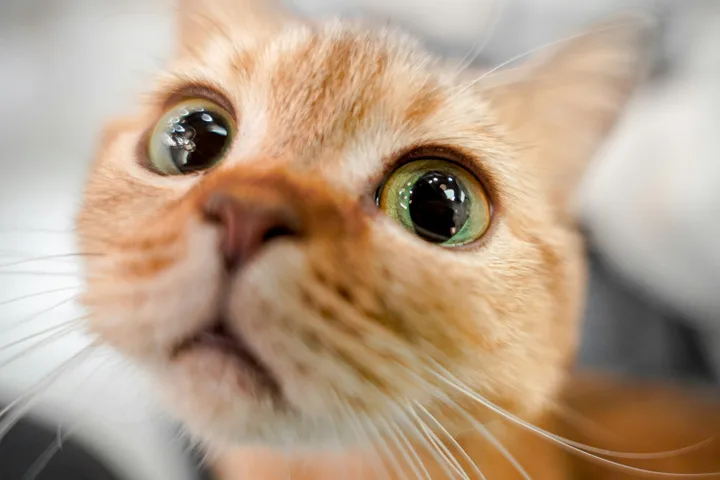
Another thing – when cats saw a person during their time of distress, they fixed them with a wide-eyed stare, sometimes flicking their eyes back to the cube of treat torment.
Those who’d been left to fend for themselves, meanwhile, stood still, gazing at the doorway, where perhaps they believed a conveniently-thumbed person may soon enter.
So, the study authors conclude, it looked like cats might meow at us for the reason many owners would guess: they want us, butler-like, to solve their problems and meet their demands.
This is, to be fair, only a small study, and it’s not conclusive.
Still, the paper states: “The recipient-directed nature of the majority of meows recorded in our study indicates that cats were not simply vocalising into the environment but targeting a specific audience, consistent with recipient-specific signalling”.