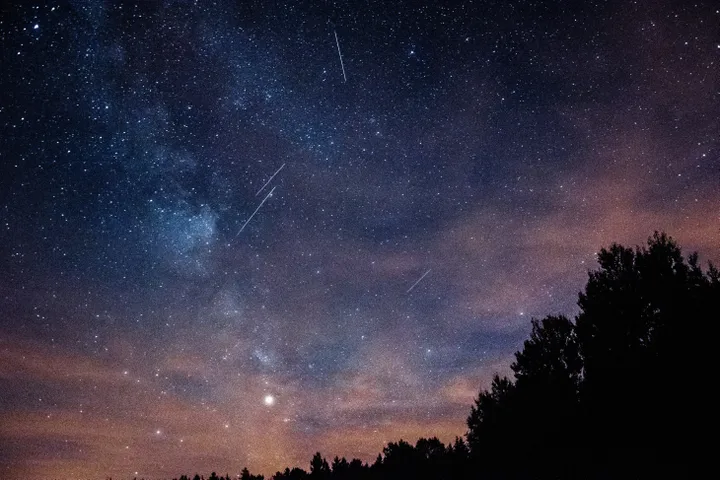
The Leonid meteor shower will dazzle skies in the UK as stargazers will have their best chance yet to see the celestial delight.
The Leonid meteor shower is associated with the Comet 55P/Tempel-Tuttle.
The radiant – the point where the meteors stream from – is at the head or ‘sickle’ of the star constellation called Leo the Lion, giving it its apt name.
As the comet follows a path around the sun, it leaves a strew of tiny debris. The celestial rubble enters Earth’s atmosphere at speeds of up to 44miles (70km) per second, vaporising and causing the streak of lights we know as meteors.
As the Leonid shower hits skies in Britain, here’s everything you need to know.
When will the Leonid meteor shower peak?
The Leonid meteor shower will reach its peak on the night of Tuesday, 17 November.
While the meteor spectacle runs from 6 November until 30 November, its greatest activity is expected on Tuesday into the early hours of Wednesday.
There could be an opportunity to spot up to 10-15 meteors per hours.
How can I see the Leonid meteor shower?
Experts advise the best way to see the meteor shower is to find a safe, dark location away from sources of light pollution such as street lights.
No specialist equipment is required to see the Leonids, which means they’ll be visible with the naked eye.
Giving your eyes some time to adapt to the dark will give you the best chance of seeing the shower, maybe heading out 20 to 30 minutes beforehand.
In order to get a full view of what’s going on, a wide, open space is the best place to be.
While meteors could be visible anywhere, the Leonids’ radiant will be around the head of the Leo constellation, making this the best direction to focus your gaze.
The Leo constellation doesn’t rise until around midnight, making this the best time to head out and see the shower.
Where is the best place to see the Leonid meteor shower?
The best chance of seeing the Leonids will be in the far north of Scotland, including Orkney and Shetland, where clouds are expected to be sparse.
Parts of Northern Ireland, Wales, the Midlands and southern England will also have clear spells at times, but they are more likely to have periods of cloudy weather and rain.
Much of Scotland away from the far north, and northern parts of England, will unfortunately have limited opportunities for viewing.