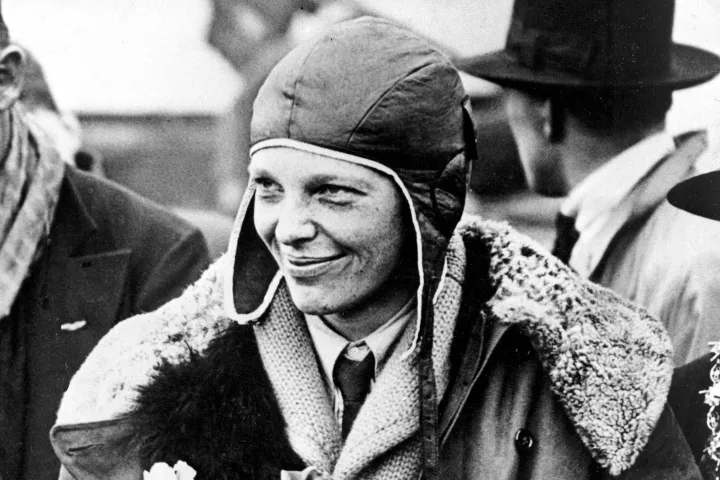
Famous aviator Amelia Earhart, who was the first woman to fly solo across the Atlantic Ocean, has been part of a 90-year-long mystery.
During a 1937 attempt to fly around the world with navigator Fred Noonan, the pair disappeared without a trace.
Their last communications suggest they had been experiencing issues with radio transmission. These were sent en route to Howland Island, an uninhabited landmass in the central Pacific Ocean.
Nobody has ever found her plane. But recently, a team from the US’ Purdue University and the Archaeological Legacy Institute (ALI) has headed to Nikumaroro Island, about 640 kilometres away from Howland Island, to revisit a popular theory about her final stop.
Here’s what that long-standing hypothesis says about the pilot’s possible death, as well as some other theories (ranging significantly in popularity and credibility):
5 theories about the unsolved Amelia Earhart mystery
1) The “castaway hypothesis” and coconut crabs
Some people think Earhart emergency-landed on the deserted Nikumaroro Island, where she lived for a while before eventually succumbing to her environment. Purdue University calls this the “castaway hypothesis” – the landmass lies near where her final transmissions were sent, and has a bank that could have served as a landing strip on one side.
In 1940, some human bones were allegedly found near the remains of a fire on the otherwise unpopulated island; but these later went missing. Unexpected objects, like a suspected bottle of freckle ointment, have also been discovered in the location, and four dogs sent to the island to look for remains separately seemed drawn to the same spot under a tree.
Disputed but “credible” reports of radio signals – including a garbled Morse code message which allegedly said, “281 north Howland – call KHAQQ – beyond north – won’t hold with us much longer – above water – shut off” – suggest her plane may have transmitted from this location, though experts don’t agree on whether these signals were actually sent at all.
Researchers, including those from Purdue University and the ALI, have been keeping an eye on the “Taraia Object”, flagged from satellite images in 2020 and traced back through aerial photos of the island as far back as 1938.
Spotted off a lagoon on Nikumaroro Island, teams are now exploring the long, thin shape that is believed by some to have a “metallic glint”. Though it seems the Purdue researchers think it may be the wreckage of Earhart’s plane, others reckon it might be a fallen tree.
Whatever the object turns out to be, though, the team are going to stay in their ship at night while on the island.
That’s because giant omnivorous coconut crabs, whose legs alone can measure a metre long, roam the island in the dark and can even climb trees.
An International Group of Historical Aircraft Recovery study in 2018 showed that coconut crabs were able to bring pig carcasses back to their homes and strip the bones of their flesh. Some think this might explain why the intact bodies of Earhart and Noonan have never been found.
2) The official ocean theory
The US government has previously concluded that Noonan and Earhart didn’t reach any island at all, and instead crashed into the ocean due to a lack of fuel. This came after what has been described as the “largest ever search for a lost aircraft” – it lasted for 16 days and involved thousands of people.
This hypothesis is popular and broadly accepted.
Earhart reportedly mentioned her low fuel supplies on the radio before communication ceased. She may have spent some time trying to locate the relatively small Howland Island in conditions that offered poor visibility – especially considering that coordinates given to the pair for the island might not have been completely accurate.
The tool that the crew needed to find their bearings may not have had adequate battery, either.
3) The U-turn theory
A less popular theory suggests that Earhart turned around mid-flight once she realised she wasn’t able to find her destination and headed instead to a New Britain airfield, some 3,500 kilometres from Howland Island.
A plane wreck was reportedly spotted by Australian soldiers in World War II in the jungle of Papua New Guinea (where the airfield is located). Some think this might be Earhart’s wreckage, and that she crashed while trying to find a safe place to land.
But Earhart expert Ric Gillespie said that this claim is “silly beyond description” – not least because some accounts suggest the plane contains gold bullion, and that it’s guarded by a serpent.
“These stories about gold bullion and a six-metre snake guarding the wreckage are just, frankly, hilarious. There is simply no way the Earhart aircraft could be anywhere near Papua New Guinea,” Gillespie added.
4) The Irene Craigmile Bolam theory
A much-derided 1970 book called Amelia Earhart Lives suggested that the aviator had actually assumed another identity – that of New Jersey businesswoman Irene Craigmile Bolam – after being captured by the Japanese on a spy mission from the White House.
It also claimed that Bolam lived in the Imperial Palace in Tokyo during World War II.
Bolam herself told the New York Times that this idea was “utter nonsense” in 1970. She added that she had been living in Long Island during those years and suggested that one of the proponents of the theory, Joseph Gervais, was “more interested in fantasy than fact”.
The book’s publisher later withdrew the title, and it’s suggested that they settled with Mrs Bolam out of court after she sued them.
5) The Japanese capture theory
A 1966 book by Fred Goerner, called The Search For Amelia Earhart, suggested that both the famous flier and her navigator died in Japanese custody after being captured on the then-Japanese-controlled Marshall Islands, and not on a desert island or in the ocean.
In 1990, a Japanese woman claimed she’d seen Noonan and Earhart’s capture. But there’s no clear-cut physical evidence to confirm this hypothesis, or Goerner’s.
Since then, a very blurry black-and-white image which some people think shows Earhart and Noonan in Jaluit Atoll in the Marshall Islands has been used to bolster the theory.
Expert Ric Gillespie has, to put it mildly, serious doubts about this , however.
He told the BBC: “This photograph has people convinced. I’m astounded by this. I mean, my God! Look at this photograph… Let’s use our heads for a moment. It’s undated. They think it’s from 1937. Okay. If it’s from July 1, 1937, then it can’t be Amelia, because she hadn’t taken off yet.
“If it’s from 1935 or 1938, it can’t be her…. This photograph has to have been taken within a very narrow window – within a couple of days of when she disappeared.”
He added that the photo didn’t suggest either crew member was imprisoned in any way.
The image was also part of a 2017 documentary which faced a lot of controversy, one of the most significant being that the timeframe for the image may not match up. The channel behind the show decided not to make the episode available on streaming and on-demand platforms while it investigated these claims.