


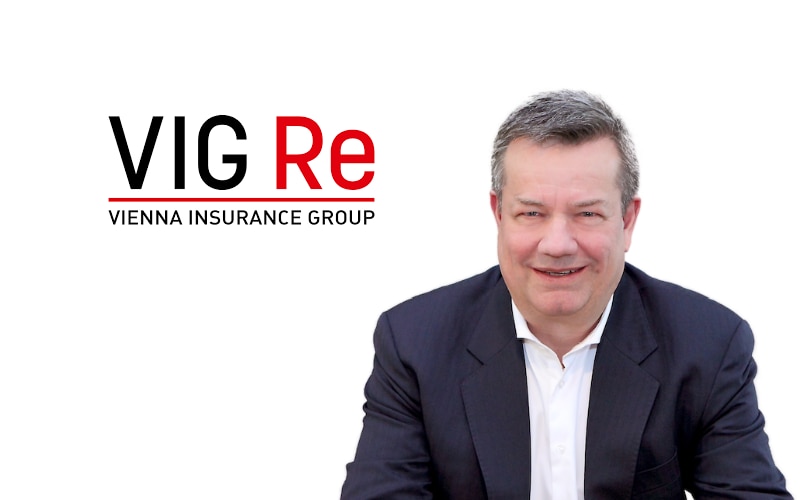
Stephan Wirz, chief commercial officer and member of the management board of Prague-based reinsurer VIG Re, said the biggest challenge facing the reinsurance market is “maintaining the credibility of our industry” by the end of 2025 and proving to investors that “over time it can deliver returns commensurate with the risk.”
In a recent interview with Reinsurance News, Wirz emphasized that if investors lose confidence in the reinsurance industry, they will not continue to deploy capital, which will certainly not help close the growing protection gap.
“Reinsurance/insurance is needed to protect investors’ investments and therefore is one of the drivers of economic growth,” Wirtz said.
He added: “Looking at the combined ROE of the insurance and reinsurance industry, reinsurers’ ROE is only slightly higher than that of primary insurers. It is highly questionable whether this marginal difference is sufficient to account for the volatility that reinsurers account for in insurers’ balance sheets.”
Regarding the opportunities facing the reinsurance market at the end of 2025, Wirz said he believes there will be a structural shift in the importance of reinsurance as climate change and new risks develop.
“We therefore believe we have a strong case to convince major insurers and society that taking risks comes at a cost and that a fair price for taking on these risks must be agreed upon,” said Wirtz. “This is also an opportunity to align with partners who share a common definition of sustainable and mutually beneficial partnerships.”
On the topic of the upcoming reinsurance renewals on January 1, 2026, he noted that the outlook varied by market.
Wirz explained: “Markets or companies that experience adverse outcomes tend to renew with smaller risk-adjusted rate reductions, while markets that deliver relatively good performance and invest in improving the terms and conditions of their primary businesses tend to benefit from higher risk-adjusted rate reductions, even in scenarios where more Nat Cat capacity is required.”
Wirz stressed that underwriting discipline will be key when entering the soft market for natural catastrophe business, with a focus on partnerships that share shared long-term values and support clients across their portfolios.
He said: “We will continue to deploy Nat Cat capacity, ideally where we have long-term mutual partnerships or where we see a very attractive risk-reward profile.
“In non-Nat Cat lines, however, we see a more differentiated market outlook. For property risk and major casualty lines, we have seen stable and risk-adequate price developments to date.”
Looking ahead to 2026, Wirz emphasized that the world is full of uncertainty and the direction of the market will depend on the extent of natural disaster activity, other significant losses, and the development of geopolitical tensions during the year.
“If we experience another year of benign Nat Cat activity, the Nat Cat market is likely to weaken further. In this scenario, underwriting discipline, strong partner management, transparent data analysis, broad support, and tight Nat Cat capacity guidance will remain critical,” Wirz concluded.