


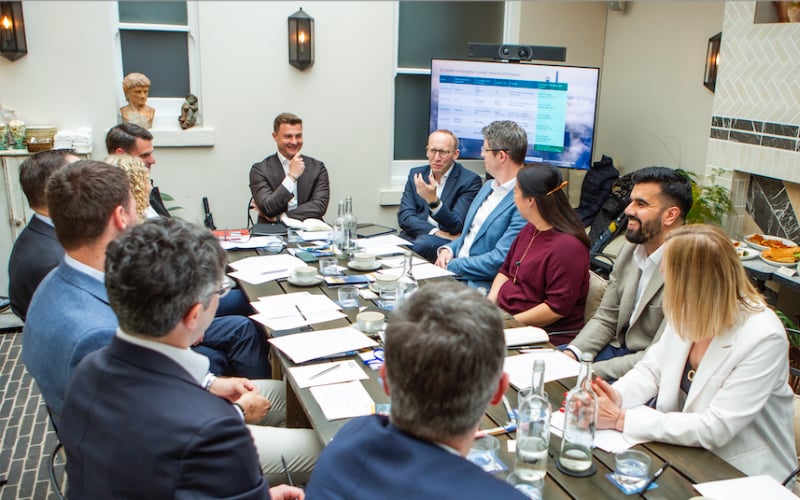
Earlier this month, Reinsurance News partnered with global reinsurance giant Swiss Re to host a retrospective roundtable in Brighton surrounding the 2026 Traditional Insurance and Reinsurance Industry Annual Conference. Stakeholders from the evolving field discuss opportunities, challenges and key market trends.
Latest Reinsurance News The Heritage Market Roundtable, in partnership with Swiss Re, was held on Monday 11 May during the 2026 IRLA Congress, a key conference on the expansion of the runoff market.
During the day, 13 experienced traditional market participants representing acquirers, sell-sides, brokers, legal and advisory sectors discussed the maturity and strategic importance of traditional markets, while also exploring challenges and opportunities in execution, reinsurance market cycles, data, U.S. casualties and more.
The 90-minute session began with a market overview from Janic Schilling, Head of Heritage Origins at Swiss Re, who described heritage as a “market in transition”.
“Increasingly, we are hearing that the market is more stable and complex, and solutions are evolving to respond to changing and more complex customer needs,” Schilling said. “Activity increases when it comes to new efforts and more innovative deal structures to address the growing complexity across the market. Interestingly, if you couple that with the natural continued growth of traditional markets, this increased activity doesn’t necessarily translate into more completed deals. Does this reflect a more mature market where execution discipline, strategic alignment, and balancing complexity with resiliency are increasingly important?”
Schilling also examines the importance of legacy in hard and soft reinsurance market cycles, noting that with the current softness in interest rates, reinsurers are focusing on capital optimization, strategic focus and portfolio quality.
“This is where we see traditional solutions playing an increasingly important role – helping clients proactively manage balance sheet resilience while focusing more on strategic areas of the business,” Schilling said.
Adding: “If these broader market trends are compared to perceptions of more stable, complex and mature traditional markets, the key question becomes whether the market is adequately prepared to deal with these dynamics.
“Are we really seeing a more strategic and embedded legacy market, or is the broader reinsurance industry still looking at legacy primarily as a tactical decision?”
On the floor, participants discussed whether heritage is actually being used as a strategic tool, with some saying that while the market is now more proactive than in the past, it is still quite passive.
Later in the session, roundtable speakers explored the role of heritage within their organizations and how well this space is understood outside of the core team, as well as when retrospective solutions typically enter the conversation. One attendee expressed surprise at the lack of awareness and understanding among some large operators of the value and role of legacy solutions.
Execution barriers and deal complexity were other hot topics at this year’s roundtable, with Andreas Schäfli, head of property and casualty estate at CUO P&C Reinsurance, Swiss Re, saying that in his experience, the level of attention and commitment behind a deal can impact execution.
“There are obviously some sellers in the market who have dedicated legacy teams and a very clear strategic approach to portfolio optimization. But in many organizations, legacy is still handled by one team that basically covers everything, and then legacy is added on top. All of a sudden the CFO says, ‘Try to sell the book,’ and then two months later comes another priority or another crisis, and the process loses momentum before it’s really started.
“Interestingly, once a deal actually reaches a more advanced stage – a data room has been set up, due diligence is underway, objectives are aligned – the execution risk is usually relatively low. Today’s markets are complex enough that complex solutions can be executed,” says Schäfli.
The conversation then turned to market innovation, particularly the potential for federation and collaboration, with one participant highlighting the importance of not being left behind by real-time markets. The session also explored some of the key challenges facing traditional markets today to understand how players will change internally or in the wider market as the market continues to grow.
We will publish the full 2026 Reinsurance News Heritage Roundtable in the coming weeks in partnership with Swiss Re, which will include additional commentary from our sponsors and extensive insights from all other participants on the day.