


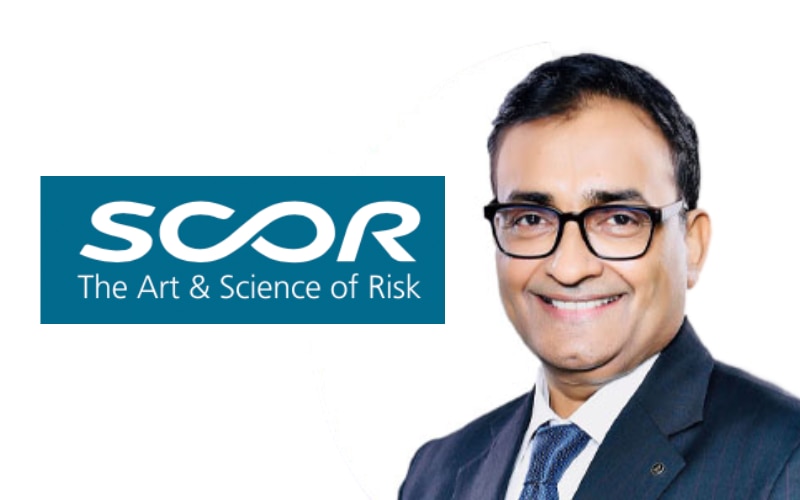
Parag Gupta, CEO of global reinsurer SCOR India, said the country’s low insurance penetration, expanding infrastructure, rising catastrophe risks, and growing demand for new solutions such as covered bonds, parametric insurance, cyber and specialty risks will inevitably require deeper and more sophisticated reinsurance support.
At the 3rd Global Reinsurance Summit 2026, Gupta shared his insights during a fireside chat titled “Unlocking India’s Reinsurance Potential: A Market on the Rise”, moderated by Deepak Sood, member, non-life insurance, Indian regulator IRDAI.
He explained that global reinsurance markets are currently in a softening cycle with abundant capital while adapting to rapidly changing risk conditions, including climate volatility, cyber threats, geopolitical uncertainty and emerging accumulation risks.
In this context, India currently accounts for only a small portion of global reinsurance premiums, but this statistic masks huge structural opportunities ahead, particularly in newer, more innovative solutions.
Gupta said, “The Indian reinsurance market also has the highest potential as the underlying direct insurance market has huge potential due to low penetration, which is very important because of the need to insure climate risks, the need for guaranteed bonds, and new reinsurance solutions and bonds.”
Furthermore, Gupta said there needs to be a clear vision, explaining that universal coverage is actually about coverage everywhere, not just a certain percentage of GDP.
“If you can cover everyone in the country, you’re insuring everyone, but your traditional penetration into GDP is very low,” Gupta said. “What that actually means is you make insurance more affordable. I think that’s a better way of looking at it. To do that, one of the key issues we have to address is catastrophic risk.”
The two highlighted that 2016 was a key historical turning point when foreign reinsurance branches (FRBs) were licensed in India for the first time. Since then, the market has evolved from limited capacity to a multi-layered ecosystem with greater competition and better pricing discovery capabilities, with reinsurers increasingly seeking leadership roles rather than passive participation.
The recent regulatory reforms through ‘Sabka Bhima, Sabki Raksha’ are further accelerating the momentum. These reforms include 100 per cent foreign direct investment (FDI) in the insurance sector, lowering the capital threshold for reinsurers from rupee to 100 per cent. 5,000 crore to Rs 1,000 crore, transition to risk-based capital (RBC) and Ind AS 117/IFRS 17, redefining the definition of intermediaries to include managing general agents (MGA), etc.
He added, “If you look at the opportunities offered by the market, we have 10 FRBs, two Indian reinsurers, and in GIFT City, there are 14 reinsurers. Generally, in the global market, we say the number of reinsurers should be 20% of the insurance companies, but in India we now have over 25% reinsurers and 24 multi-line GI companies, excluding L&H. I think India is in a very, very different situation.” Spot, maybe the opportunity is driving it. “
However, Gupta said that capabilities and capital are critical, and in order to attract investment and gain global trust, it is necessary to address risks and move towards simple parametric solutions, as well as risk mitigation, transfer and mapping.
He explained: “Disasters require problem solving, jobs, talent, capital and appropriate risk modeling. We must always remember that the same thing, the same event, is catastrophic to one person but not to someone else. What is an event to one person is not to another A disaster. So I think the right risk mapping, the right modeling to understand where the risk exposure is is critical for us to be able to deliver the right products and solutions to the right people, the right niches, so we can address that and move to parametric solutions.”
As India moves towards its vision of universal insurance by 2047, reinsurance will be the cornerstone in providing capital, catastrophe resilience, advanced risk models and long-term stability.
The discussion also highlighted the strategic importance of GIFT IFSC not only as a regulatory innovation but also as a global platform providing ease of doing business, ease of living, access to talent and the ability to conduct regional and international reinsurance business in India.