


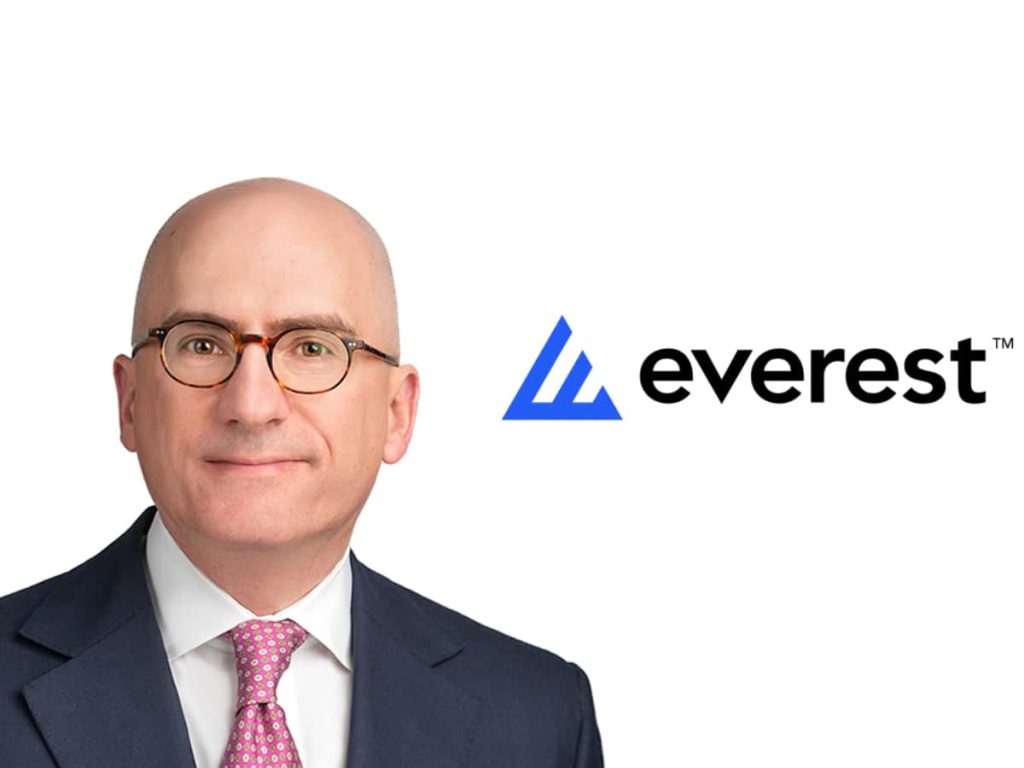
Jim Williamson, president and chief executive officer (CEO) of Everest Group, praised the company’s reinsurance team for its outstanding performance in responding to a more challenging market at the time of renewal on January 1, while also saying that the reinsurer beat the real estate catastrophe market with a 10% global average rate decrease.
Everest recently held its fourth-quarter and full-year 2025 earnings call, in which CEO Williamson commented on the airline’s experience with 1.1 2026 renewals, specifically on the property cat side, and looked ahead to the subsequent 2026 renewal period.
“As expected, market conditions were soft across many sectors during the January 1 renewal period, with global real estate catastrophe rates down an average of 10% but still above the technical rates we requested,” Williamson said. “As has been the case with past renewals, our preferred market position allows us to adjust our contracting to maximize expected profitability.”
The CEO explained that Everest’s premiums, which had exceeded $6.3 billion as of Jan. 1, were reduced by just 1% on maturity, while terms and conditions and add-on points were essentially retained by the company.
“Total property limits deployed fell for the first time since 2022, with a slight reduction of 2%. Capacity deployment is selective. We retain more than 95% of effective premiums in top-tier accounts, while deliberately reducing exposure to less profitable trades,” Williamson continued.
He went on to note that Everest still sees good opportunities in Asia, including its new Indian subsidiary and its targeted specialty product lines.
“Global growth in data centers, supporting energy capacity and other infrastructure investments, has helped drive and diversify our specialty book, which currently has premiums of around $2 billion and attrition rates in the mid-80s.
“Our Mt. Logan third-party capital business is also performing well, with over $2.5 billion in assets under management as of January 1. We have significant investor interest in Mt. Logan across multiple business lines, and I expect that over time, Logan will play a more significant role in our capital portfolio.
“Overall, the Everest Re team performed well again in dealing with a more challenging market,” Williamson said.
Later in the call, an analyst pressed Williamson on the company’s 10% average rate decline of 1.1 points in 2026, and he responded: “Right now, I think based on what I’m hearing from some of the broker indexes, maybe reports from some of our esteemed competitors, I still think our 10% is a good number. Frankly, I think we’re beating the market… I think a lot of them are in the mid-teens, and I think that’s a testament to our market position.”
Adding: “If we look at the cat prices of real estate right now, there are a lot of attractive opportunities around the world. Obviously, I think the U.S., particularly the southeast U.S., is the peak area for the best prices, but there is good business all over the world. We are actively pursuing these opportunities globally. So, there is not really a region where we say, okay, we want to double down here because of its price relative to other regions. It’s a fairly broad-based opportunity.”
During the Q&A, the CEO further asked about reinsurance pricing and how he sees reinsurance pricing this year, particularly in the real estate space.
“As a general expectation, given what we saw on January 1 from a supply and demand perspective, I would expect the rest of the year to be similar to 1.1 renewals, with real estate rates falling in the 10 to 15 percent range that many are reporting, which I think is a reasonable expectation.
“Florida is going to be an interesting dynamic. There’s a clear reliance on reinsurance capacity to serve that market, and I think that’s going to help boost the demand side. At the same time, we’re clear in the data right now, and I think we’re being very conservative about it, and the reforms in Florida are working, and I We clearly see it playing out in our data, and I think others do as well, so I’m not going to give you a point estimate on how those two factors intersect other than to say I think there’s probably some reason to suspect it might be better than what we had in 1.1. We’re seeing a little more of a decline,” Williamson said.
The rate adequacy of the business has been a hot topic given the $1.1 weakness in real estate that some industry insiders say is more dramatic than expected, and Williamson was asked how the current situation compares to 2022, before the real estate market resets.
“I would say from a rate adequacy and return on capital perspective, I like real estate cats better now than in 2022. Certainly, you saw us cutting expenses quite meaningfully in ’22, which I think was the right move, especially given the cat losses that occurred at the end of that year.
“And then the thing to really keep in mind, other than rates, is structurally, I think, how the plans are set up today, it’s more advantageous for the reinsurance market relative to plan structures like caps, low down payments are gone, we’re not going to be participating in those. So, given where we are now, it feels a lot better about the returns,” he said.