


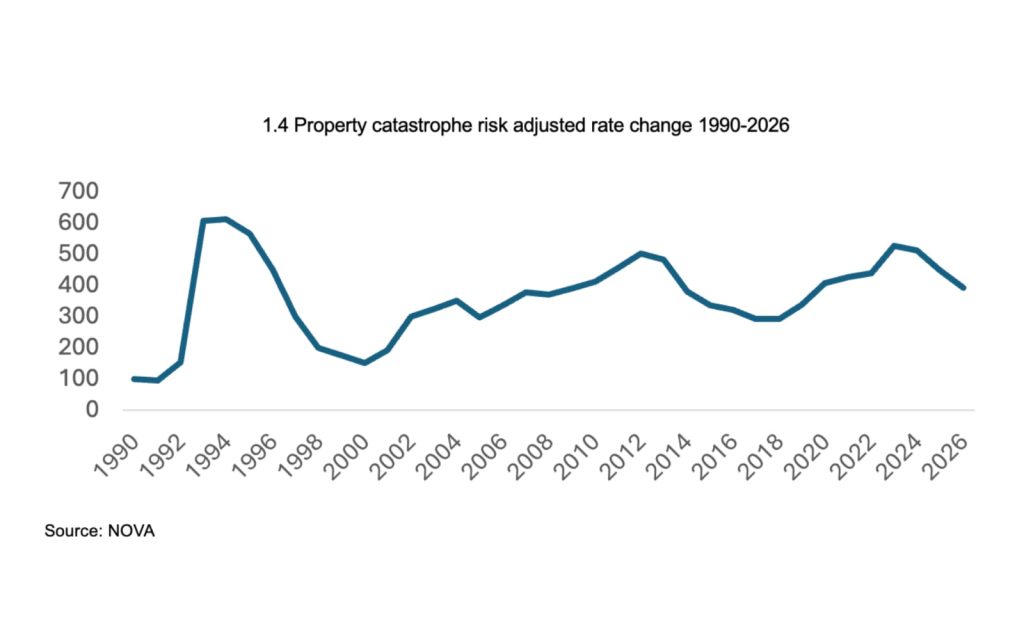
Global reinsurance brokerage Howden Re said that at reinsurance renewal on April 1, 2026, risk-adjusted online property catastrophe rates in Japan returned to levels seen in the early 2020s, with risk-adjusted prices for the country’s catastrophe excess loss plans falling by as much as 20%.
In the Japan-focused April renewal season, Howden Re noted that despite the uncertain and unstable geopolitical situation in the Middle East, the weak trend continued on January 1, which the broker said has put significant pressure on multiple specialty product lines globally.
Risk-adjusted prices for Japan’s catastrophe excess loss program fell 20% (point estimate 16%) as global real estate market conditions were favorable and Japan experienced another year of lower catastrophe losses.
In proportional reinsurance business, Howden Re said commissions for property surplus and earthquake quota share agreements rose between 2% and 5% to 1.4, with earthquake quota share agreements most often reaching the top end of the range.
Andy Souter, head of Asia Pacific at Howden Re, said: “Japanese interest rates are now broadly back to levels in the early 20s. Strong reinsurer appetite, improving underlying performance and a lack of significant loss activity all contributed to a favorable outcome for the cedants.”
The chart below, provided by Howden Re, shows the change in real estate cat prices from 1990 to April 1, 2026.
Importantly, Howden Re emphasized that it continues to impose discipline on reinsurers during the renewal period, although some sellers do look for opportunities to increase their stakes.
“Overall, the supply-demand balance remains broadly consistent with the prior year; program structure remains largely unchanged relative to maturities, with only limited additional purchases or restructuring,” Howden Re explained.
Outside Japan, Howden Re said 1.4 renewals supported the view that reinsurer balance sheets remain strong, and that demand for well-structured risk transfer programs also remains strong.
“The orderly completion of the renewal, with no structural disruption, capacity being tightly constrained and pricing outcomes favorable to carve-outs, is testament to the underlying health of the market, even in a period of heightened geopolitical uncertainty,” the broker explained.
The broker said that while the Strait of Hormuz remained effectively closed following the conflict between the United States and Israel with Iran, this had no direct impact on the 1.4 real estate cat renewals and any disruption was mainly concentrated in the specialist market.
“This update is completed in a largely benign real estate disaster environment, independent of direct disruptions in the Gulf region,” said David Flandro, head of industry analysis and strategic consulting at Howden Re. “That said, ongoing energy supply shocks increase the risk of inflationary pressures and rising interest rates, dynamics that have historically impacted reinsurance capital and pricing across all sectors, not just those directly affected by the conflict.”
In terms of reinsurance renewals in mid-2026, Howden Re expects global buyers and sellers to face further complications, with upward pressure on pricing expected across marine, energy and political violence as the full impact of the situation in Hormuz is absorbed. Howden Re expects this will lead to reinsurers reassessing aggregation, event definitions and Middle East exposures within their specialist portfolios.
“The reinsurance market remains well-capitalized and highly engaged. As we enter what is set to become a more complex mid-year environment, technical discipline, transparency and proactive monitoring will be critical,” Suter added.