


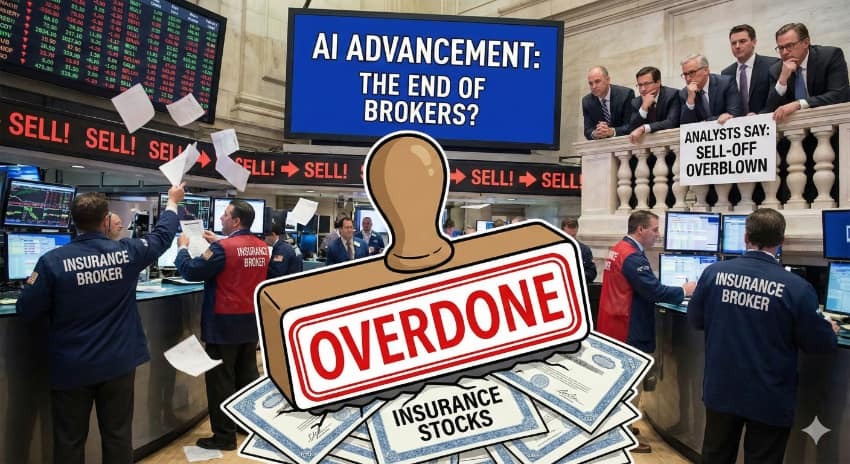
Insurance brokers suffered a sell-off earlier this week that was widely attributed to our report that OpenAI approved an insurance provider’s first artificial intelligence application on ChatGPT, with several analyst firms valuing shares down an average of about 9%.
Many described the decline as an “overdone” or “overreaction,” with some emphasizing the short-term resilience of brokers’ business models.
However, other analysts said the sell-off reflected investor concerns about potential disintermediation, as artificial intelligence platforms increasingly allow operators to reach consumers directly during initial searches.
Yesterday, OpenAI announced the approval of an insurance provider’s first AI application on ChatGPT.
Developed by Tuio, one of Spain’s leading digital insurance companies, and powered by WaniWani’s AI distribution infrastructure, the app allows users to receive personalized home insurance quotes and soon purchase policies entirely within a conversation.
OpenAI says Tuio’s app is just the beginning, noting that U.S. insurance aggregator Insurify also received app approval last week.
Meanwhile, WaniWani revealed that a dozen more insurance AI applications, including those from several customers and partners in North America and Europe, are in the process of approval and expected to go live in the coming weeks.
The news triggered a sell-off in the insurance brokerage industry, prompting responses from several leading analysts.
Goldman Sachs, for example, said it believed the 9% decline was “excessive” from a fundamental perspective.
Goldman Sachs added: “As one would expect, discussions of AI are becoming increasingly prominent on insurance earnings calls. Companies in the financial and insurance industries tend to discuss AI in the context of productivity more frequently than other industries, which we attribute primarily to the ability to train AI on large and often proprietary data sets, in addition to the exposure of a significant portion of labor costs to AI automation.”
“In insurance, we think AI in self-driving cars has put pressure on stocks, and yesterday we arguably saw the first clear example of AI impacting insurance brokers.
“So far, investors appear to have placed commercial insurers in the medium-term beneficiary camp, even as they acknowledge that long-term cost savings are likely to be passed on to insureds.”
Analysts at KBW also weighed in, echoing Goldman Sachs’ sentiments, noting that they believe the sell-off, especially by commercial brokers, is a gross overreaction as the OpenAI integration currently only serves as a lead generation tool for individual businesses.
KBW added: “Even assuming future purchasing power, we view these tools as another form of direct-to-consumer marketing that may have limited impact on commercial insurance brokerage operations, whose growing complexity and insured demand for customization may create a long-term need for true advisors.”
However, KBW noted that the announcement helps explain significant weaknesses among insurance brokers, reflecting investor concerns about potential disintermediation as AI platforms enable insurers to reach consumers during initial searches.
Meanwhile, JPMorgan described the recent volatility as a “thought experiment in the world of artificial intelligence,” acknowledging a credible bear case that AI agents embedded in platforms like ChatGPT could over time replace human brokers in personal lines.
The bank outlined a scenario where consumers start and end their insurance journey in an AI ecosystem, thereby increasing price transparency, churn and competition.
However, the report believes that leading personal insurance brokers can adapt by developing their own digital agents and AI distribution, even as the model shifts to more DTC marketing, a shift that creates operational disruption and puts pressure on cash flow.
For now, JPMorgan expects human- and AI-led distribution to coexist, with the market remaining “open enough” for incumbents to defend their competitive positions.
BMO Capital Markets observed, “Insurance brokers have lagged the market by more than 10% over the past two days. Part of the impact appears to be driven by an ongoing wave of artificial intelligence-related uncertainty regarding the potential disintermediation of insurance brokers in the insurance purchasing value chain.”
BMO continued, “While we cannot predict how AI will impact our industry’s P&L over the long term, we believe it is reasonable to estimate that insurance brokers’ near-term (1-2 years from now) revenue will not be affected by the greater than 10% selloff seen in recent days.”
TD Cowen also dismissed the sell-off as an “overreaction” and said it did not expect substantial AI disintermediation among commercial brokers in the medium term.
TD Cowen added: “Given the rapid changes in the capabilities/use of AI, it is difficult to definitively rule out any impact.
“Having said that, we believe any such pressures will be gradual, gradually muted, and should be absorbed given the pressures brokerage stocks have faced in recent months and today.”
“Additionally, margin gains should also be considered. Therefore, while AI news flow may continue to drive near-term volatility in brokerage stocks, we believe current price levels represent an attractive entry point.”
Evercore ISI analysts believe the insurance broker business model is durable, citing the consultative nature of the broker-client relationship and the fact that clients can avoid potential downside risks by using a broker.
Evercore concludes: “The data and scale that brokers possess not only allows them to inform risk management decisions, but also to obtain better terms from insurers than through direct channels.
“It’s not as simple as changing a software solution – clients will change the way they make risk management decisions to save on commissions in exchange for potentially under-covered risks.”